The revelation that the so-called ‘hidden debt’ narrative, first unveiled by Prime Minister Ousmane Sonko in a press conference, was entirely fabricated has now been conclusively established. While some had immediately questioned the credibility of these claims, a coordinated propaganda effort worked to embed these falsehoods into public discourse, prolonging their damaging effects.
Legal implications of false economic claims
With the principal figure behind these allegations now admitting to deception—and considering the severe consequences for Senegal’s international standing, economic partnerships, and daily life for citizens—should the Prosecutor General pursue charges against Ousmane Sonko for economic treason, dissemination of false economic information, and falsehood? Should accomplices who perpetuated this deception also face legal consequences?
The answer requires separating political controversy from legal accountability. The focus isn’t merely on the content of the statements but on the authority of their origin, the context in which they were made, and the tangible damage inflicted on public trust in the State.
Ousmane Sonko’s recent clarification—“When I spoke at certain events, I was speaking as the head of a political party expressing an opinion”—introduces a critical legal and institutional dilemma. Claims that undermine Senegal’s economic perception cannot be dismissed as mere partisan rhetoric when they emanate from a figure holding governmental office. As Prime Minister, with constitutional authority over the Administration (Article 57 of the Constitution), his statements carried the weight of State authority and could influence international partners’ confidence in Senegal.
Institutional weight of the statements
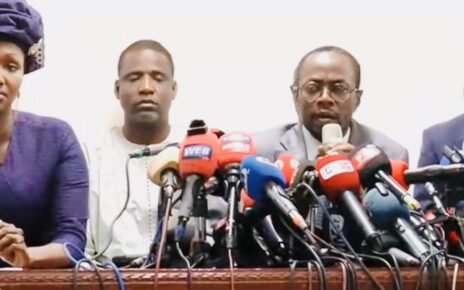
The ‘hidden debt’ episode illustrates this ambiguity. By attempting to frame his earlier statements as those of an opposition leader—“I did not yet have all the levers of the State”—Sonko seeks to distance himself from institutional responsibility. However, this justification collides with the reality of how the issue was publicly framed. The press conference in question was not a partisan event but a government gathering, featuring not only the Prime Minister but also the Secretary-General of the Government, the Minister of Economy, and the Minister of Justice. The debt issue was presented with grave implications, repeated in institutional settings such as a press conference at the Prime Minister’s office and before parliamentary deputies. Under these circumstances, the statements transcended partisan discourse; they became official declarations of a Prime Minister, engaging the authority of the State.
Too little, too late
The debate must therefore distinguish between two levels: legitimate political criticism based on verifiable facts, and institutional accountability when accusations are made in official settings with real-world consequences. When such statements affect public or financial confidence, they must be grounded in evidence. Otherwise, they expose their authors not only to political but also institutional liability. This raises the question: Can the Prosecutor intervene over the dissemination of false economic information?
This distinction naturally leads to examining the role of the Court of Auditors. If the controversy was fueled by political interpretations, it is essential to return to the institution’s official findings to assess the gap between its report and the claims derived from it.
The recent remarks by Mamadou Faye, former President of the Court of Auditors, have reignited the controversy. By stating that the term ‘hidden debt’ does not appear anywhere in the Court’s report, the former magistrate acted as a post-mortem physician. When asked about the existence of a ‘hidden debt,’ he referred back to the report itself, noting that no page explicitly uses that phrase. This clarification is decisive: it separates the Court’s technical findings from the political interpretations that followed. For two years, Mamadou Faye remained silent while Ousmane Sonko, alongside Bassirou Diomaye Faye, dragged Senegal into a sterile debate without any rebuttal. Faye would have been better off staying silent permanently. However, in revisiting the February 2025 report, he emphasized that the institution limited itself to presenting findings using its standard audit methods. He also clarified the methodology: the debt-to-GDP ratio was calculated using both the Tofe method (Tableau des opérations financières de l’État) and the budgetary method based on the difference between revenue and expenditure relative to GDP. According to his explanation, both approaches should have yielded consistent results if the transition table had been correctly applied.
Thus, the absence of an explicit mention of ‘hidden debt’ does not, in itself, resolve the debate. However, it weakens the political framing of the issue. It shifts the center of gravity of the discussion: the question is no longer whether accounting anomalies existed, but whether their public presentation was accurate, proportionate, and legally responsible.
The controversy surrounding this falsehood is far from trivial. By persisting without firm clarification, it contributed to undermining Senegal’s financial credibility, fostering uncertainty among economic actors, and negatively impacting credit rating agencies’ perceptions. The responsibility of public actors must therefore be assessed in light of the foreseeable effects of their statements—especially when those statements concern debt, the integrity of public accounts, and the State’s ability to meet its obligations.
Financial credibility at stake
This analysis aligns with warnings issued in our September 28, 2024 commentary (“Sonko does not love Senegal”). We highlighted how reckless government communication on debt could erode market confidence, provoke negative investor reactions, lead to sovereign rating downgrades, and increase borrowing costs. These effects, if realized, could shrink budgetary margins, slow investment, and weigh on employment.
After the Court of Auditors’ report was published, the priority was not to transform administrative dysfunctions into political scandals, but to precisely determine their nature, scope, and legal consequences. The report called for an administrative, budgetary, and institutional response: correcting procedures, improving accounting traceability, and clarifying potential responsibilities.
This demand for rigor extends beyond public debt. It applies equally to any dramatic economic declaration that risks compromising the State’s credibility or creating unfounded public expectations. The same standard applies to claims about the alleged existence of 1 trillion CFA francs in a personal account attributed to a former dignitary of the outgoing regime. When such assertions come from a public official, they cannot rest on mere assertion. They must be supported by verifiable evidence subject to review by competent courts or oversight bodies. Otherwise, they fuel confusion, weaken institutional trust, and expose their authors to challenges on grounds of accountability.
Demanding that the Prosecutor initiate proceedings is not a partisan maneuver. It reflects a broader principle: public speech, especially when emanating from a government authority, must be proportionate, verifiable, and compatible with the requirements of institutional stability. When economic statements risk affecting the State’s financial credibility, it is the duty of competent institutions to determine whether they belong to ordinary political debate or warrant deeper legal scrutiny under applicable law.
Beyond this controversy, the issue underscores the enduring role of oversight institutions. The credibility of public discourse depends on the ability of competent bodies to produce regular, clear, and incontestable findings to inform democratic debate.
Postscript: A transitional presidency at the Court of Auditors
The newly appointed President of the Court of Auditors brings a distinguished career and credentials to the role, marking a culmination of decades of service. However, this is a transitional presidency—with less than three years until retirement—and above all, a mission-driven one. Four major challenges lie ahead. First is ensuring the timely publication of annual reports. Second is completing the reform of the Court to align it with international standards. Third is opening the institution to technical expertise (oil, gas, infrastructure engineers, chartered accountants, public health specialists), leveraging internal talent through a career development plan for auditors, and enhancing the institution’s visibility. Fourth is strengthening professionalization, including certification of accounts and evaluation of public policies.