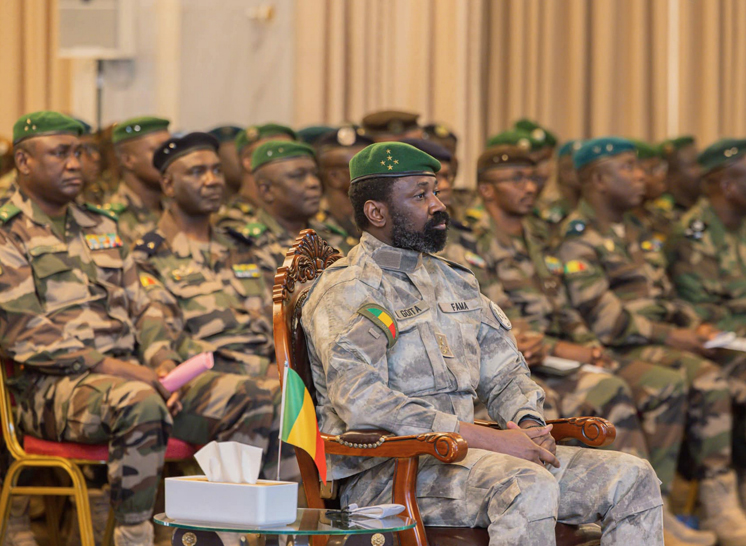
After two decades under the same national defense law, Mali is set to implement a sweeping overhaul of its security and defense architecture, expanding its scope to include internal security, cyber threats, and crisis management. The sweeping reform, recently approved by the National Transitional Council, redefines strategic decision-making, operational command, and the roles of regional actors.
The updated framework, slated to replace the 2004 law once finalized and published, marks a critical evolution in response to shifting security dynamics. Addressing members of the CNT, General Daoud Aly Mohammedine, Minister of Security and Civil Protection, emphasized the urgency of this revision, citing over twenty years of operational experience and the need to adapt to contemporary challenges. He noted that security stakeholders were closely involved in the preparatory phases to ensure an inclusive approach.
Security and defense in the 21st century
The 2004 law, though originally military-focused, already encompassed internal security, civil defense, and the participation of local governments, civil society, and communities. Under the previous structure, the Chief of the General Staff led military operations and, in instances of territorial defense, exercised authority over certain security forces.
The new reform does not introduce entirely new responsibilities but consolidates, clarifies, and modernizes them to address today’s threats. Internal security and cyberdefense are now explicitly recognized as core components of national security. The National Security Council and the National Defense Committee replace the former Superior Defense Council and Defense Committee, strengthening centralized coordination under the President’s leadership.
The reform also formalizes unified operational command under the Chief of the General Staff in territorial defense scenarios, enabling faster response times when multiple forces must coordinate against attacks, major crises, or cross-border threats. Importantly, this does not mean placing the Police, Gendarmerie, National Guard, and Civil Protection under permanent military command.
Another key development since the previous law is the militarization of the National Police and Civil Protection since 2022, a change that enhances their integration into security operations while preserving their everyday public safety and emergency response roles.
Strengthening local resilience and cyber resilience
General Daoud Aly Mohammedine highlighted three priorities during his address: bolstering territorial administration, engaging traditional authorities in counterterrorism efforts, and accelerating recruitment and equipping of security forces. These goals align with the expanded mandate of the Ministry of Territorial Administration and Decentralization, which now plays a central role in civil defense, interagency coordination, local governance, and community mobilization. The aim is to create a system where early warnings flow efficiently from municipalities without turning civilians into auxiliary security agents.
Cybersecurity has also been elevated to a strategic level. In June, the government approved legislation establishing the National Agency for Information System Security (ANSSI), as outlined in the 2026–2030 National Cybersecurity Strategy. The ANSSI will lead responses to cyberattacks and protect critical infrastructure, distinguishing cyberdefense—reserved for state-level threats—from broader cybersecurity, which covers public administration, networks, and electronic communications.
Meanwhile, the ongoing DDR-I program is already testing interagency coordination. On August 4th, 254 former armed group members completed their integration into the Armed Forces after training in Soufouroulaye. The initiative plans to include 2,000 ex-combatants and support the socioeconomic reintegration of 1,000 more. While not legally tied to the new law, this effort demands collaboration between Defense, Security, Reconciliation, and local authorities.
The success of this reform hinges not on titles or structures but on execution. Critical factors will include implementing regulations, intelligence sharing, local government capacity, cyber expertise, monitoring of integrated personnel, and clearly defined roles. The chain of command is now set. Its effectiveness will be measured by decision speed, field coordination, and trust among institutions, security forces, and citizens.