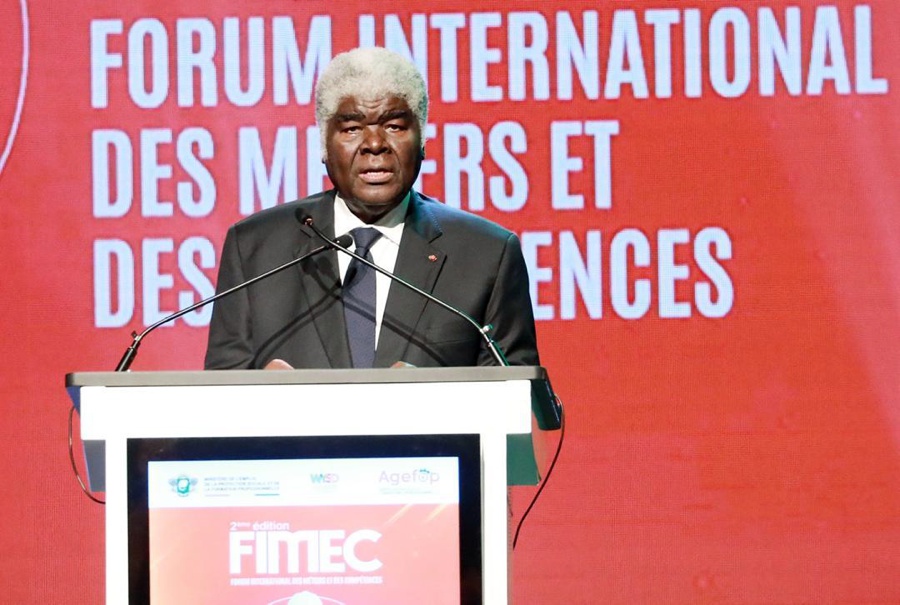
Abidjan, July 15, 2026 – The International Forum on Trades and Skills (FIMEC) serves as a crucial catalyst for achieving the goals outlined in the National Development Plan (PND) 2026-2030. This was emphasized by Prime Minister Robert Beugré Mambé on Wednesday, July 15, 2026, during the event held at the Sofitel Hôtel Ivoire in Abidjan. FIMEC aims to sustainably align the economy’s demands with the competencies fostered by the nation’s training sector.
The Prime Minister presided over the opening ceremony of FIMEC’s second edition, which centered on the theme: “Skills, Employment, and Economic Transformation in Africa: The Strategic Role of Vocational Training.”
Robert Beugré Mambé underscored the ambitious targets of the National Development Plan 2026-2030, stating, “This plan is designed to accelerate industrialization, strengthen our economic competitiveness, foster national industry leaders, boost private investments, and generate over 3 million jobs by 2030. From this viewpoint, skills development transcends mere training; it has evolved into a fundamental policy for economic competitiveness. Every investment directed towards enhancing skills is, in essence, an investment in the productivity of our enterprises, the appeal of our economy, and the sovereignty of our national progress.”
He affirmed the government’s unwavering commitment to making the requisite investments to position vocational training as a genuine driver of competitiveness, social inclusion, and sustainable wealth creation. “Our aspiration,” he declared, “is to cultivate an ecosystem where vocational training fully supports national development priorities, bolsters business competitiveness, encourages innovation, and plays a vital role in the industrialization of our economy.”
The Prime Minister highlighted FIMEC’s significance as a platform for dialogue, bringing together public authorities, the private sector, training institutions, and development partners. This collaborative environment is crucial for formulating unified solutions to the pressing challenges of employment, qualification, and economic transformation.
“It is our collective responsibility to foster an environment where every young person can acquire the essential skills to succeed, innovate, embark on entrepreneurial ventures, and contribute meaningfully to their nation’s advancement,” he further elaborated. “This profound ambition steers the government’s initiatives, informs the reforms we are implementing, and unites us all here today at FIMEC.”
He emphasized that the convening of this second FIMEC edition underscores Côte d’Ivoire’s steadfast dedication to making human capital development a cornerstone of its economic and social transformation strategy. “The global landscape is changing rapidly; economies are shifting, and professions are continually being reimagined,” he observed. “In the face of these profound changes, our only viable path is to anticipate, innovate, and invest in our most invaluable asset: the women and men who will build the Africa of tomorrow. Together, let us ensure that skills become the foremost engine of our competitiveness, our economic sovereignty, and our shared prosperity.”
The two-day agenda for this edition featured a variety of activities, including extensive exhibitions and high-level panel discussions.