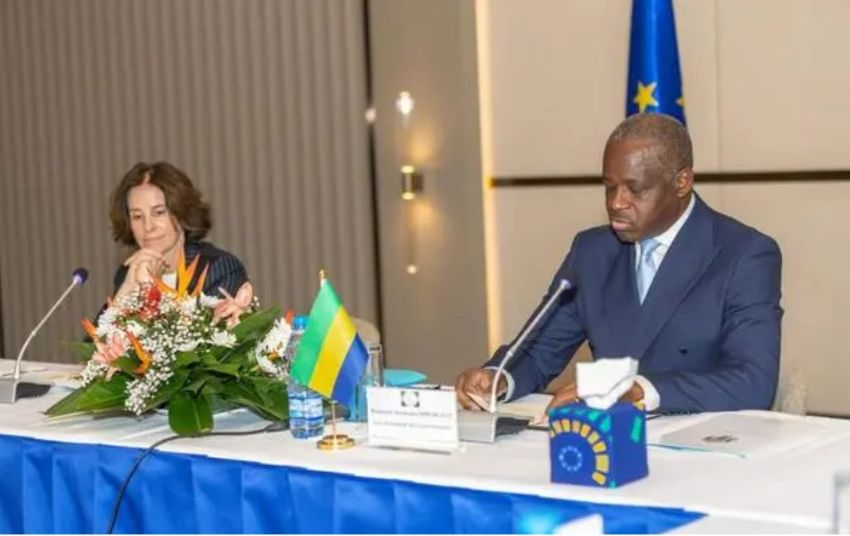
Gabon and EU forge stronger partnership beyond aid
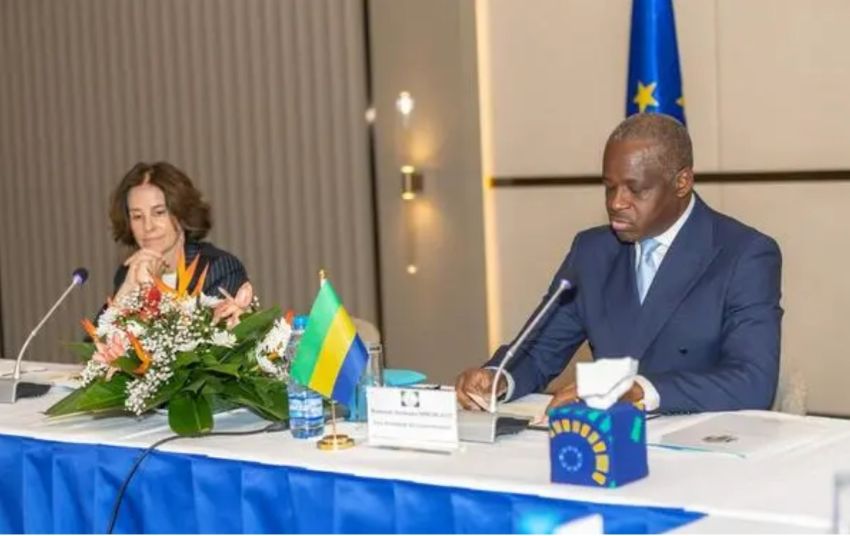
Libreville, Tuesday, June 9, 2026 — The strategic dialogue held in Libreville between Gabon and the European Union marks a turning point in bilateral relations.
Against the backdrop of the Fifth Republic established after the April 2025 presidential election, this session signals a profound shift in how Libreville and Brussels engage. Gabon is no longer content to be seen as a passive recipient of international aid. Instead, it is positioning itself as an equal economic, political, and environmental partner.
The discussions at the Omar Bongo Ondimba Congress Palace, led by Vice-President of the Government Hermann Immongault and EU Ambassador to Gabon Cécile Abadie, laid the groundwork for a new cooperation framework. This approach prioritizes investment, local value creation, skills transfer, and recognition of Gabon’s strategic role in regional and global stability.
Assessing Gabon’s Fifth Republic through European eyes
The second session of the Gabon–EU political dialogue was highly anticipated, serving as the first major international evaluation of the new institutional cycle following the 2025 political transition and presidential election.
Political reforms and governance were central to the talks. Minister of Reform and Relations with Institutions François Ndong Obiang outlined the pillars of the new Constitution, designed to strengthen national unity, citizen participation, and sustainable development.
The government highlighted institutional recognition of indigenous peoples and the integration of the diaspora into state institutions. Authorities argue these changes reflect a commitment to building a more inclusive and representative governance framework.
The 2025 elections were also scrutinized. Gabon emphasized the credibility of a process described as free, fair, and peaceful, citing official figures showing over 70% voter turnout. Authorities contend this participation demonstrates strong public support for the new institutional order.
The underlying goal is clear: reinforcing Gabon’s democratic credibility to secure investments and bolster economic appeal on the global stage.
From aid dependency to co-investment
The most decisive message came from Vice-President Immongault, who called for a paradigm shift in Gabon–EU relations. He argued it is time to move beyond aid-based cooperation toward a structured economic partnership rooted in productive investment, local wealth creation, and human capital development.
This shift aligns with the spirit of the Samoa Agreement, the EU’s new framework for relations with African, Caribbean, and Pacific states.
Libreville’s objectives are ambitious: attracting more European capital into key sectors such as industry, infrastructure, local resource processing, renewable energy, digital technology, and vocational training.
This evolution reflects the economic ambitions of President Brice Clotaire Oligui Nguema, whose agenda includes diversifying the economy, reducing reliance on raw material exports, and accelerating industrialization.
Ambassador Abadie echoed this sentiment, stressing the need to adapt cooperation tools to build a renewed partnership focused on tangible economic outcomes and mutual interests.
Gabon’s green diplomacy takes center stage
Environmental protection was another major topic. With nearly 88% forest coverage and a significant share of the Congo Basin—the world’s second-largest carbon sink after the Amazon—Gabon is a global ecological linchpin.
Vice-President Immongault emphasized that safeguarding these ecosystems demands substantial national effort. Libreville is advocating for stronger international financing mechanisms to reward forest nations for their climate contributions, ensuring a balance between conservation and economic development.
This demand resonates in global climate debates, where nations preserving vast forests seek fairer compensation for their ecological services.
The discussions also covered regional cooperation, Central African stability, CEEAC’s role, Gulf of Guinea security, and the strengthening of multilateralism.
The Libreville dialogue reveals a new reality: Gabon is redefining its place in the international order. With greater institutional stability, stronger diplomatic assertiveness, and higher economic ambitions, it seeks to build a more balanced and reciprocal relationship with the EU.
For both Brussels and Libreville, the stakes transcend bilateral cooperation. The challenge is to craft a partnership model capable of addressing growth, ecological transition, and regional stability simultaneously. The future of Gabon–EU relations will hinge on their ability to harmonize national sovereignty with international collaboration.