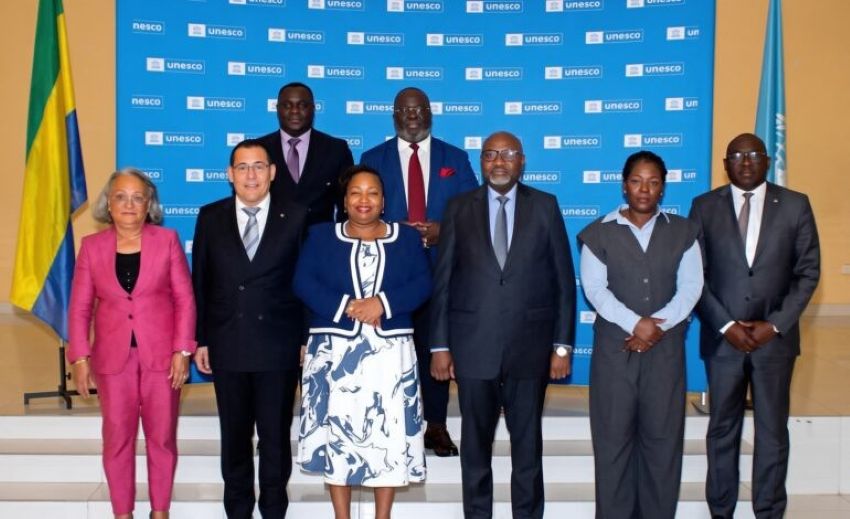
Libreville, July 2026 — Gabon has just launched one of the most critical national transformation initiatives. By adopting the interim education sector plan 2026-2030 roadmap, authorities are committing to a clear vision: transforming the education system into the primary engine for economic diversification, social cohesion and international competitiveness. This technical document represents far more than a policy framework—it embodies a strategic battle for the nation’s future.
The official launch ceremony, held at the Alibandeng school complex, brought together government officials, technical and financial partners, and civil society representatives to formally endorse the reform guidelines that will shape Gabon’s educational landscape over the next five years. The event was led by the State Minister for National Education, Camélia Ntoutoume Leclercq, alongside UNESCO’s resident representative in Gabon, Patricio Zambrano Restrepo, and key stakeholders driving the sector’s modernization.
This collective mobilization reflects a globally recognized truth: no economy can aspire to join emerging nations without substantial investment in human capital development.
Addressing demographic and economic pressures
Gabon’s education system faces dual challenges. First, a burgeoning youth population demanding expanded infrastructure, enhanced training programs and expanded career opportunities. Second, an economy that must gradually reduce reliance on extractive industries while transitioning toward industrial processing, service sectors and digital innovation.
The PSEI 2026-2030 emerges as a comprehensive response to long-standing challenges finally being addressed systematically. The roadmap outlines a phased implementation strategy comprising five stages, spanning from governance mechanism consolidation to outcome evaluation by 2030.
Four strategic priorities have been established:
- Expanding educational access: Building new schools, increasing enrollment capacities and eliminating regional disparities in service delivery.
- Enhancing learning quality: Elevating teacher training standards, integrating digital learning tools and aligning curricula with evolving labor market demands.
- Modernizing governance: Streamlining administrative processes, improving transparency and optimizing resource management across the sector.
- Promoting inclusive education: Creating equitable learning opportunities, protecting vulnerable student populations and ensuring accessibility for children with special needs.
Education as a pillar of national sovereignty
The active participation of UNESCO, UNICEF and international development partners underscores the strategic importance of Gabon’s education reform. Yet beyond financial support and technical assistance, the fundamental challenge remains national sovereignty.
In an era dominated by artificial intelligence, automation and knowledge-based economies, raw materials alone cannot secure a nation’s prosperity. Tomorrow’s leaders will be those capable of cultivating talent, mastering advanced technologies and driving innovation.
For Gabon, education transformation represents both a strategic necessity and an economic imperative. The goal is clear: better prepare youth for future careers, enhance employability prospects and align educational offerings with actual business sector requirements.
This approach could also help address Africa’s persistent youth unemployment crisis.
The credibility test ahead
African education initiatives have frequently struggled with implementation gaps, inconsistent funding or inadequate evaluation mechanisms. The success of Gabon’s PSEI will depend not on the quality of its design but on institutional capacity to sustain implementation over time.
Key success factors include:
- Rigorous indicator monitoring
- Stable funding mechanisms
- Effective inter-agency coordination
- Teacher engagement with reform initiatives
By launching this ambitious reform, Gabon is sending a powerful message to the world. The nation’s future wealth will no longer be measured solely in underground resources but in classroom achievements. The 21st-century global competition will be won not by natural resource endowments but by knowledge creation, skill development and the ability to cultivate homegrown talent.
Gabon’s education wager represents more than administrative reform—it’s an investment in economic sovereignty, social stability and the nation’s rightful place in tomorrow’s Africa.