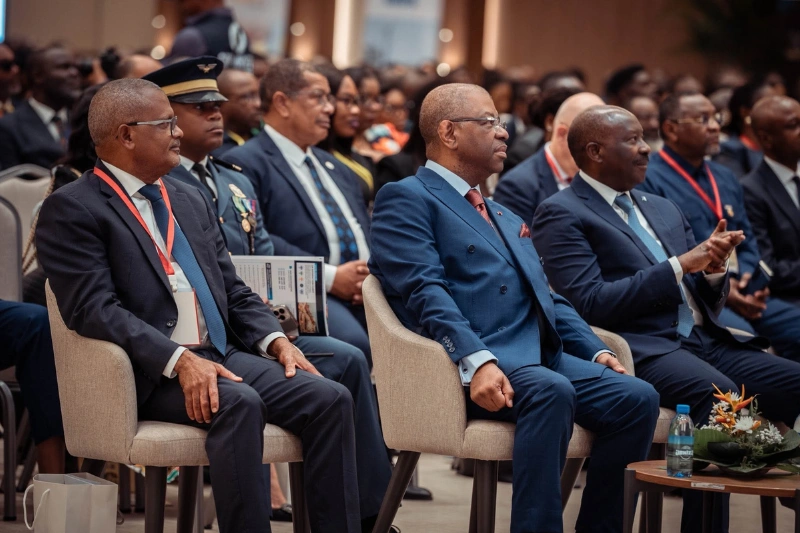
The Gabon Economic Forum (GEF) 2026, themed ‘Strong enterprises for sustainable growth and shared prosperity’, set the stage for a pivotal dialogue on the country’s economic future. Hosted at the Palais des Congrès de la Cité de la Démocratie in Libreville, the event brought together business leaders, government officials, and former state authorities to chart a course for Gabon’s economic development.
Private sector as the engine of Gabon’s growth
Alain-Claude Kouakoua, President of the Gabonese Federation of Enterprises (FEG), underscored the critical need for a mutual trust-based partnership between the private sector and the state. His message was clear: sustainable economic growth in Gabon hinges on collaboration, where businesses thrive in a stable and predictable environment. This sentiment was echoed by Vice-President Hugues Alexandre Barro Chambrier, who stressed that ‘without trust, no progress can be made. Investments will not materialize.’
Kouakoua went further, arguing that while diagnosing challenges is important, it is only the first step. He emphasized that ‘a diagnosis, no matter how insightful, holds no value unless it leads to action. Reports do not improve lives, and statistics do not create jobs. Results, however, do.’
Government’s role in fostering a business-friendly ecosystem
Vice-President Barro Chambrier reassured participants that the state remains committed to creating an attractive business climate. He highlighted ongoing efforts to streamline public finances, ensuring timely payments to enterprises and reinforcing legal security. ‘The government will continue to play its part by implementing policies that foster transparency, predictability, and a level playing field for all investors,’ he stated.
Both leaders agreed that no nation achieves sustainable development without robust national enterprises. Similarly, no country can generate mass employment without private investment and a dynamic entrepreneurial ecosystem. The message was unmistakable: businesses are not peripheral players in Gabon’s economy—they are the driving force behind progress.
From dialogue to action: the road ahead for Gabon
As the second edition of the GEF drew to a close, the consensus was clear: Gabon must move beyond rhetoric and translate commitments into tangible outcomes. Investors, the leaders noted, respond to stability, transparency, and enforceable policies—not mere promises. Kouakoua reiterated the FEG’s stance, advocating for an economic environment built on ‘legal certainty, transparency, and unwavering adherence to agreements.’
The African Continental Free Trade Area (AfCFTA) was highlighted as a game-changer for Gabonese businesses. With the continent’s markets opening up, enterprises can no longer afford to focus solely on local production. The challenge now is to scale up for regional integration, penetrate new markets, and nurture national champions capable of competing beyond Gabon’s borders.
The path forward: unity and execution
For Gabon, the GEF 2026 was more than a forum—it was a declaration of intent. The private sector and the government have laid the groundwork for a partnership rooted in mutual trust. The real test, however, lies in execution. As Kouakoua put it, ‘Africa’s future will be written by those who act, not those who merely observe.’