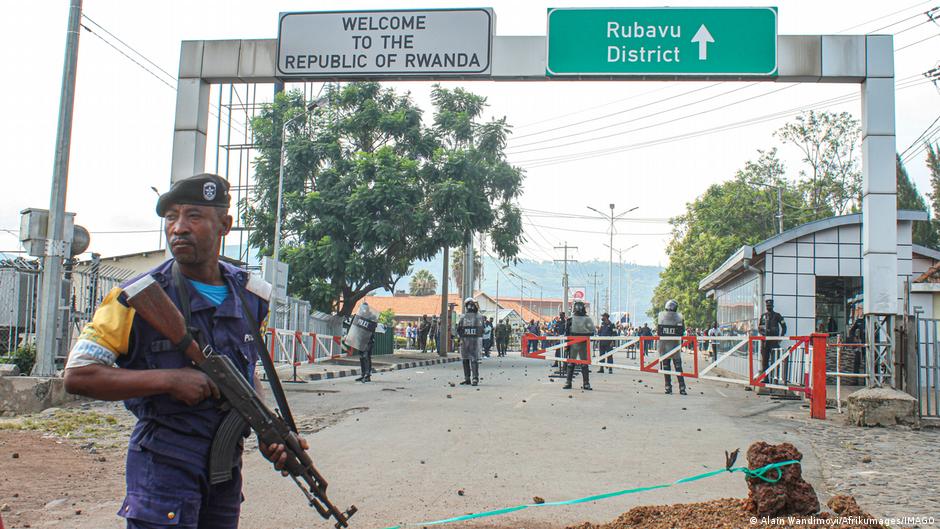
Goma’s economy under strain due to border closure
Goma, a bustling city in the eastern part of the Democratic Republic of Congo (DRC), is experiencing severe disruptions in its commercial activities following the closure of key border crossings with Rwanda. The city, heavily reliant on cross-border trade and financial flows with its neighbor, is now grappling with the economic fallout of this decision.
The border closure, implemented by Rwandan authorities primarily as a precautionary measure against the Ebola virus, has led to tightened sanitary controls at all entry points. While the intention is to safeguard public health, the unintended consequence has been a significant slowdown in economic activity in Goma.
Local traders bear the brunt of economic slowdown
Small-scale traders, including street vendors like Jacques Safari, who sells eggs near the border, are among the hardest hit. Safari, who has been operating in the area for years, reports a drastic decline in sales. Previously, he could sell up to five egg cartons daily, but now he struggles to sell just two. The drop in foot traffic is evident, as most of his customers were travelers crossing the border regularly.
“The economic hardship caused by the border closure is directly responsible for this decline. Most of our customers were travelers,” he explains.
Wholesalers face supply chain challenges
Wholesalers in Goma’s Birere Market are also feeling the pinch. Hamuli Kasilembo, a wholesaler in the market, points out that the once-efficient supply chain from Rwanda has been disrupted. The closure has not only created logistical hurdles but also reduced overall demand. Financial transactions have slowed significantly, making it harder for businesses to operate smoothly.
Kasilembo notes that the flow of goods and money that once sustained local commerce has now dwindled, leaving many traders in a precarious position.
Economists warn of long-term consequences
Economists like Alphonse Muanda emphasize that the closure of the Goma-Gisenyi border has far-reaching implications. They highlight that daily exchanges between the two cities are a cornerstone of the local economy, supporting countless small-scale traders who depend on cross-border commerce for their livelihoods.
“When authorities close the border, it’s the small traders who suffer the most. Many rely on daily income from cross-border exchanges,” Muanda points out.
With the border closure still in effect due to health concerns, residents of Goma fear worsening social and economic conditions in the coming weeks. The prolonged disruption threatens to deepen poverty and instability in a region already facing significant challenges.