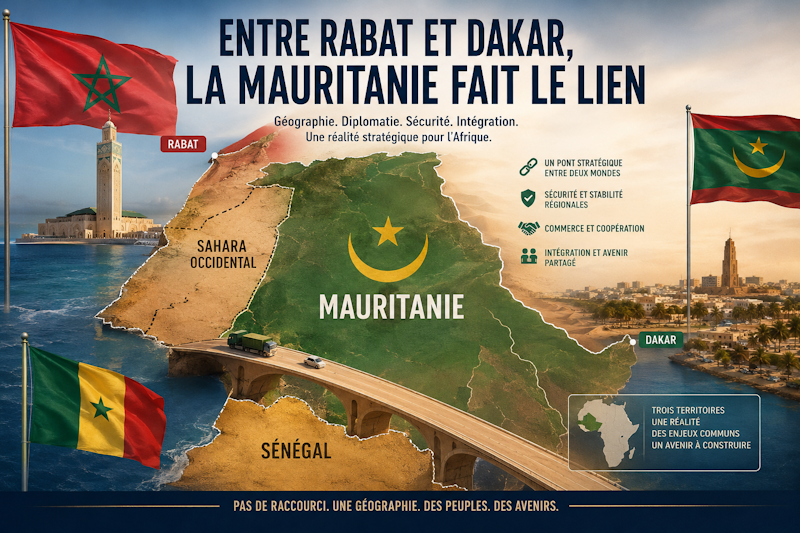

When examining the ties between Morocco and Senegal, one region often overlooked is the vast stretch of land that lies between them—the Western Sahara—but above all, the Islamic Republic of Mauritania. This is a point frequently emphasized by Mauritanian journalist Ahmed Ould Bettar, who highlights a fundamental geographic truth: there is no shortcut between Rabat and Dakar.
The Mauritania connection is not merely a matter of convenience; it is a strategic necessity. The country serves as a crucial bridge between North Africa and West Africa, playing a pivotal role in diplomacy, security, and economic integration across the continent. To disregard its significance is to oversimplify a complex geopolitical landscape.
The Mauritania factor in regional dynamics
Beyond its deserts and trade routes, Mauritania is a sovereign nation with a distinct identity and a voice on the continental stage. Its position makes it an indispensable player in stabilizing the region, facilitating cross-border cooperation, and mediating disputes that could otherwise escalate.
Consider the Western Sahara, a territory whose status remains a subject of international debate. To the south, Mauritania stands as a stabilizing force, ensuring that tensions do not spill over into broader conflicts. Its government has consistently advocated for dialogue and peaceful resolutions, reinforcing its role as a neutral yet influential mediator.
Why geography cannot be ignored
Geopolitics is not a game of chess where pieces can be moved arbitrarily. The reality of borders, nations, and histories must be respected. When analysts or policymakers bypass Mauritania in their assessments of Morocco–Senegal relations, they risk painting an incomplete picture of the region’s dynamics.
The stakes are high. From security threats to economic corridors, Mauritania is at the heart of key decisions that shape the future of West Africa and the Maghreb. Whether it’s combating terrorism, fostering trade, or strengthening regional blocs like the Economic Community of West African States (ECOWAS), the country’s contributions are undeniable.
The dangers of oversimplification
Reducing the relationship between Morocco and Senegal to a direct line ignores the realities of geography and governance. Such shortcuts may seem efficient in theory, but in practice, they lead to miscalculations and missed opportunities for collaboration.
For Ahmed Ould Bettar, the message is clear: Mauritania is not an optional detour—it is a fundamental part of the journey. Ignoring its role does more than distort the narrative; it undermines the very foundations of regional stability.
In the end, the geopolitics of West Africa demands precision, not approximation. The Islamic Republic of Mauritania stands as a testament to this truth, proving that sometimes, the most critical connections are those we cannot afford to overlook.