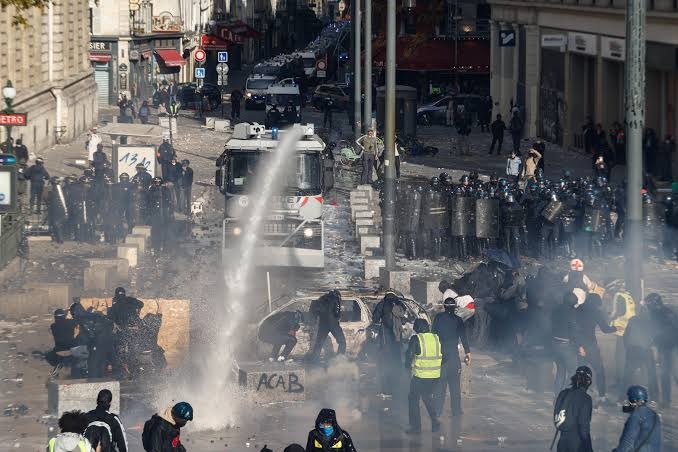
Scenes of violent unrest in French cities are no longer confined to European headlines—they’re now fueling political discussions from Burkina Faso to Niger. Images of shattered storefronts, riot police in full gear, and clouds of tear gas aren’t just breaking news; they’re being repurposed by pro-coup factions as evidence of Western decline. For advocates of Burkina Faso‘s Captain Ibrahim Traoré, Mali‘s Colonel Assimi Goïta, and Niger‘s General Abdourahamane Tiani, the turmoil in France isn’t just a domestic crisis—it’s a powerful rhetorical tool to legitimize their authoritarian rule.
France’s self-inflicted reputational damage in Africa
The idea of France as a beacon of democracy and stability has taken a severe hit across the Sahel. What was once a badge of honor is now a source of mockery among coup supporters. Viral clips showing law enforcement overstepping boundaries, elected officials sidestepping constitutional norms, and accusations of excessive force are being weaponized to undermine France’s moral authority. The unspoken message is clear: if the cradle of human rights can’t manage its own political turmoil, how can it preach governance standards to others?
The three-pronged strategy behind anti-France propaganda in the Sahel
The schadenfreude felt by some observers in response to France’s struggles isn’t coincidental—it’s part of a deliberate campaign with three core objectives:
- Undermining democracy’s credibility: By portraying elections, protests, and judicial checks as inherently flawed or unsustainable, military-aligned voices reframe coups not as power grabs, but as necessary measures to preserve national sovereignty and stability.
- Diverting attention from local failures: As Paris grapples with unrest, the pressing issues facing Sahelian populations—rising extremist violence, economic hardship, and energy shortages—receive far less international coverage.
- Promoting the narrative of Western decline: Leveraging Moscow-backed media outlets, graphic footage of French unrest is used to reinforce the idea that Western powers are in irreversible decline. This narrative helps justify shifting alliances with countries like Russia, Türkiye, and Iran.
Can France’s resilience counter Sahelian authoritarian narratives?
While critics argue that France’s free press, active civil society, and robust debate culture expose the hypocrisy of junta claims, perception often outweighs reality in geopolitical influence. Every conflict escalation in France feeds into a digital propaganda machine exploited by Sahelian regimes to justify their own crackdowns. For the leaders of the Alliance of Sahel States, every riot or tear gas incident becomes a strategic asset—shared, reposted, and magnified across social networks to sway public opinion south of the Sahara.