The escalating terrorist threat in the Sahel has prompted Ivory Coast to take a decisive step toward fostering regional unity. As armed groups continue to expand their reach, Abidjan is urging Mali and Burkina Faso to prioritize pragmatic collaboration over political posturing to safeguard collective security.
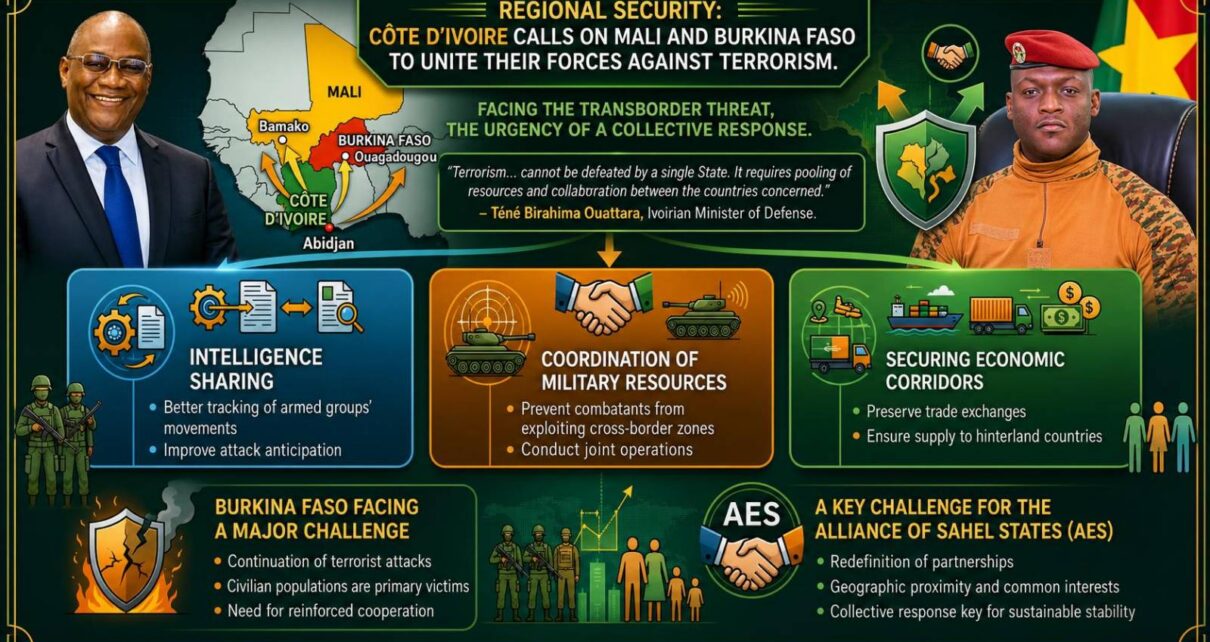
The urgency of the situation was underscored by Ivory Coast’s Minister of Defense, Téné Birahima Ouattara, who emphasized the need for shared resources and coordinated efforts:
« Terrorism does not respect borders. A unified strategy, combining intelligence-sharing and joint military operations, is the only viable path to defeating this scourge. »
Burkina Faso’s moment of reckoning
Despite national mobilization efforts, Burkina Faso continues to face relentless attacks, with terrorist groups exploiting weak territorial control and vulnerable civilian populations. For Captain Ibrahim Traoré, Chair of Burkina Faso’s transitional government, the time has come to reconsider isolated approaches. Analysts suggest that the survival of his nation hinges on embracing regional partnerships rather than clinging to divisive rhetoric.
Abidjan’s proposed framework for collaboration
Ivory Coast, leveraging its strategic stability and logistical strengths, has outlined a three-pillar cooperation plan to counter the terror threat:
- Intelligence sharing: Monitoring the movements of jihadist factions across porous borders to anticipate and disrupt attacks.
- Joint military operations: Coordinating cross-border operations to prevent terrorists from exploiting gaps between nations.
- Economic corridor security: Protecting vital trade routes that sustain the economies of landlocked Sahel nations.
A test of Sahel solidarity
The Alliance of Sahel States (AES) now faces a critical test: the viability of its alternative alliances versus the reality of shared security challenges. While Mali and Burkina Faso have pursued independent international partnerships, geography dictates an inescapable truth—regional cooperation remains indispensable.
For Captain Ibrahim Traoré, aligning with Ivory Coast would not signify surrender but rather a strategic pivot toward protecting Burkinabè lives. In the face of a mobile and adaptive enemy, fragmentation ensures defeat; unity offers hope for restoring stability to the region.