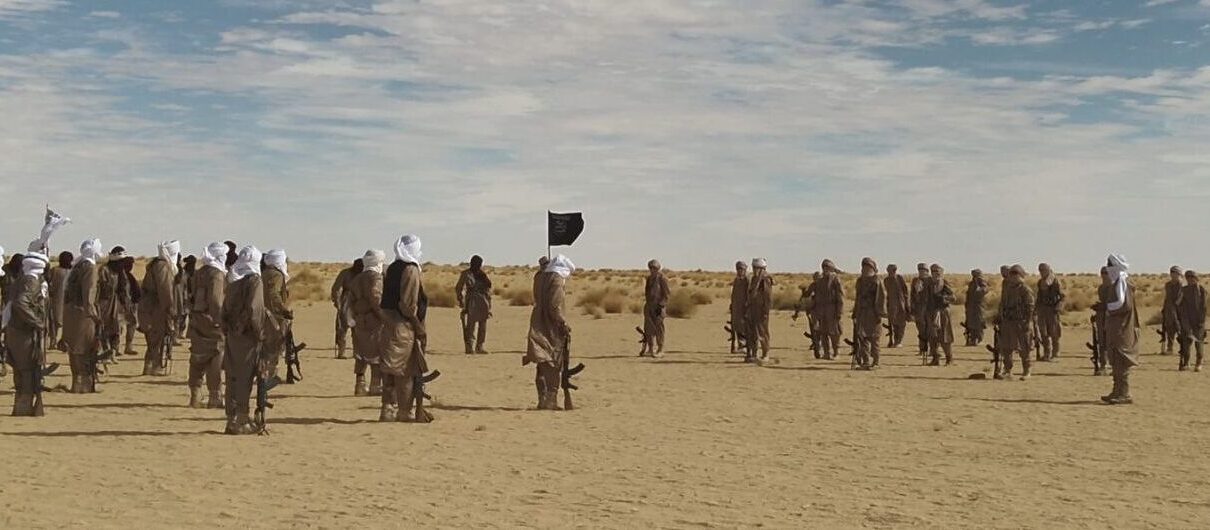
The landscape of violence in northern and central Mali has shifted from sporadic attacks to a grinding, unrelenting conflict that drains both communities and institutions. Recent offensives by the Group for the Support of Islam and Muslims (JNIM) and the Azawad Liberation Front (FLA) against military bases, supply convoys, and critical infrastructure signal a fundamental change in strategy—not just in tactics, but in the very nature of the war.
From territorial ambition to strategic suffocation
The JNIM is no longer focused solely on capturing towns or staging high-profile attacks. Instead, it is waging a campaign designed to erode the Malian state’s grip on the country, pushing the military junta into an increasingly precarious position in and around Bamako. The goal is not just to control land, but to render entire regions ungovernable by disrupting circulation—of people, goods, fuel, civil servants, and essential services.
This transformation is significant because it redefines the conflict’s core question: no longer merely *who controls what*, but *who can still move and operate* within the country. Roads once considered safe are now contested arteries. Administrative travel requires armed escorts. The state’s presence is shrinking not through outright defeat, but through systematic erosion.
War on mobility: the silent collapse of state authority
Over the past several months, attacks on roadways and military convoys have surged, particularly in rural areas where administrative mobility has become nearly impossible without armed protection. This isn’t just a military challenge—it’s a governance crisis. The more the state’s reach contracts, the more communities turn to parallel systems of protection, dispute resolution, and survival.
The JNIM has recognized a critical truth: in a country already weakened by years of institutional, economic, and security failures, exhaustion is a more effective weapon than a direct battle. This strategy is cheaper than territorial conquest. It disperses enemy forces, inflates security costs, and embeds a permanent sense of danger. Most damaging of all, it fosters collective fatigue—military, economic, and social.
In many rural zones, the absence of a functioning state is becoming more dangerous than the presence of armed groups. Schools close. Clinics shut down. Justice becomes inaccessible. The result is not just a security vacuum, but a collapse of public life.
The limits of a purely military response
The Malian military leadership has staked its legitimacy on restoring security, especially since the series of coups. The withdrawal of French forces and the expansion of Russian military cooperation were framed as acts of sovereignty. But sovereignty cannot be measured only in firepower. It must also be seen in the ability to maintain territorial, economic, and administrative continuity.
Yet the paradox is clear: intensified military operations have not led to lasting stability. In many regions, they coexist with growing fragmentation of rural spaces. The dominant security logic relies on offensive operations, airstrikes, and troop deployments—but it has yet to rebuild durable administrative presence: functioning schools, accessible healthcare, local justice, infrastructure, and economic circulation.
Where the state withdraws, informal systems fill the gap. This is not statebuilding—it’s state collapse disguised as security.
The Sahel’s shifting battlefields
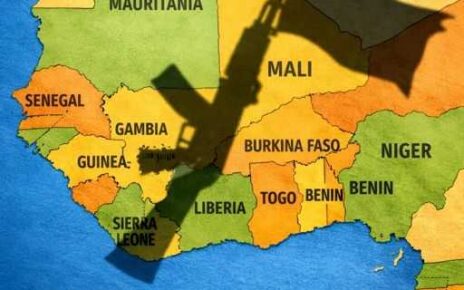
The crisis in Mali is no longer confined within its borders. Across the Sahel, armed groups, local alliances, and shadow economies are rapidly recomposing themselves. The porous borders between Mali, Burkina Faso, and Niger allow militant groups to move freely, while state responses remain stubbornly national.
The alliance between these three countries, despite its political and military undertakings, has proven unable to provide mutual support during crises. The recent offensive by the JNIM and FLA exposed the fragility of this cooperation—and the isolation of the Malian junta, which now relies almost exclusively on the Africa Corps mercenaries for support.
This asymmetry favors groups that can adapt quickly. The JNIM leverages its territorial flexibility, local anchoring in certain zones, and integration into informal economic networks. It may not control every territory it passes through, but it imposes a high security cost on the state—one that drains resources, sows fear, and weakens legitimacy.
The Sahel conflict is becoming a war of endurance. Armed groups are not necessarily aiming to govern entire nations. They seek to prevent states from functioning normally—permanently.
What Mali reveals about Sahelian conflict
A strictly counterterrorism lens distorts the reality of the Sahel crisis. Reducing the conflict to a military confrontation obscures its deeper roots: social grievances, land disputes, communal rivalries, structural poverty, and chronic state abandonment. Armed jihadist groups don’t always create these fractures—but they exploit them with ruthless efficiency.
The central challenge is political: how to rebuild state legitimacy in territories where the government appears only intermittently—mostly in the form of soldiers, not civil servants. The future of Mali will not be decided in a single decisive battle, but in the capacity to restore a stable public presence beyond security operations.
A war of attrition doesn’t just destroy military positions. It erodes roads, economies, administrations, social trust, and ultimately, the very idea of a governed territory. The longer this goes on, the harder it becomes to imagine a return to normalcy.
Mourad Ighil