JNIM’s evolving strategy in Mali: a war of attrition targets state function
Mali’s north and center face a strategic shift in conflict
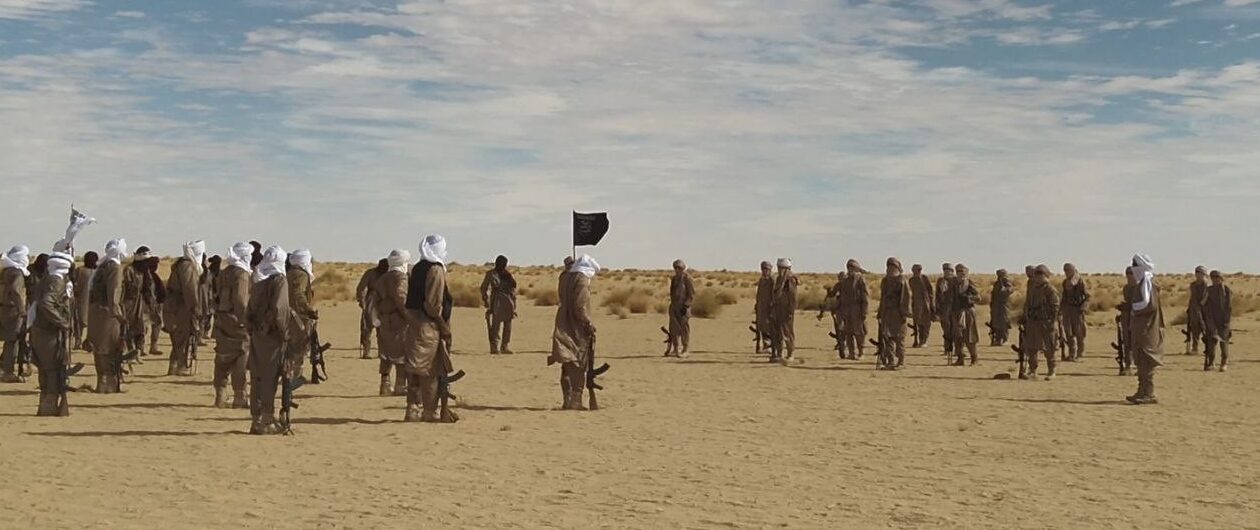
The northern and central regions of Mali are no longer merely enduring sporadic armed assaults. For several years, these areas have been trapped in a relentless cycle of permanent conflict and civilian exhaustion. Recent offensives by the Jama’at Nusrat al-Islam wal Muslimeen (JNIM) and the Front de Libération de l’Azawad (FLA) against military outposts, supply convoys, and critical road infrastructure signal a significant strategic evolution in their operations.
These armed factions are no longer solely focused on capturing specific towns or executing high-profile, spectacular attacks. Their current objective appears to be systematically eroding the military junta’s control over the territory, gradually pushing the Malian authorities back to their last strongholds in Bamako.
This strategic transformation is profoundly important because it redefines the core of the conflict. The central question is no longer who controls a particular city or military base. Instead, it has become: who can still ensure the movement of people, goods, fuel, administrative personnel, or public services across the country?
A war against mobility and state presence
For many months, attacks targeting vital road networks and military convoys have intensified. In some regions, administrative travel has become increasingly perilous without armed escorts. This trend not only weakens the Malian army but also undermines the state’s fundamental capacity to operate effectively beyond major urban centers. Such developments are crucial for any Sahel analysis English speakers seeking to understand the region’s dynamics.
JNIM appears to have grasped a critical insight: in a state already fragile from years of institutional, economic, and security crises, sustained attrition can yield greater political dividends than direct, frontal engagements.
This strategy is less resource-intensive than traditional territorial conquest. It enables the groups to disperse opposing forces, escalate security expenditures, and foster a pervasive sense of insecurity. Crucially, it cultivates collective fatigue—military, economic, and social—among the populace and the authorities.
In numerous rural areas, the primary concern is no longer just the presence of armed groups. The more pressing issue has become the gradual disappearance of any stable administrative horizon or public services.
The limitations of a purely military approach in Mali
Mali’s military government has made security restoration a cornerstone of its political legitimacy since the successive coups. The departure of French forces and the subsequent increase in Russian military cooperation were presented as a reassertion of national sovereignty.
However, sovereignty is not solely measured by the ability to conduct military operations. It is equally defined by the capacity to maintain territorial, economic, and administrative continuity throughout the nation.
Herein lies the Malian paradox: increased military activity does not necessarily translate into lasting stabilization. In certain regions, it coexists with an accelerating fragmentation of rural spaces.
The prevailing security doctrine largely relies on offensive operations, airstrikes, and military deployments. Yet, it struggles to rebuild a sustainable administrative presence, including schools, healthcare, local justice, infrastructure, and economic circulation.
This void then generates its own destabilizing dynamic. As public services vanish, local populations increasingly depend on parallel systems for protection, arbitration, or sheer survival.
The Sahel: a dynamic landscape of armed recomposition
The Malian situation now extends beyond its borders, offering valuable Sahel analysis. The entire Sahelian belt is experiencing a rapid recomposition of armed actors, local alliances, and clandestine economic networks. This is critical for any West Africa insider news report.
The porous borders connecting Mali, Burkina Faso, and Niger facilitate the mobility of armed groups. State responses, however, remain largely national, even as insurgent dynamics operate regionally. Furthermore, the political-military alliance formed by these three nations has proven incapable of providing mutual support. The recent offensive by JNIM and FLA underscored the fragility of this alliance and the isolation of the Malian military junta, whose primary support comes from Africa Corps mercenaries. This highlights a key aspect of Sahel politics.
This asymmetry favors groups capable of swift adaptation. JNIM, in particular, leverages its territorial flexibility, its ability to establish local roots in specific areas, and its integration into informal economic networks.
This does not imply that JNIM maintains lasting control over all territories it traverses. However, it consistently succeeds in imposing a significant security cost on the states in the Mali, Burkina Faso, Niger analysis.
The Sahel conflict is thus transforming into a war of political endurance. Armed groups are less interested in fully governing a country than in persistently preventing states from functioning normally.
Insights from the Malian crisis
The Malian case also exposes the limitations of a strictly counter-terrorism interpretation of the Sahel. Reducing the crisis to a simple military confrontation obscures the profound social, economic, and territorial dimensions of the conflict. This nuanced perspective is essential for any Sahel Insider.
In many rural areas, frustrations stemming from state neglect, land disputes, communal rivalries, and structural poverty fuel enduring vulnerabilities. Jihadist armed groups exploit these existing fractures; they do not always create them, but they adeptly capitalize on them.
The central challenge, therefore, becomes political: how can state legitimacy be rebuilt in territories where the state’s presence is often intermittent and primarily manifested through military operations?
This is where the future of Mali likely hangs in the balance. It is not about a single decisive battle, but rather the capacity – or incapacity – to reconstruct a stable public presence that extends beyond mere security operations. A war of attrition does not just destroy military positions; it wears down roads, the economy, administrative structures, social bonds, and ultimately, the very idea of a governed territory.