For over two years, Burkina Faso’s leadership has adopted an increasingly confrontational tone toward France. Under Captain Ibrahim Traoré, Ouagadougou has framed Paris as a symbol of colonial oppression that the country must now reject outright. The government has expelled French troops, publicly distanced itself from Western influence, and forged closer ties with Russia and Iran—all while positioning itself as a bold champion of national sovereignty.
Yet beneath the bold rhetoric, subtle actions paint a more complex picture.
Behind the tough talk: a high-profile visa request
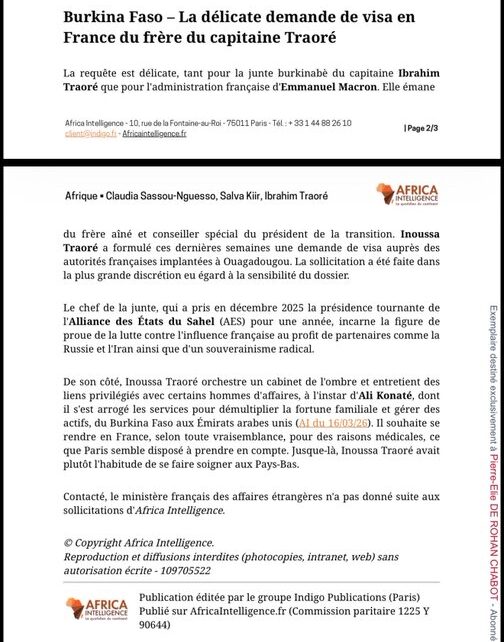
Reliable sources indicate that Inoussa Traoré, the elder brother of President Ibrahim Traoré and a senior advisor to the transitional government, recently submitted a discreet visa application at the French consulate in Ouagadougou. The request was handled with the utmost confidentiality, reflecting the sensitivity of the matter.
Unnamed officials familiar with the dossier suggest that Inoussa Traoré’s visit to France may be motivated by health concerns. Previously, he had relied on medical care in the Netherlands, but recent reports indicate a shift in his preferred destination.
The French Ministry of Foreign Affairs has not issued an official response, leaving the request’s details—and its purpose—open to interpretation.
A clash of words and actions
This potential visa request underscores a glaring contradiction in Burkina Faso’s current political posture. Since seizing power, Ibrahim Traoré has positioned himself as a fierce opponent of French influence, frequently denouncing Paris in public speeches and policy statements. The government has framed France as an adversary and called for a definitive break from its former colonial power.
In this context, the reported visa application by a close family member of the president raises an uncomfortable question: why seek entry to a country that the government publicly vilifies as an enemy?
Critics of the regime have long pointed to this kind of discrepancy, arguing that the government’s tough anti-French rhetoric does not always align with the personal choices of its leaders. Such inconsistencies fuel perceptions of double standards—publicly condemning France while quietly relying on its institutions when the need arises.
Sovereignty in practice: words vs. reality
Ouagadougou has repeatedly asserted its full independence, vowing to end any lingering dependence on former colonial powers. Yet real-world needs—especially in healthcare, financial transactions, and administrative procedures—often defy political slogans.
Many African leaders, despite publicly criticizing Western influence, continue to travel to Europe for specialized medical treatment, business negotiations, or personal matters. The reported visa application by Inoussa Traoré, if confirmed, would only reinforce perceptions that Burkina Faso’s anti-French stance is more performative than absolute.
Politics of perception: credibility at stake
In politics, perception matters as much as policy. When a government portrays another nation as hostile or undesirable, any private interaction with that country can be seen as contradictory. While this does not necessarily invalidate the government’s broader stance, it does invite scrutiny over the sincerity of its sovereignty-first narrative.
If these reports are accurate, they highlight the fragility of a political strategy built on outright rejection of France. They also reveal how personal or institutional necessities can sometimes override ideological posturing—even in regimes that prioritize anti-colonial rhetoric.
As Burkina Faso navigates its evolving relationship with Paris, the actions of its leaders—both in public and behind closed doors—will continue to shape how its sovereignty claims are perceived at home and abroad.