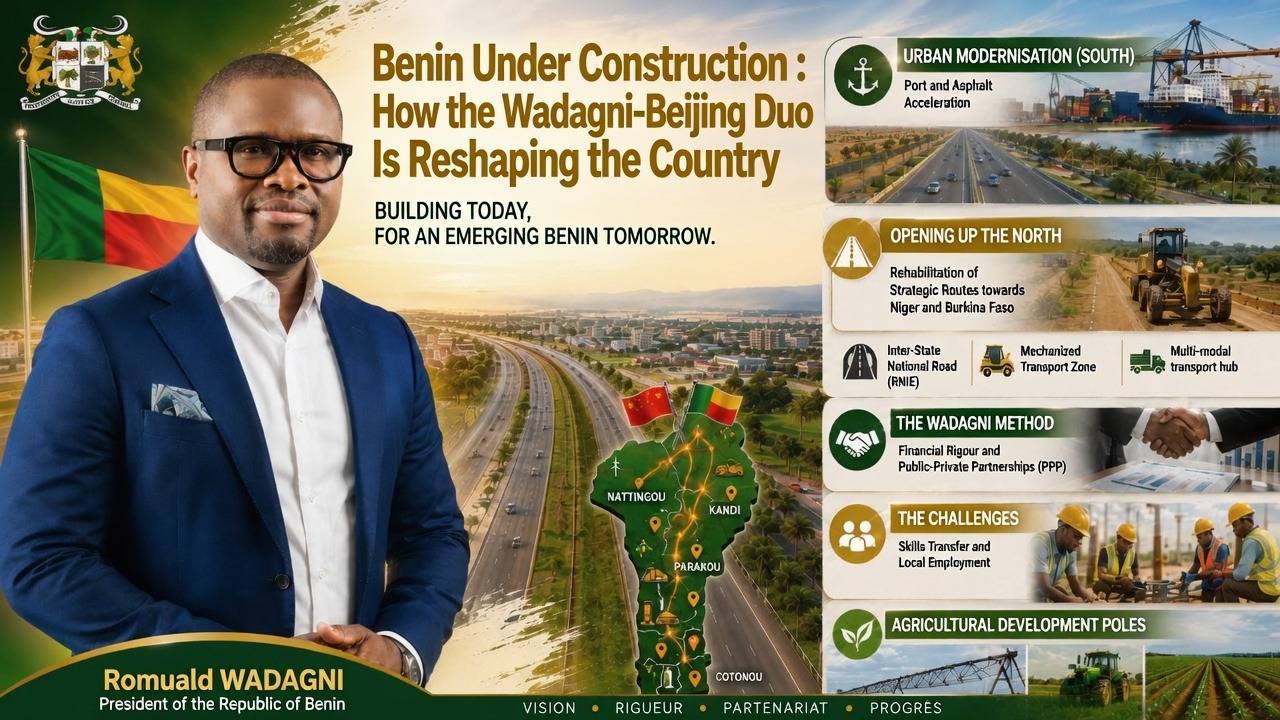
Under the leadership of President Romuald Wadagni, the Republic of Bénin is embarking on a bold new chapter in its national development strategy. Central to this vision is the revitalization of long-standing cooperation with the People’s Republic of China, marked by the resumption of large-scale infrastructure initiatives across Cotonou and key northern regions.
Strategic infrastructure: transforming Cotonou and beyond
Within months of assuming office, President Wadagni has set in motion a series of ambitious projects aimed at modernizing the country’s economic backbone. The renewed Sino-Béninese partnership is already yielding tangible results, from the bustling port of Cotonou to the remote northern towns of Parakou, Natitingou, and Kandi.
The capital, Cotonou, stands at the forefront of this transformation. Efforts are concentrated on enhancing urban infrastructure and alleviating congestion in vital economic corridors. Chinese engineering firms are leading the charge, deploying advanced technical solutions to:
- Upgrade port facilities and access roads: Work is underway to expand and streamline the Port of Cotonou, the nation’s economic lifeline, ensuring smoother freight movement to inland markets.
- Combat urban flooding: A comprehensive drainage and road paving program, supported by Chinese expertise, is nearing completion to protect the capital from seasonal inundations.
Northern development: addressing security and economic imperatives
The government’s commitment to the Grand Nord reflects a dual strategy: fostering economic resilience while mitigating security risks exacerbated by regional instability. By accelerating infrastructure development in Parakou, Natitingou, and Kandi, Bénin aims to:
- Improve connectivity: Rehabilitation of critical road networks linking Bénin to Niger and Burkina Faso, enhancing trade flow and regional integration.
- Boost agricultural productivity: Investment in multimodal transport hubs to facilitate the movement of goods from northern farmlands to domestic and international markets.
- Strengthen logistical networks: Development of interstate highways to bolster Bénin’s position as a competitive trade corridor in West Africa.
These initiatives are expected to sustain a robust growth trajectory, with international financial institutions projecting medium-term expansion of nearly 6% annually.
Balanced partnership: financial prudence meets technical expertise
President Wadagni’s approach to the Sino-Béninese alliance prioritizes fiscal responsibility and mutual benefit. Leveraging his expertise in macroeconomic management, he has structured agreements to ensure transparency and long-term viability. The framework emphasizes:
- Public-private collaboration: Chinese firms contribute technical and industrial capacity, while Bénin provides a stable macroeconomic environment to attract foreign investment.
- Debt sustainability: Rigorous financial oversight ensures that infrastructure financing aligns with the country’s long-term economic health.
Overcoming obstacles: ensuring sustainable progress
Despite the momentum, challenges remain. To guarantee the success of these projects, the government must:
- Enhance local capacity: Prioritize the involvement of Béninese subcontractors and workforce to maximize job creation and skill transfer.
- Streamline project execution: Accelerate administrative and procurement processes to avoid delays that could undermine progress.
By simultaneously advancing infrastructure in both southern and northern Bénin, President Wadagni has positioned the country for transformative growth. The partnership with China is more than a catalyst for development—it is a cornerstone of Bénin’s economic future.