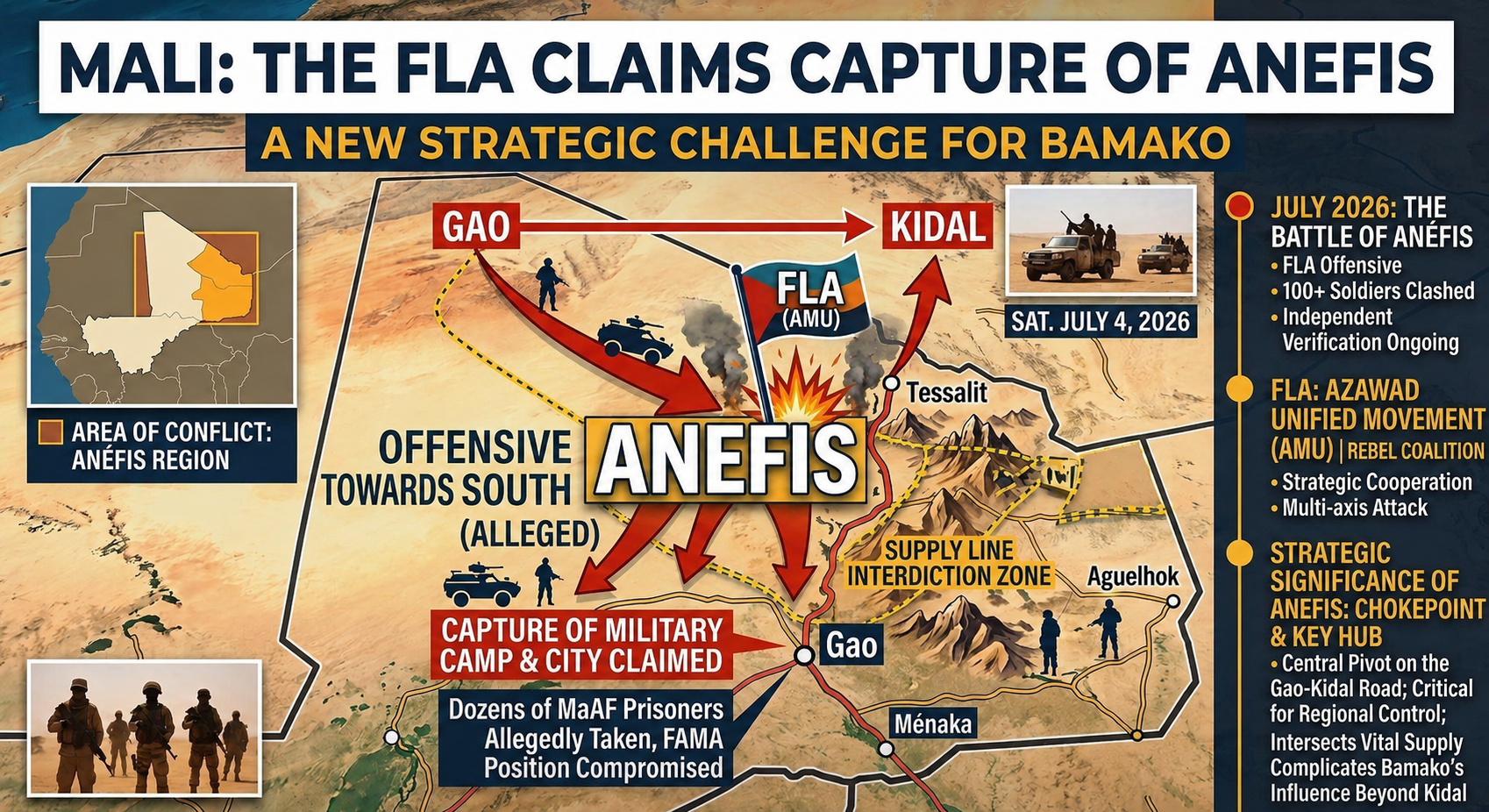
On Saturday, July 4, 2026, a significant military escalation gripped northern Mali, centered on Anefis, a critical crossroads connecting Gao and Kidal. The Front for the Liberation of Azawad (FLA), a coalition of Tuareg separatist factions, declared it had seized both the military encampment and the town following an offensive targeting the Malian armed forces.
The FLA further asserted that dozens of Malian soldiers were taken captive during the intense clashes. As of now, these claims remain unverified independently, and Malian authorities have yet to issue any official statement to confirm or or deny the developments.
Concurrently with the northern conflict, reports emerged from local observers detailing a separate assault during the night of July 3-4, 2026, on the Kéniéroba civilian prison, situated approximately sixty kilometers from Bamako. Armed individuals reportedly targeted the correctional facility. By 5:30 AM UTC on Saturday, heavy gunfire and other loud explosions indicated that confrontations were still active in the vicinity. Again, no official casualty figures or communications from Malian authorities were available at the time of this report.
The simultaneous occurrence of these incidents underscores the persistent security challenges confronting Mali on multiple fronts. With the army heavily engaged against separatist groups in the north, the reported assault near the capital, if confirmed, would highlight the armed factions’ capability to escalate tensions and stretch the resources of national security forces.
The battle for Anefis holds particular significance due to its pivotal geographical placement. Acting as a critical choke point between Gao and Kidal, it has long served as a vital transit hub for military operations, logistical supply lines, and controlling movement across the northern territories. Its potential loss, should it be verified, would mark a considerable setback for the Malian army, which has spent months striving to solidify its control over recently reclaimed areas.
Since government forces recaptured Kidal in 2023, the region has remained a flashpoint for consistent clashes between the national army and various armed groups. Despite Bamako’s repeated offensives, the security landscape remains highly volatile. The ongoing fighting demonstrates the rebel factions’ sustained ability to execute coordinated operations against military installations, thereby challenging the perceived stability of areas deemed under governmental control.
Beyond the immediate military implications, this series of events vividly illustrates the persistent struggles the Malian state encounters in simultaneously securing diverse regions across the nation. Caught between claimed offensives in the north and reported attacks near Bamako, authorities face an exceptionally intricate security environment, fueling ongoing questions about the conflict’s trajectory and the efficacy of resources deployed to address it.