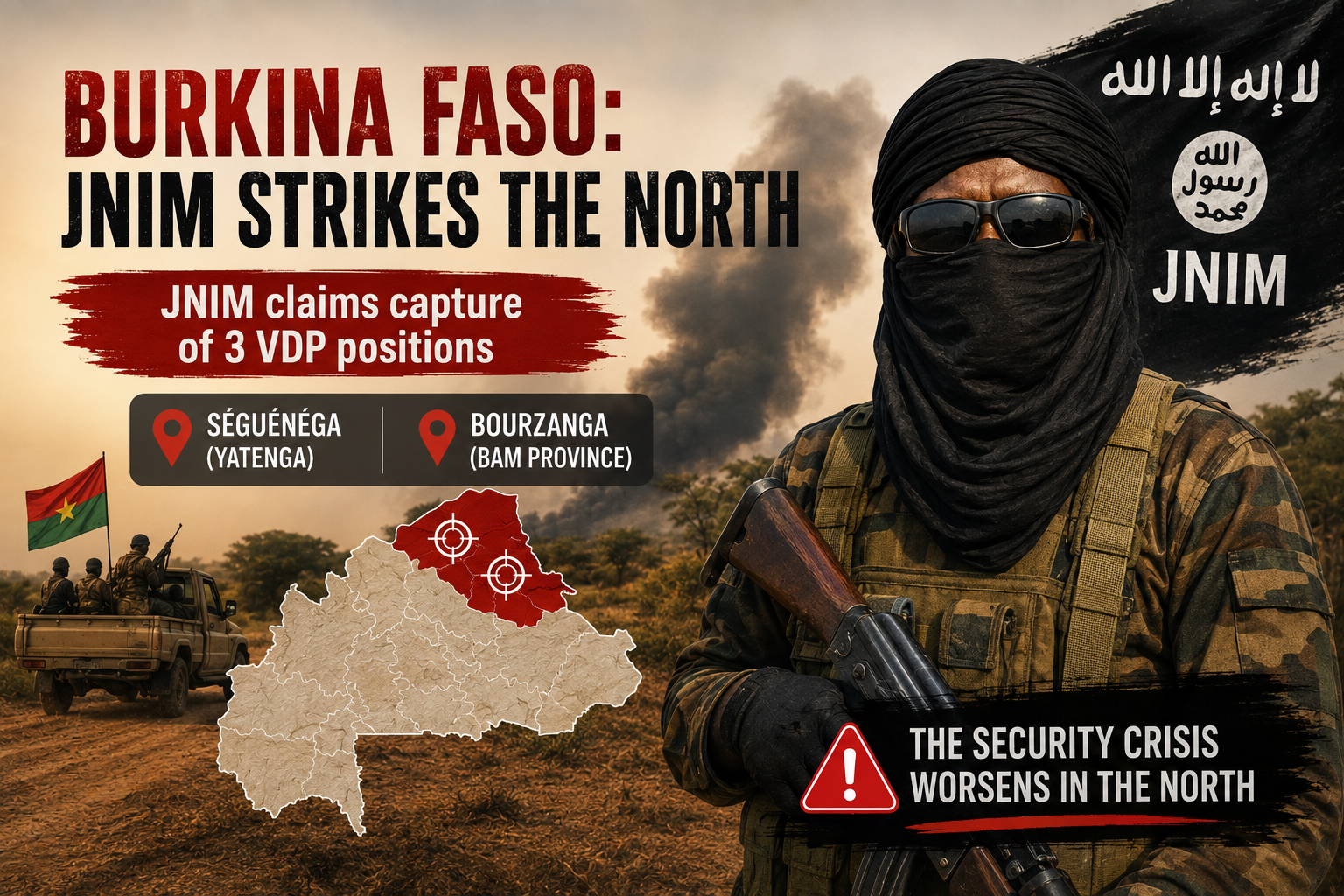
The unrelenting security crisis in Burkina Faso continues to take a severe toll, while the government’s communication strategy increasingly draws criticism. On August 19, the JNIM terrorist group claimed responsibility for seizing three critical positions held by the Volunteers for the Defence of the Homeland (VDP) in the country’s northern region. The brazen attacks targeted Séguénéga in the Yatenga province and Bourzanga in the Bam province further evidence of the militant groups’ expanding influence.
Military victories alone cannot guarantee lasting security
This latest offensive underscores once again the limitations of Burkina Faso’s military-led counterterrorism efforts. Sustained security in liberated zones demands more than just tactical gains it requires robust state presence, reliable intelligence, adequate logistical support, and, above all, effective protection of civilian populations. Recent events reveal that without these measures, even hard-won positions remain vulnerable to renewed attacks, while civilians continue to bear the brunt of insecurity.
The VDP, a cornerstone of the nation’s security strategy, frequently bears the brunt of these attacks. Operating with limited resources and often outgunned, the volunteer forces face militant groups that possess far greater mobility and firepower. The loss of any position is not merely a military setback it erodes public trust, displaces communities, and obstructs humanitarian access, compounding an already dire situation.
Political rhetoric fails to address the core security challenges
Despite mounting security concerns, the government’s approach under Captain Ibrahim Traoré raises serious questions. Rather than offering a sober assessment of the crisis or acknowledging strategic shortcomings, leadership has relied on disjointed public statements characterized by populist undertones. These speeches, lacking clear direction, appear less like a crisis strategy and more like an attempt to deflect criticism amid growing public frustration over deteriorating safety conditions.
Yet, in a crisis of this magnitude, rhetoric cannot substitute for concrete action. While appeals to national sovereignty and resistance may resonate with some, they do not shield villages, secure roads, or prevent attacks on military and civilian positions. What matters most to the Burkinabè people is tangible, measurable progress not political narratives.
Accountability and transparency remain critical
The central issue is no longer the official narrative, but the tangible impact on daily life. When towns remain exposed, communities are uprooted, or positions fall despite allocated resources, the problem transcends rhetoric and points directly to the effectiveness of the broader security strategy. The state’s ability to fulfill its commitments is now under scrutiny.
Compounding the crisis is the growing repression of independent media. Once a vibrant sector, journalism in Burkina Faso now faces severe restrictions. Reporters and dissenting voices who attempt to expose the truth are systematically silenced through arrests, forced detentions in so-called re-education camps, or deployment on frontlines under the guise of patriotism. By stifling critical journalism, the government not only suppresses free expression but also deprives itself of essential insights into battlefield realities, public sentiment, and humanitarian needs.
The suppression of independent reporting creates a dangerous disconnect between official narratives and ground realities. While the government may manipulate the national discourse to project control, it cannot erase the reality of ongoing attacks, mass displacements, or civilian casualties. The harder the state clamps down on information, the wider this gap becomes, undermining both public trust and strategic decision-making.
A call for realism over denial
The paradox is stark: as the security situation deteriorates, the space for open debate and critical assessment continues to shrink. Yet, an effective counterterrorism strategy depends on recognizing failures, understanding their root causes, and adapting swiftly. Refusing to acknowledge mistakes may offer short-term political relief, but it deprives leaders of the feedback needed to refine their approach and improve security outcomes.
Ultimately, the people of Burkina Faso need security not just words. As militant groups expand their reach and maintain relentless pressure across key regions, the government must prioritize transparency, accountability, and responsiveness. Communication may shape perception for a time, but it cannot, on its own, end the war against terrorism. Only sustained, results-driven action will restore stability and protect the lives of all Burkinabè.