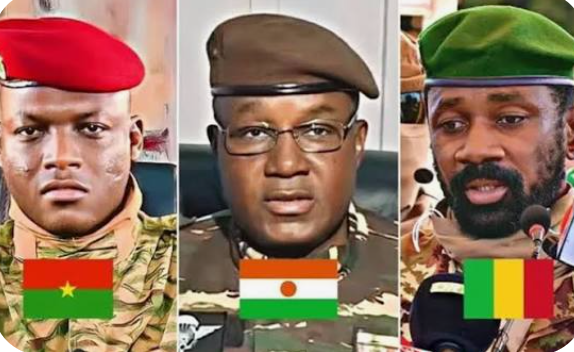
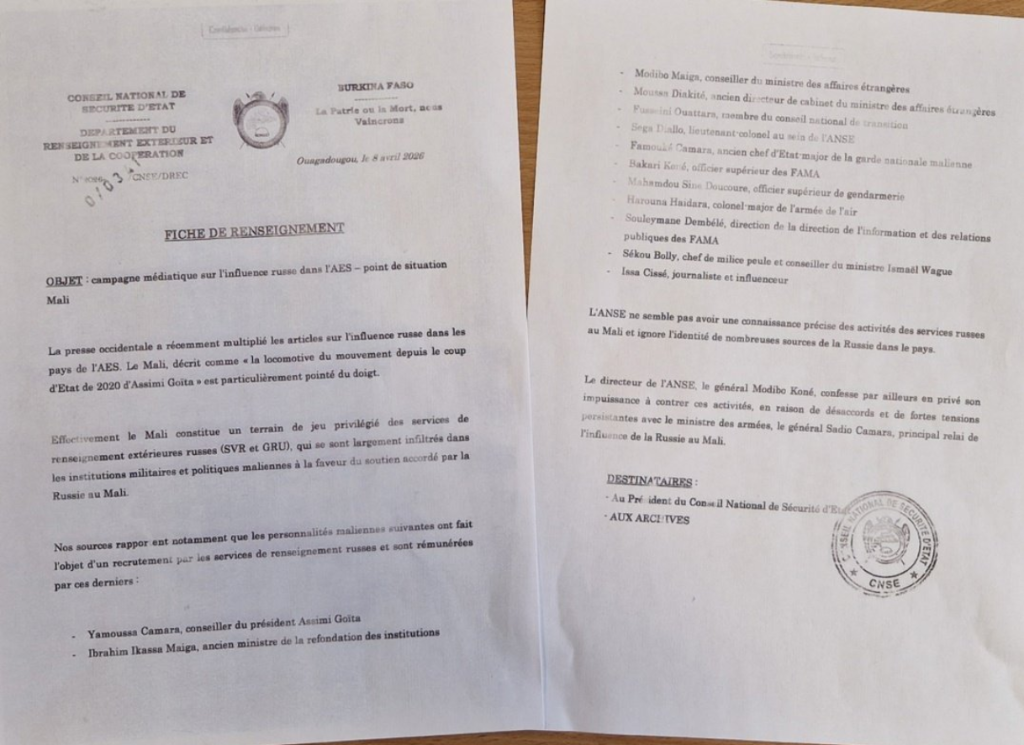
In the heart of the Sahel, the Alliance of Sahel States (AES)—a coalition uniting Mali, Burkina Faso, and Niger—faces an unprecedented challenge. While official narratives emphasize unity against external threats, a leaked intelligence report from Burkina Faso reveals a troubling reality: Mali’s leadership may no longer act independently, with its institutions heavily infiltrated by Russian networks.
The shadow network shaping Mali’s decisions
According to Burkinabè intelligence, Russian influence extends far beyond a few military advisors. Key figures in Mali’s government, administration, and media are allegedly tied to Moscow. Names like Yamoussa Camara, a close advisor to President Assimi Goïta, Modibo Maïga and Moussa Diakité, prominent diplomats, and high-ranking military officers such as Bakari Koré and Harouna Haidara appear on the list. Even media personalities and militia leaders, including Sékou Bolly and journalist Issa Cissé, are reportedly part of this intricate web.
For Burkina Faso, this revelation is alarming. If Mali’s decisions are shaped by Russian interests rather than regional priorities, the AES’s cohesion could crumble, leaving its counterterrorism strategy vulnerable.
From colonial dependency to new geopolitical chains
The AES was formed on a bold promise: severing ties with Western influences to reclaim African sovereignty. Yet, Mali’s growing reliance on Russian advisors and mercenaries raises a critical question—is the country merely swapping one dependency for another? Neighbors like Niger and Burkina Faso are increasingly skeptical, fearing that Bamako’s military and political choices may now serve Moscow’s agenda rather than regional stability.
The unease is palpable. Niger, in particular, views this foreign encroachment with suspicion, questioning whether Mali can still be a reliable partner in the alliance’s shared security goals.
A fragile alliance on the brink
The leaked report has cast a long shadow over the AES. Can the alliance survive if one of its members is perceived as losing control of its sovereignty? Burkina Faso is already distancing itself from Bamako’s decision-making, wary of instability or forced policies spilling over into the broader Sahel.
The stakes are no longer just about defeating terrorism—they’re about whether the AES can endure its internal fractures. Analysts warn that if Mali fails to regain control of its national direction, the alliance could collapse as quickly as it was formed, undermined by the very foreign influence its founders vowed to resist.