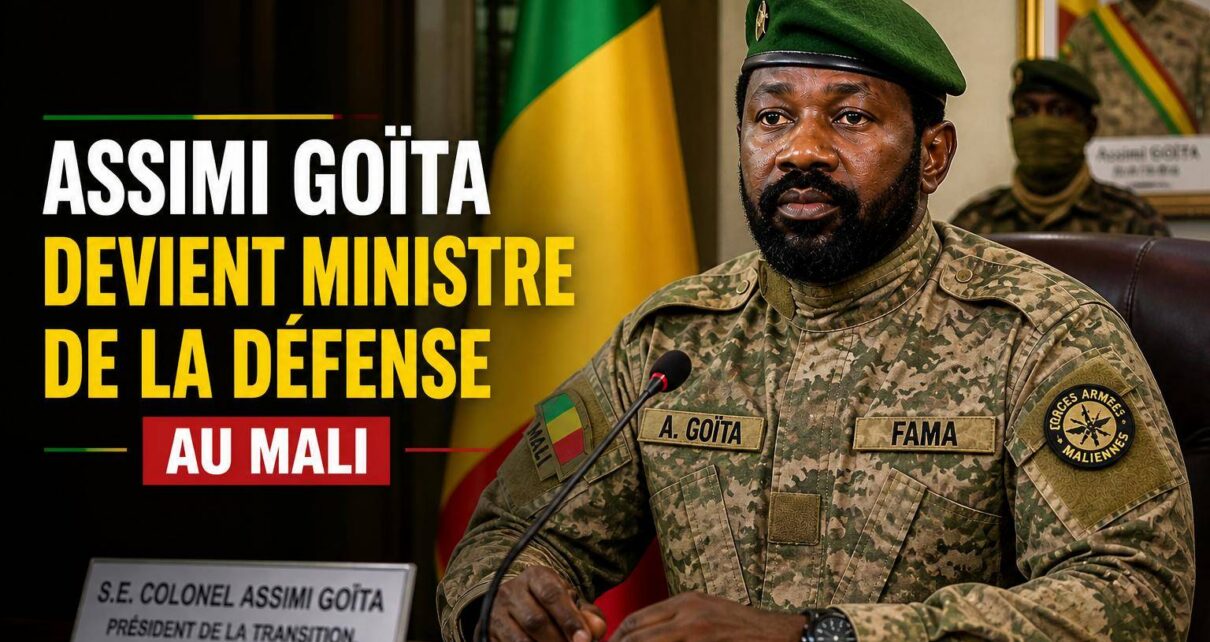
By officially taking on the responsibilities of Minister of Defense in addition to his duties as Head of State, Colonel Assimi Goïta has finalized the centralization of power in Bamako. This decision, far from being a mere administrative adjustment, appears to signal a profound vulnerability: a faltering chain of command and an increasingly strained military strategy. Amidst the recent setback in Kidal, which fell under the control of the JNIM and FLA, and the questionable effectiveness of its Russian partners, Mali is entering an unprecedented period of instability.
In Bamako, all avenues now lead to Koulouba. By combining the presidency with the defense portfolio, Colonel Assimi Goïta no longer merely outlines political direction; he has become the primary operational leader of the armed forces. For many regional observers, this move reflects growing mistrust within the inner circle of power.
Within the context of a prolonged transitional period, this extreme centralization raises a fundamental question: how can a single individual effectively manage national affairs, regional diplomacy, and the tactical intricacies of an asymmetric conflict? This accumulation of roles suggests a desperate move forward. By removing ministerial buffers, Goïta now places himself directly in the line of fire. Any battlefield reverse will no longer be attributed to a subordinate but will be perceived as a direct failure of the Head of State.
the Kidal illusion: from recapture to loss of control
Just a few months prior, official communications enthusiastically celebrated the “liberation” of Kidal. It was hailed as a symbol of regained sovereignty, a trophy of the transition. However, recent ground realities have shattered these aspirations. The city, a crucial strategic point in the North, has been reoccupied by armed factions, notably the Group for the Support of Islam and Muslims (JNIM) and forces aligned with the Coordination of Azawad Movements (CMA/FLA).
This reversal is not just symbolic; it carries significant tactical weight. The insurgent takeover of Kidal demonstrates that the Malian army, despite pronouncements of increased capabilities, struggles to maintain control over recaptured territories for extended periods. The absence of public administration and the security vacuum allowed for swift reoccupation by jihadist groups and separatist rebels. The JNIM, in particular, appears to have refined its approach, isolating garrisons and disrupting supply lines, effectively turning Bamako’s victories into fleeting successes.
the shadow of Wagner: a struggling russian partner?
Another cornerstone of Goïta’s security strategy is the partnership with Russia, primarily embodied by the Wagner paramilitary group (now operating under the Africa Corps banner). While this choice was presented as a sovereign alternative to former colonial power France, its tangible security outcomes have yet to convince.
Despite their presence on the most active fronts, the Russian partners seem to favor a scorched-earth methodology that, far from fostering peace, tends to radicalize local populations. Reports of human rights violations are escalating, providing fertile ground for the recruitment efforts of terrorist organizations. More critically, the technical proficiency of these instructors is being questioned given the alarming frequency with which Malian army convoys fall victim to bloody ambushes. With Russia itself entangled in its own conflict in Europe, can it truly provide Mali with the essential air and technological support needed to counter the JNIM’s agility? This remains highly uncertain.
tattered regional diplomacy
This escalating security crisis coincides with growing diplomatic isolation for Mali. By withdrawing from ECOWAS to form the Alliance of Sahel States (AES), Mali gambled on security self-reliance. Yet, reality is stark: borders are permeable, and terrorism respects no national boundaries.
By severing ties with regional cooperation mechanisms, Bamako deprives itself of vital intelligence and logistical support from neighboring states. Goïta’s consolidation of roles is perceived by neighboring capitals as an authoritarian hardening, complicating dialogue even further. Mali now finds itself in a paradoxical position: it seeks to assert its sovereignty through military force, yet it appears more reliant than ever on opaque external forces and a command structure concentrated in the hands of one individual.
the specter of quagmire: what future for Mali?
The situation remains grim for populations in the Central and Northern regions. Despite leadership changes and shifting geopolitical alliances, insecurity continues to surge. Attacks against civilian and military convoys have become almost daily occurrences.
The new “President-Minister of Defense” is playing a high-stakes game. If the security situation does not improve rapidly, social discontent, currently suppressed by a heavy security presence, could very well erupt. African history is replete with examples where excessive power concentration served as a prelude to significant instability.
To navigate this impasse, Mali cannot avoid a thorough re-evaluation of its overall strategy. Brute force and mercenary alliances have demonstrated their limitations. Without a return to inclusive governance and a genuine strategy for social reintegration across its territory, Colonel Goïta’s military approach risks quickly losing its edge against the persistent resilience of armed groups.
The moment calls not for wartime rhetoric, but for urgent political pragmatism. For beyond titles and uniforms, the very existence of the Malian state hangs in the balance on the shifting sands of the North.