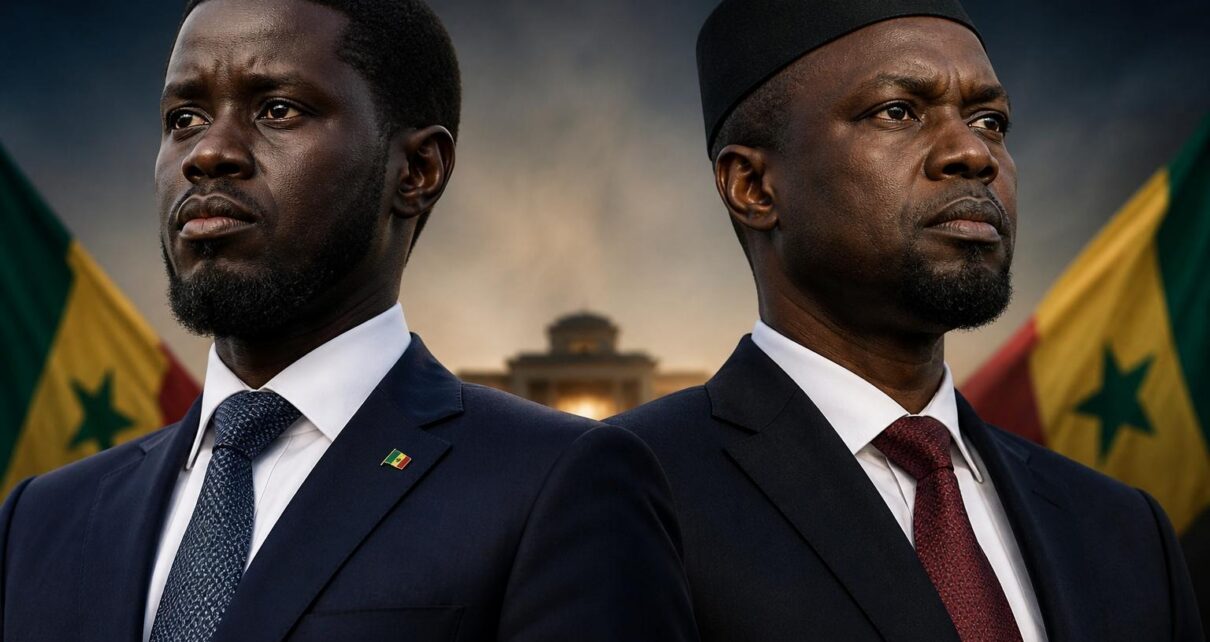
Political observers in Senegal are witnessing a significant shift in power dynamics between President Bassirou Diomaye Faye and Prime Minister Ousmane Sonko. The unfolding events from the 2nd and 3rd of May 2026 have underscored a pivotal moment in the nation’s governance, marking a departure from the previously portrayed unity between the two leaders.
Breaking point in the political tandem
During a national press interview, President Faye made a bold statement that sent shockwaves through the political landscape. By declaring his readiness to separate from the Pastef party if national interests demanded it, he shattered the illusion of an inseparable duo. This public stance highlighted a growing divide between the government’s strategic direction and the often outspoken actions of Pastef officials.
The president emphasized his detachment from partisan politics, asserting his role as a leader for all Senegalese citizens. His remarks underscored an unwavering loyalty to the national project but made it clear that his ultimate responsibility lies with the people. This firm declaration positioned him as an independent figure, unwilling to let party politics overshadow state interests.
The shadow of Ousmane Sonko: a dominant presence
The origins of this tension trace back to the very foundation of their leadership. Elected on a platform that equated voting for Diomaye with supporting Sonko, the president has long navigated the shadow of his charismatic prime minister. Sonko, never fully shedding his party leader persona, frequently took center stage in media appearances, sometimes overshadowing official state communications.
Over recent months, strategic disagreements have surfaced on critical issues such as debt management and international relations. While Sonko advocates for a radical break, Faye adopts a more diplomatic and pragmatic approach. Additionally, the clash over appointments—balancing technocratic expertise with the demands of party loyalty—has further strained their relationship. The contrast between Sonko’s fiery rhetoric and Faye’s measured demeanor has become increasingly apparent.
Is separation inevitable?
While an immediate split may be premature, the possibility has now entered the realm of plausible political outcomes. Faye’s public stance suggests a deeper resolve: to govern independently and assert the presidency’s autonomy. Within the Prime Minister’s circles, attempts are made to downplay the remarks, framing them as role divisions rather than a potential rupture. However, the president’s message signals a more profound shift—one where the presidency will not be held hostage by any pressure group.
This evolving situation places Senegal in a period of institutional uncertainty. Past experiences with tumultuous executive duos raise concerns about potential state paralysis. Should a separation occur, Faye would face the challenge of governing without the full support of the Pastef’s militant machinery, necessitating a search for new political alliances or governance through decrees.
The stakes of presidential emancipation
For Faye, the challenge lies in reassuring international partners of the country’s stability while demonstrating to citizens that he is firmly in control. Public opinion remains divided. A segment of the youth, loyal to Sonko’s charisma, may perceive this shift as a betrayal. Conversely, a more legalistic faction of the population applauds the president’s newfound assertiveness in exercising his constitutional duties.
The president is navigating a delicate balancing act—asserting authority without triggering social unrest that opponents could exploit. The question no longer revolves around personal affinities but rather the sustainability of a state architecture with dual power centers. The political landscape in Senegal is evolving, and the era of naive political alliances is drawing to a close. Governance, as Faye has reiterated, hinges on constitutional prerogatives and national interests rather than partisan loyalty. The duo that once symbolized change now risks becoming an obstacle to effective leadership. Senegal stands at a crossroads where the state must take precedence over the party, and Faye has just drawn the line.