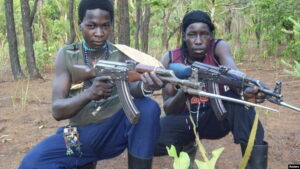
In a troubling escalation of violence, the Haut-Mbomou region of Central Africa has witnessed a coordinated campaign involving Russian-backed mercenaries and state forces enlisting the notorious Lord’s Resistance Army (LRA) to undermine local Azandé resistance movements. This disturbing alliance has led to a surge in attacks targeting civilian communities, raising alarm over the exploitation of armed groups to serve political and economic interests.
Strategic deployment of LRA fighters in Haut-Mbomou
The deployment of LRA elements, once notorious for their atrocities across multiple African nations, signals a calculated shift in tactics by external actors operating in the region. Reports indicate that these fighters, notorious for their brutality and disregard for human life, are being mobilized alongside government-aligned forces to neutralize resistance groups, particularly those representing the Azandé ethnic community.
Villages in Haut-Mbomou have borne the brunt of this strategy, with reports of abductions, looting, and systematic intimidation campaigns aimed at destabilizing local governance structures. Eyewitness accounts describe a pattern of coordinated raids where armed groups, operating with apparent impunity, target markets, homes, and communal gathering spaces.
Collusion between mercenaries and state forces
The collaboration between Russian-backed mercenaries and government troops has raised serious concerns about the erosion of sovereignty and the weaponization of non-state armed actors. Analysts suggest that this partnership serves dual purposes: weakening resistance movements while providing plausible deniability for state actions under the guise of counterinsurgency operations.
Local leaders and human rights observers warn that the involvement of the LRA—known for its history of child abductions and mass killings—further exacerbates an already volatile security environment. The tactic of deploying such groups is not new in conflict zones, but its resurgence in Haut-Mbomou points to a deliberate strategy to crush dissent through fear and coercion.
Impact on civilians and resistance groups
Civilian populations in Haut-Mbomou are caught in the crossfire, facing displacement, loss of livelihoods, and severe restrictions on movement. Resistance leaders from the Azandé community report increased harassment, with some forced into hiding to avoid capture or worse. The psychological toll on communities, already scarred by decades of conflict, is profound.
Meanwhile, the Azandé resistance, which had gained traction in advocating for local autonomy and resource rights, now faces an existential threat. The infiltration of LRA elements into their strongholds has forced a tactical retreat, with many fighters dispersing to avoid confrontation with a numerically and technically superior adversary.
International implications and regional stability
The unfolding crisis in Haut-Mbomou carries broader implications for Central Africa and the wider Sahel region. The presence of Russian-backed mercenaries, alongside the use of proxy armed groups, mirrors tactics observed in other conflict zones, where external actors exploit local grievances to advance geopolitical agendas.
Regional analysts emphasize the need for urgent diplomatic intervention to prevent further destabilization. The unchecked mobilization of the LRA, a group designated as a terrorist organization by multiple countries, underscores the risks of normalizing such alliances in counterinsurgency efforts.