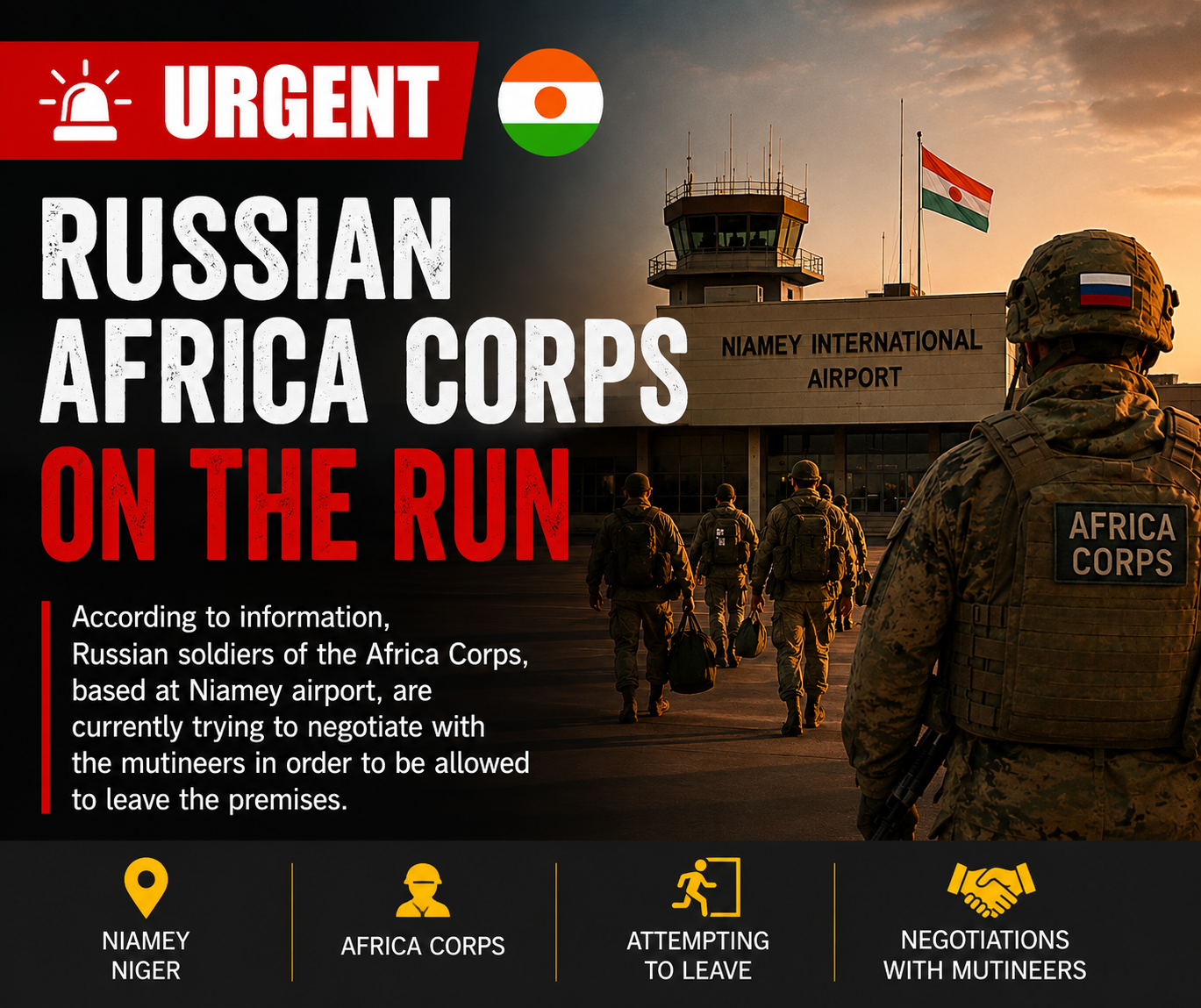
Reports of gunfire and unrest near Niamey’s Diori-Hamani International Airport have brought to light a profoundly significant development: Russian elements of the Africa Corps are reportedly seeking an urgent negotiated departure from Nigerien military forces controlling the facility.
Should these accounts be substantiated, this episode would transcend a mere security incident at an airport. It would serve as a stark revelation of the inherent fragilities within the security paradigm adopted by several Sahelian military regimes.
The illusion of an unshakeable ally
In a departure from their traditional partnerships, several juntas across the Sahel have opted to forge closer ties with Moscow, entrusting a portion of their security strategy to Russian forces.
The Africa Corps, which has progressively succeeded Wagner in various African operational theaters, was presented as a crucial instrument for bolstering military regimes, ensuring the safety of leaders, and combating jihadist groups.
However, the unfolding situation in Niamey poses a fundamental question: what is the true value of a security partnership when confronted with an internal crisis, a mutiny, or a scenario where the interests of the foreign partner diverge from those of the local authority?
1. Engagement primarily driven by russian interests
Unlike a national army, the primary mission of a foreign force is not the sustained defense of the population or institutions of the country in which it operates.
Its involvement is dictated by political, military, and strategic objectives inherent to its nation of origin.
This creates a fundamental contradiction: a regime may perceive the Russian presence as vital to its survival, while Moscow might determine that a given situation no longer warrants additional exposure for its own personnel.
The Niamey incident, if confirmed, would precisely illustrate this limitation: when the risk becomes too substantial, safeguarding one’s own personnel can become the paramount concern.
2. The pitfall of security dependence
By relying heavily on an external partner, military regimes risk cultivating a new form of dependency.
The initial promise is that of regained sovereignty: reduced reliance on Western powers, greater strategic autonomy, and enhanced territorial control.
Yet, a crucial question persists: can true sovereignty be claimed when a state’s security is largely contingent upon a foreign force?
The paradox is evident. To diminish one form of dependence, one may merely substitute it with another.
Furthermore, when foreign forces are positioned in strategic locations — airports, military bases, logistical arteries, or command centers — their abrupt withdrawal can instantly create a security vacuum.
3. Foreign presence alone does not guarantee victory
The arrival of foreign combatants or instructors can temporarily enhance certain military capabilities. Nevertheless, it does not resolve the underlying causes of a security crisis.
The struggle against jihadist groups also necessitates:
- reliable intelligence;
- an effective chain of command;
- a sufficiently trained and equipped national army;
- a sustained state presence in rural areas;
- cooperation with local populations;
- considerable logistical resources;
- and, crucially, a political strategy capable of mitigating factors that foster the recruitment of armed groups.
No foreign force, regardless of its equipment, can sustainably replace these essential elements.
4. Results that remain challenging to quantify
The Russian presence is often portrayed as a strategic shift designed to regain the initiative against jihadist groups.
However, the true measure remains the situation on the ground for populations and national forces.
When attacks persist, certain areas remain difficult to control, and military losses accumulate, an inevitable question arises: what is the relationship between the cost of this cooperation and its tangible results?
It is precisely at this juncture that political rhetoric risks colliding with operational realities.
Niamey: a military, but also a political challenge
The significance of this episode extends beyond the immediate situation around the airport.
It also lies in its symbolism.
If Russian military personnel, ostensibly involved in protecting the regime, find themselves in a position to negotiate their departure with elements of local forces, it would expose a frequently obscured reality: the external partner does not necessarily control the internal power dynamics of the country where it operates.
In essence, the presence of a foreign power guarantees neither the cohesion of the national army nor the political stability of the regime.
5. The myth of invincibility can fracture
For several years, Russia has sought to project an image in Africa of a military partner capable of intervening where Western powers have purportedly failed.
This communication strategy relies partly on an image of strength, determination, and efficacy.
However, this image can transform into a vulnerability when a dramatic incident contradicts it.
A force presented as indispensable and formidable suddenly seeking to negotiate its evacuation would send a particularly potent political signal.
Adversaries of the regime might interpret it as a sign of weakness.
Military personnel themselves might question the true extent of their Russian partner’s support.
And populations might begin to inquire about the concrete outcomes of this alliance.
What should Moscow’s allied juntas now anticipate?
If the information regarding Niamey is confirmed, several consequences could materialize.
6. A risk of strategic isolation
Regimes that have severed ties with several Western and regional partners have progressively diminished their diplomatic maneuvering room.
If, concurrently, their primary foreign military partner proves unable or unwilling to intervene during a major internal crisis, they could find themselves isolated in facing their own security and political challenges.
The question, therefore, is no longer merely: “Who will combat the jihadist groups?”
It also becomes: “Who will genuinely come to the regime’s aid in the event of a major crisis?”
7. Increased vulnerability to internal dissent
A military authority also relies on the loyalty of its own armed forces.
If foreign soldiers appear incapable of controlling a crisis situation or seek to hastily depart the theater of operations, this can contribute to weakening their deterrent capability.
The risk then is the emergence of a psychological effect: the perception that the authority may not be as robust as it claims.
In an environment marked by internal tensions, mutinies, or rivalries among military factions, this type of perception can become particularly perilous.
8. The economic cost of the strategy
Foreign military cooperation also entails a significant financial burden for states with limited resources.
However, a security strategy cannot be assessed solely based on the number of military partners present on the ground.
It must be evaluated by its results: territory controlled, populations protected, attacks prevented, reduced military losses, and the capacity of national armies to operate autonomously.
If expenditures escalate while insecurity persists, the model inevitably faces scrutiny regarding its effectiveness.
The true imperative: constructing a durable national defense
The Niamey episode ultimately reiterates a reality that shifts in alliances cannot erase.
Replacing one foreign partner with another is insufficient for building a sustainable defense policy.
A state’s security fundamentally rests upon the cohesion of its institutions, the professionalization of its military, the quality of its intelligence, trust between military personnel and populations, and the state’s capacity to exert its authority across its entire territory.
External support can complement this architecture. It cannot supplant it.
Niamey, a cautionary signal?
Should the reported attempt by the Africa Corps to negotiate its departure be confirmed, Niamey could evolve into far more than an incident of tension around an airport.
It would stand as a cautionary signal to all regimes that have based a portion of their survival strategy on a foreign military partner.
An external power can provide weapons, instructors, combatants, and political backing. However, it cannot, by itself, guarantee the stability of a regime, the cohesion of an army, or victory against an insurgency.
The more profound question now confronting Sahelian juntas is, therefore:
What transpires when the partner presented as indispensable also decides to prioritize its own interests?
The Niamey episode could thus reveal the primary weakness of the model: having replaced one strategic dependence with another, without resolving the internal fragilities that fuel the security crisis.