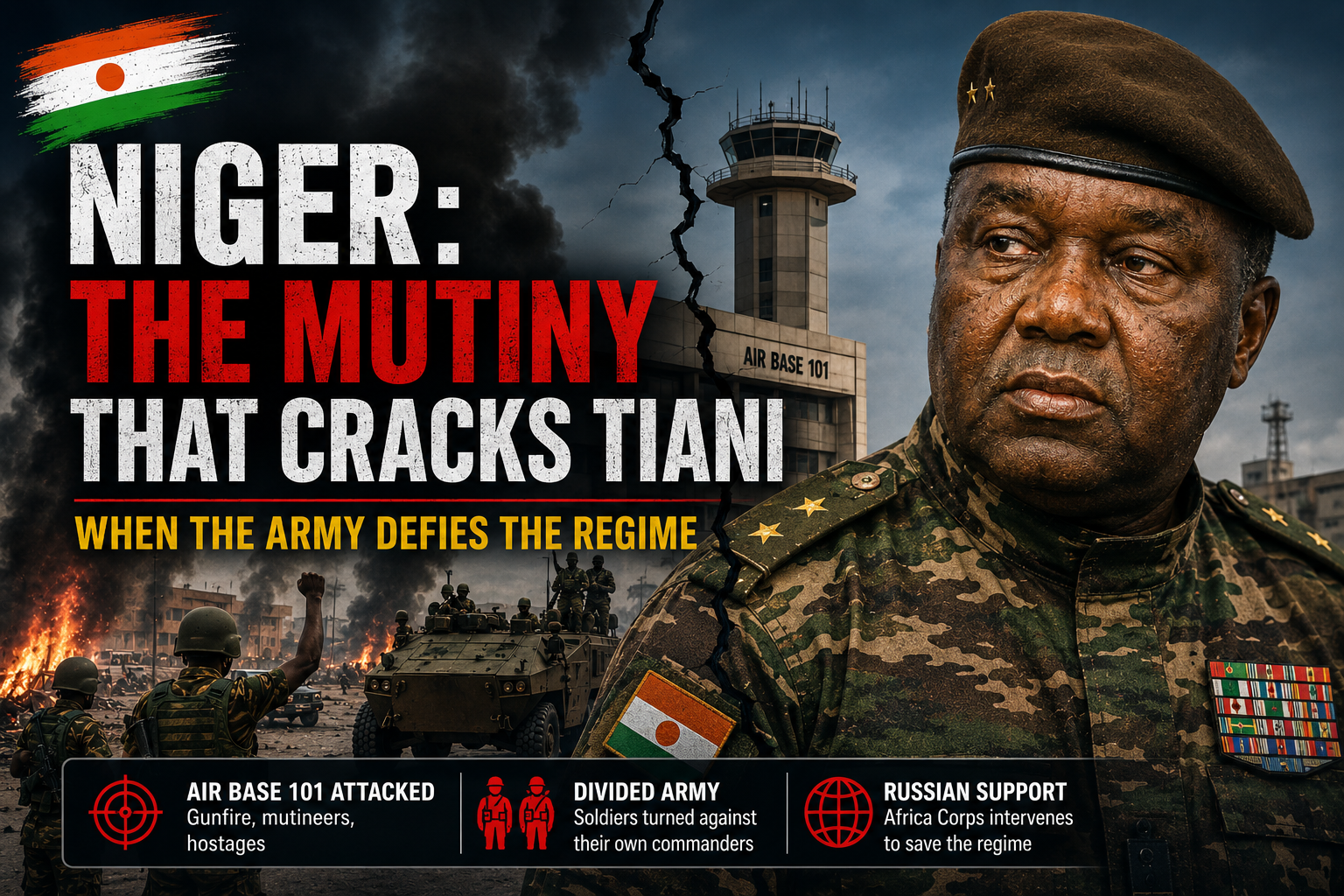
The violent events of Saturday, August 29th, 2026, in Niamey cannot be dismissed through official rhetoric nor dismissed as a mere display of ‘revolutionary impatience’ among the ranks. The attack orchestrated by a faction of soldiers on Air Base 101 and multiple strategic sites across the capital represents a critical rupture in the nation’s recent political trajectory. Authorities have acknowledged that a group of servicemen detained their own colleagues before engaging in gunfire at high-profile locations.
The implications of this insurrection extend far beyond isolated unrest. When military dissent targets a pivotal defense installation at the heart of the capital, when gunfire echoes around the airport and presidential palace, and when national broadcasting outlets face temporary blackouts, the very foundations of state authority are thrust into question. Reports from Reuters indicate sustained gunfire for several hours near key government sites, while state television and radio fell silent during the incident.
A fracture rooted in internal division
Dismissing the mutineers as overzealous soldiers seeking expedited geopolitical realignment ignores the gravity of their targets. When Nigerien troops turn their weapons on vital infrastructure within their capital and engage in armed confrontation with loyalist forces, the crisis transcends mere ideological posturing—it becomes a structural failure of the state’s security apparatus.
This development raises pressing questions about military cohesion. A nation’s armed forces may withstand political disagreements or internal rivalries, but they become fundamentally compromised when armed clashes erupt between soldiers sworn to the same nation. The severity of this fracture is magnified by the profiles of those involved. Available intelligence suggests the mutineers were not isolated dissidents but combatants drawn from multiple regions—including Ouallam, Téra, and Dosso—who managed to seize control of a site as critical as Air Base 101.
The paradox of an ostensibly fortified regime
Since seizing power in July 2023, the administration led by General Abdourahamane Tiani has framed its legitimacy on three pillars: national sovereignty, enhanced security, and military reorganization. Yet, three years into this strategy, the regime now confronts a security crisis emanating from within its own defense establishment.
This paradox underscores one of the most glaring weaknesses in the current leadership’s narrative. A regime that claims to have re-established authority over the state, restructured national defense, and consolidated sovereignty should, by definition, possess an unassailable command structure. And yet, soldiers succeeded in seizing control of a strategic military facility, detaining comrades, and engaging in prolonged firefights within central Niamey before loyalist forces gradually reasserted control.
While the mutiny was ultimately quelled, the mere fact that it occurred constitutes a grave warning sign for the government.
Sovereignty undermined by external intervention
Another dimension deepens the regime’s credibility crisis: the reported involvement of Russian personnel from the Africa Corps in retaking Air Base 101. Regional media outlets allege that foreign forces played a role in recapturing the installation during the crisis.
This development exposes a fundamental contradiction. The Tiani government has consistently framed sovereignty as the cornerstone of its legitimacy. To rely on foreign military assistance to secure a strategic site at the heart of the capital contradicts this narrative and signals a critical structural vulnerability within the Nigerien armed forces.
The presence of foreign troops is not the core issue—though it raises legitimate questions about national autonomy. The deeper concern is symbolic: a regime that proclaims restored military autonomy yet must depend on external allies to defend its most vital installations reveals a dangerous reliance that risks inflaming internal military resentment.
>Military victory but unresolved political crisis
The recapture of Air Base 101 and the surrender of several mutineers mark a clear tactical triumph for the authorities. However, a military resolution does not erase the underlying causes of discontent that led to the uprising. While the government can reclaim barracks, detain soldiers, and restore order in the streets, it remains accountable for the deeper question: why did members of the defense apparatus turn against their own command structure?
This unanswered query may haunt the regime in the coming months. Suppressing a mutiny can prevent an immediate coup, but it does not necessarily restore cohesion between competing factions within the armed forces.
Security front overshadowed by internal threats
The crisis unfolds against a backdrop of persistent insecurity, where the regime’s central promise—restoring safety and defeating jihadist groups—remains unfulfilled. Despite the government’s pledge to break from past security failures, terrorist attacks continue to plague Niger, and the capital itself has witnessed multiple assaults on military and airport facilities in 2026.
The irony is stark: a leadership that touts its security reforms as a historic shift now faces not only external insurgent threats but a new peril from within its own ranks. The regime must now confront a dual challenge: curbing armed groups across the territory while preventing internal frustrations from escalating into further mutinies.
The illusion of unity begins to crumble
For years, the military leadership portrayed itself as the unifying force behind a national movement against the former political order and foreign interference. The August 29th mutiny exposes a far more complex reality. The reported cohesion under the National Council for the Safeguard of the Homeland (CNSP) appears illusory; dissent is no longer confined to opposition outside the state but has now surfaced within the very institution tasked with preserving stability.
This internal fracture poses an existential challenge for General Tiani. A regime may withstand external criticism or political opposition, but when its own soldiers turn their weapons inward, the stability of the government itself becomes uncertain.
A warning, not a definitive collapse
It would be premature to interpret the August 29th mutiny as the beginning of the end for General Tiani’s rule. Loyalist forces reclaimed Air Base 101, and authorities declared full control restored. Yet, it would be equally naive to dismiss the episode as a minor disciplinary issue.
This incident marks the first time since the 2023 coup that the Tiani administration has faced a military challenge of such scale, resulting in armed confrontation across multiple strategic sectors of Niamey. The mutiny failed militarily, but it succeeded in exposing a critical political weakness: beneath the image of a tightly controlled regime lies a fractured security apparatus whose loyalty cannot be taken for granted.
The real lesson of August 29th may be this: General Tiani has won the battle for Niamey, but he has just discovered that the most dangerous threat to his authority could now emerge from within his own ranks.