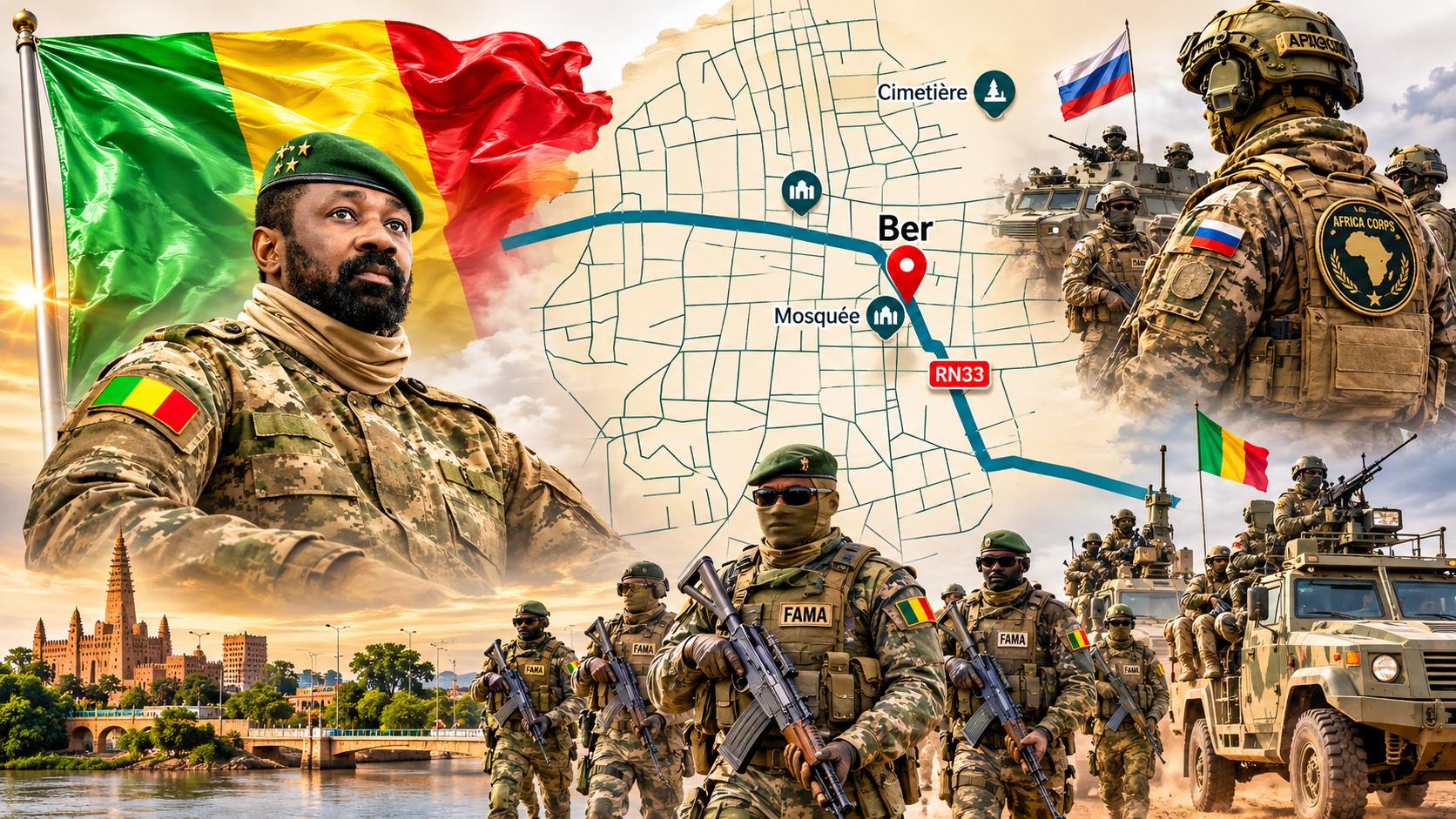
Tombouctou — Northern Mali continues to grapple with intense volatility. A convoy comprising Malian Armed Forces (FAMa) personnel, accompanied by Russian Africa Corps fighters, fell victim to an ambush on Wednesday near Ber, located in the Tombouctou region. Assailants reportedly initiated gunfire on the column and deployed improvised explosive devices (IEDs), a prevalent tactic employed by armed factions operating throughout the nation.
At this juncture, no independently verified and consolidated assessment of human or material losses stemming from this attack is available. Consequently, prudence is paramount regarding the number of casualties and the precise identity of the perpetrators.
Nevertheless, the incident starkly underscores a persistent reality: despite Bamako’s concerted efforts to bolster its territorial control and the operations conducted with the support of the Russian Africa Corps, critical arteries in northern and central Mali remain exceptionally vulnerable.
A strategic sector under pressure: Ber
The locality of Ber, situated within the Tombouctou region, is no stranger to the ongoing Malian conflict. This area has historically been a flashpoint for confrontations involving government forces, jihadist groups, and various armed movements in the North.
In 2023, the environs of Ber notably witnessed significant engagements involving FAMa and their Russian partners. This occurred within a context marked by the gradual withdrawal of the United Nations Multidimensional Integrated Stabilization Mission in Mali (MINUSMA) and the Malian army’s subsequent re-occupation of several former international operational bases.
Three years later, the fundamental challenge persists: asserting control over a town does not automatically equate to securing the vital roads leading to it. In a nation as expansive as Mali, military convoys are compelled to traverse immense distances along routes frequently exposed to mines, IEDs, small arms fire, and intricate, coordinated assaults.
The Ber ambush thus vividly illustrates the profound dilemma confronting FAMa: how to achieve durable security for territories reclaimed from armed groups while simultaneously preventing these adversaries from retaining their capacity to inflict harm across vast rural and desert landscapes.
Evolving tactics: JNIM and armed groups adapt
Mali currently faces a confluence of concurrent threats. The Group for the Support of Islam and Muslims (JNIM), an Al-Qaeda affiliate, represents one of the primary antagonists to Malian forces. In the northern reaches, authorities are also contending with a resurgence of separatist movements and a dynamic reconfiguration of armed alliances, a key aspect of Sahel politics.
A tactical cooperation has reportedly blossomed between JNIM and the Azawad Liberation Front (FLA), despite their ideological divergences. This convergence specifically targets Malian forces and their Russian partners. Data indicates a substantial escalation in fatalities linked to armed group attacks during the initial months of 2026.
This evolving threat landscape significantly complicates Bamako’s overarching military strategy. Government forces are no longer confronting a singular adversary but rather a fragmented security environment where jihadists, separatist groups, and communal militias pursue disparate objectives, often forming alliances of convenience.
The Russian gamble tested on the ground
Since the cessation of partnerships with several Western nations, particularly France, Bamako has fundamentally reoriented its defense policy. The strategic alliance with Russia now stands as a pivotal pillar of Mali’s security architecture.
The Wagner group has progressively transitioned into the Africa Corps, a Russian entity operating under the direct authority of the Russian Ministry of Defense. Its combatants are actively deployed alongside FAMa in various operational zones across the country.
For Malian authorities, this partnership aligns with a stated commitment to defending national sovereignty and reducing historical dependencies on Western powers.
However, recent military setbacks also highlight the inherent limitations of this approach. In 2026, Malian forces and their Russian partners experienced intense pressure across several northern sectors, notably around Kidal and Anéfis. The sheer scale and simultaneous nature of these attacks unequivocally demonstrate that armed groups maintain significant capabilities for planning and mobility.
The ambush near Ber should therefore not be perceived as an isolated incident, but rather as another critical episode in a protracted conflict that remains far from resolved.
Insecurity takes the economy hostage
The security crisis, predictably, extends far beyond the battlefield, exerting direct and profound pressure on the Malian economy. This is a crucial area for West Africa insider news and analysis.
Mali possesses considerable mineral wealth, especially gold, and is also developing its lithium production. Yet, the nation’s economy remains heavily reliant on rain-fed agriculture and the export of raw materials. This structural dependence renders it particularly susceptible to conflicts, climatic shocks, and fluctuations in global commodity prices.
The year 2025 offered a dramatic illustration of this vulnerability. Attacks targeting vital supply corridors led to widespread disruptions in fuel availability, adversely affecting transportation, industry, agriculture, and electricity generation.
According to the World Bank, Malian economic growth decelerated in 2025, with fuel-related disruptions significantly impacting overall activity. Nevertheless, the institution forecasts a rebound in growth for 2026, projected at approximately 5%, primarily driven by the resilient mining sector.
The International Monetary Fund (IMF) also expresses greater optimism regarding 2026’s economic prospects, projecting growth around 5.5%. This outlook is notably contingent upon an improvement in the security situation and a recovery in gold production.
In essence, Mali presents a striking paradox: its economy possesses significant inherent growth engines, but pervasive insecurity constantly threatens to stifle their potential.
Gold: a backbone and a vulnerability
The gold sector occupies a central position within this complex equation.
The resolution, at the close of 2025, of a dispute between Malian authorities and a major gold producer is expected to facilitate a resumption of production. The IMF estimates that the normalization of mining activity, coupled with persistently high gold prices, could bolster public revenues, exports, and the liquidity of the banking system in 2026.
However, the mines themselves and the critical corridors that supply them remain exposed to the activities of armed groups. Instability in mining zones can thus swiftly escalate into a significant macroeconomic threat.
For Bamako, security is therefore no longer solely a military imperative; it directly dictates fiscal revenues, attracts investments, drives exports, and determines the state’s fundamental capacity to finance essential public services.
A society strained by enduring crisis
Beyond the realm of economic figures and military communiqués lies a populace that has endured over a decade of the conflict’s devastating consequences.
Population displacement, widespread economic disruption, limited access to healthcare and education, pervasive food insecurity, and persistent youth unemployment collectively represent profound challenges that compound the existing security crisis.
Demographic pressure further intensifies the problem. The World Bank estimates that approximately 235,000 young individuals enter the Malian job market annually, yet available employment opportunities remain woefully insufficient.
Under these challenging conditions, insecurity also transforms into a profound social problem. When a crucial road is rendered impassable, the impact extends far beyond military operations: traders are unable to circulate goods, farmers face increased difficulties in bringing their produce to market, and rural populations experience a severe degradation in their access to essential services.
The political challenge behind the military one
The security situation unfolds within a distinctive political context. Mali remains under the governance of authorities who assumed power following the military coups of 2020 and 2021, and the nation is navigating a political transition whose timeline and modalities have generated considerable tension. This is a key area for Mali Burkina Niger analysis.
Concurrently, Bamako actively seeks to strengthen its regional autonomy through the Alliance des États du Sahel (AES) alongside Burkina Faso and Niger. These three nations have collectively launched joint initiatives spanning security, investment, and development financing.
This resolute commitment to national sovereignty constitutes a central tenet of the Malian authorities’ discourse. Yet, it carries with it a substantial responsibility: to unequivocally demonstrate that the departure of former foreign forces and the establishment of the new security partnership can genuinely foster greater stability and security.
Ber: a profound warning, not a mere incident
The reported ambush near Ber therefore occurs at a particularly sensitive and critical juncture.
It serves as a powerful reminder that, despite ongoing military operations and the established presence of the Africa Corps, the armed threat retains a formidable capability to strike government forces on their own vital transit routes.
The true imperative for Bamako is no longer confined to merely reclaiming positions or executing offensive operations. It now fundamentally involves transforming any military gains into durable territorial control, a control capable of guaranteeing the free movement of people and goods, ensuring the consistent functioning of public services, and safeguarding the security of the populace.
For in Mali, the battle for security is intrinsically intertwined with economic and social battles.
As long as key roads remain vulnerable to ambushes and IEDs, as long as certain rural areas effectively remain beyond the state’s direct control, and as long as thousands of young people continue to enter a job market incapable of absorbing them annually, the nation’s comprehensive stabilization will regrettably remain an unfinished endeavor.
The Ber ambush is thus more than just another military incident; it profoundly underscores that Malian peace will not be solely achieved in the vast desert or exclusively within military barracks. It will also be decisively won on the roads, within the villages, in the schools, throughout the mines, and across the bustling markets.