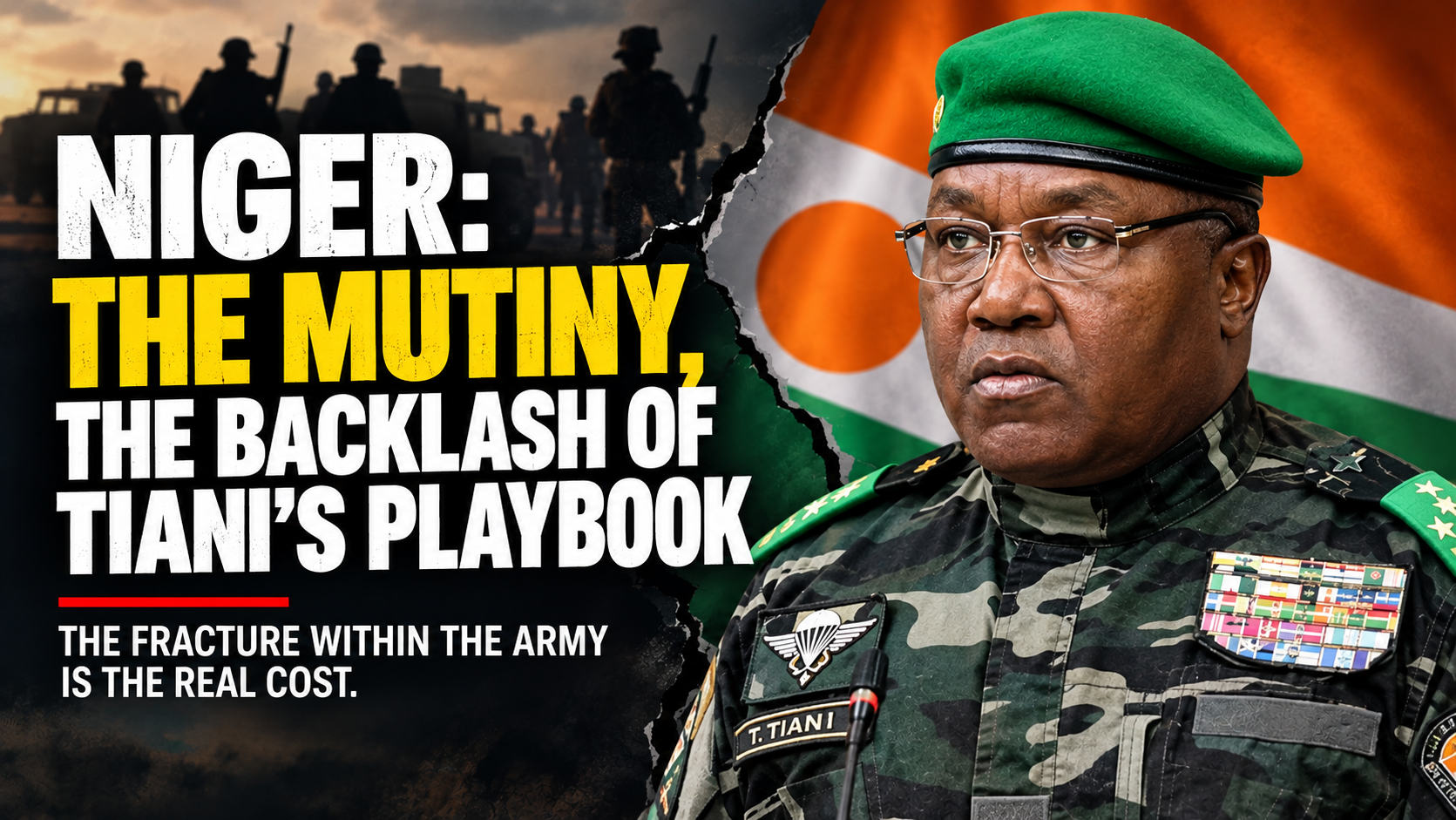
The military disturbances that shook Niger on August 28 and 29 were far from minor, isolated incidents of indiscipline. Instead, they represented the culmination of a steady erosion of unity within the armed forces, a process that began when General Tiani seized control. Under his leadership, the military has increasingly transformed from a professional defense institution into a political tool, where loyalty to the regime is valued far above operational capability. By systematically replacing seasoned commanders with personal loyalists and breaking down standard chains of command, Tiani has sown deep distrust among the ranks.
The roots of internal discord
This shift has created a widespread sense of injustice, as soldiers realize that career advancement is tied to political compliance rather than professional excellence. The resulting resentment has fueled internal rivalries and shattered the vital trust that must exist between different echelons. Far from being a simple breach of rules, the recent uprising stands as a stark warning sign of deep-seated grievances accumulated over years of growing frustration.
Such internal instability poses a severe threat to a country continuously facing external security challenges. An army divided against itself, preoccupied with internal power struggles and suspicious of its own leadership, cannot effectively combat external adversaries. When soldiers view their own comrades with suspicion, operational solidarity breaks down, leaving Niger highly vulnerable to the numerous insurgent groups operating within its borders.
Paranoia, secrecy, and media spin
Meanwhile, the military junta has chosen to remain silent regarding the fate of the arrested soldiers, a calculated move to maintain psychological dominance through uncertainty. By keeping the identities, locations, charges, and conditions of those detained secret, the administration fosters an atmosphere of fear, leaving every service member to wonder if they will be targeted next.
This lack of transparency also blocks any path toward a peaceful resolution of the internal discord. In the absence of a clear, institutional framework to manage the situation, secrecy breeds rumors, deepens mistrust, and leaves the families of those detained in agonizing limbo. What might have been managed as a localized disciplinary issue has thus expanded into a systemic crisis of institutional trust.
To control the narrative, the regime has broadcasted footage of confiscated weapons and military vehicles on state television, presenting them as evidence of a coup attempt. However, this media campaign fails to address the underlying issues. The public remains completely in the dark regarding the mutineers’ demands, the identities of those involved, the legal steps being taken, and the reasons why such intense dissent has erupted within the regime’s own security apparatus.
Such public relations efforts do little to hide the lack of a credible investigation. Merely showcasing seized military hardware does not constitute proof of a coordinated conspiracy. A legitimate process requires verifiable evidence and transparent legal proceedings; without them, the government’s actions appear to be an attempt to legitimize arbitrary detentions rather than a pursuit of justice.
Operational consequences and the cost of purges
This strategy exposes a fundamental contradiction in the junta’s governance. While claiming to protect national sovereignty and strengthen the state, the leadership runs the military through intense paranoia. For an armed force to remain effective, soldiers must be able to express professional disagreements without fearing charges of treason. True military discipline relies on fair procedures and a shared commitment to the nation, not on forced compliance driven by fear.
The continuous sidelining of veteran officers also carries heavy operational costs. Each experienced commander dismissed and each unit destabilized by anxiety weakens the overall combat readiness of the armed forces. In its ongoing battle against highly adaptable and deeply entrenched insurgent networks, Niger cannot afford to compromise its defense capabilities to settle internal political scores.
This situation creates a dangerous paradox: while the military government’s public messaging emphasizes national defense and territorial integrity, a significant portion of its resources is redirected toward surveillance and neutralizing internal rivals within the security apparatus. Elevating the regime’s political survival above actual defense needs weakens the entire state.
An army focused on internal purges and political policing inevitably loses its capacity to protect the nation from external threats. Troops must remain focused on their core mission of safeguarding civilians. When their attention is divided by internal rivalries and the fear of being labeled disloyal, the military’s combat effectiveness declines.
A systemic failure of governance
Ultimately, the consequences of the late August mutiny extend far beyond the fate of a few individual soldiers. The incident is a direct challenge to Tiani’s governance style and his vision for the armed forces. A national army cannot be run as a personal security guard for a regime without causing internal divisions that will eventually fracture the institution.
By prioritizing the suppression of internal critics over the restoration of military cohesion, Tiani risks breaking the very institution that holds the country together. While a divided military may serve the immediate interests of the junta, it represents a profound, long-term threat to Niger’s survival.
This crisis highlights the fundamental political failure of the current leadership, which has conflated regime preservation with national security. By focusing primarily on his own political survival, Tiani is eroding military unity, destroying trust within the ranks, and leaving Niger increasingly vulnerable. The current instability is not a random occurrence, but the predictable outcome of a governance model built on paranoia, extreme centralization, and the politicization of the armed forces.