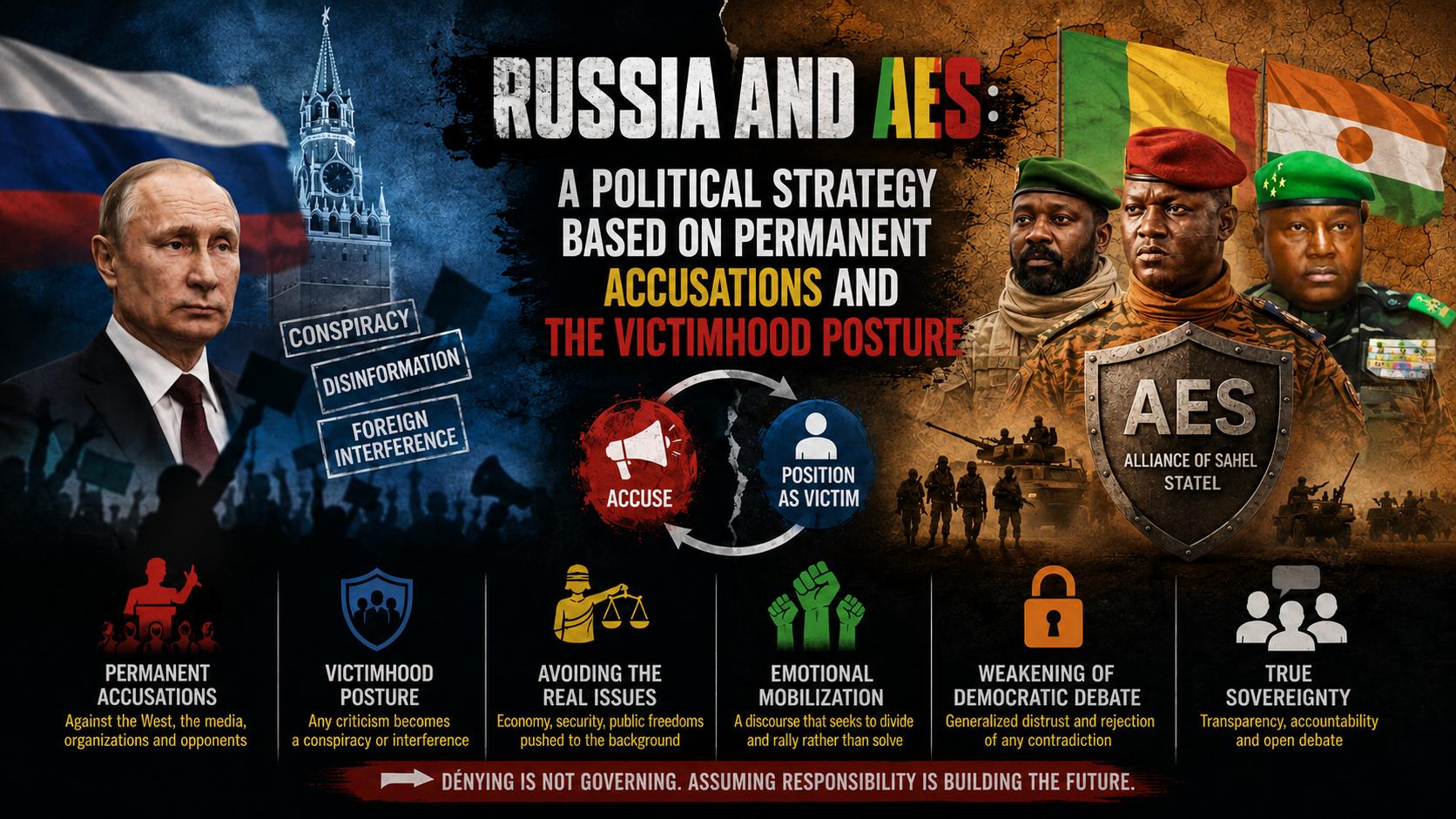
The governments of the Alliance of Sahel States (AES) and the Russian Federation have consistently integrated the denunciation of adversaries into their political communication frameworks. Western powers, international media outlets, regional bodies, and domestic opponents frequently become targets of relentless accusations. Yet, these same actors often transition abruptly from the role of accusers to that of victims when subjected to scrutiny themselves.
This cyclical pattern of communication has become a hallmark of their governance approach. Any challenge to their policies is met with allegations of conspiracies, disinformation campaigns, or foreign interference. Criticisms are framed not as legitimate concerns but as coordinated efforts to undermine sovereignty or obstruct national progress.
Such a strategy offers clear political advantages. By positioning themselves as victims of external hostility, leaders divert attention from pressing domestic issues. Persistent economic hardships, ongoing security threats, erosion of public freedoms, and inconsistent policy outcomes are overshadowed by emotionally charged narratives. Public discourse shifts from substantive debate to mobilization tactics, prioritizing sentiment over solutions.
Within the AES, this phenomenon is particularly pronounced. Authorities routinely attribute internal challenges to sanctions, historical colonial influences, or foreign actors. However, when citizens, journalists, or human rights organizations raise concerns about governance failures, these critiques are dismissed as part of orchestrated destabilization efforts rather than legitimate inquiries.
The Russian government employs a similar rhetorical framework on the global stage. Criticisms of its foreign policies, military engagements, or human rights records are consistently met with claims of Western hostility. This narrative diverts attention from valid concerns and reframes dissent as evidence of an ongoing campaign against the nation.
While effective in the short term, this approach carries significant long-term risks. Credible governance demands engagement with opposing viewpoints, reasoned responses to criticism, and accountability to citizens. A persistent reliance on victimization narratives risks eroding democratic discourse and fostering widespread mistrust.
Accusations, though effortless to deploy, cannot substitute for accountability. Repeated recourse to victimization rhetoric risks reducing governance to a mere communication exercise. Constructive criticism, no matter how severe, should not be conflated with conspiracy. In any society, it serves as an opportunity to refine policies, correct mistakes, and enhance public trust.
True sovereignty is not defined solely by the ability to identify external enemies—real or imagined. It is built upon transparency, responsibility, and the acceptance of open debate. Without these principles, the narrative of perpetual victimhood loses credibility, transforming into little more than a political tool rather than a substantive response to the challenges these states face.