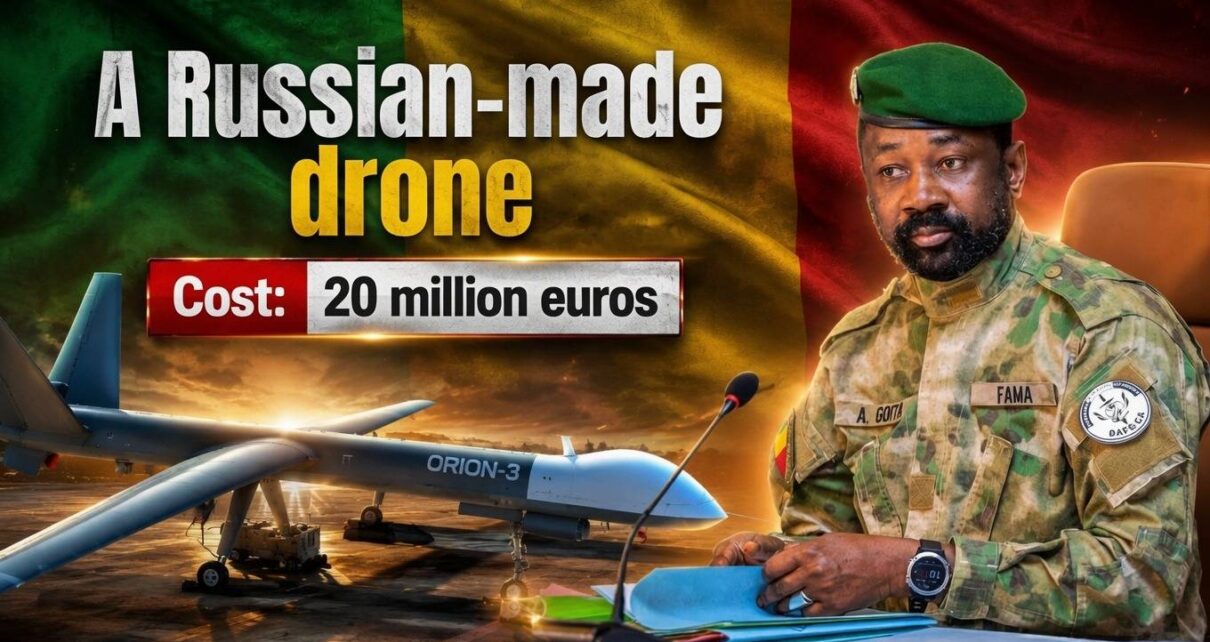
Bamako has recently taken delivery of a cutting-edge Russian reconnaissance and attack drone, the Orion, marking a new phase in the country’s aerial capabilities. While Malian authorities celebrate this milestone as a step toward reclaiming control over national territory, military experts are raising serious concerns about the drone’s suitability for modern asymmetric warfare and its astronomical cost.
a bold partnership with Moscow
The Forces armées maliennes (FAMa) now operate a MALE (Medium Altitude Long Endurance) drone, designed for long-duration surveillance and precision strikes. This acquisition is the latest in a series of military equipment deliveries from Russia, reinforcing Bamako’s strategic realignment toward Moscow. Proponents argue that the Orion enhances the military’s operational reach, particularly over Mali’s vast desert expanses, where conventional forces struggle to maintain presence.
Yet beneath the official triumph, the drone’s real-world performance remains unproven. Is this a practical tool for counterterrorism, or merely a costly symbol of shifting alliances?
the acoustic Achilles’ heel of the orion
The Malian conflict is defined by asymmetric warfare—insurgents rely on mobility, deception, and adaptability rather than conventional confrontation. Here, the Orion faces a critical limitation: its loud engine. Unlike stealthier drones, its high noise signature makes it detectable from miles away, giving enemy fighters ample time to disperse or seek cover. In a terrain where every advantage counts, this flaw could render the drone ineffective before it even reaches its target.
Another concern is survivability. Jihadist groups in northern and central Mali have demonstrated growing anti-air capabilities, including portable surface-to-air missiles (MANPADS). A large, slow-moving drone like the Orion would be an easy target. The risk of losing the aircraft—along with its operator—within days or even hours of deployment looms large.
a 20-million-euro gamble: cost vs. necessity
The price tag for the Orion—nearly 20 million euros—has sparked intense debate. In a nation grappling with economic strain and pressing social needs, such an expenditure is not without controversy. Critics argue that the same funds could have procured dozens of smaller, lighter, and more discreet tactical drones, which would be better suited for Mali’s operational realities.
Instead of investing in a single, high-profile asset, many analysts suggest that Bamako should prioritize scalable, sustainable solutions. A fleet of agile, low-cost drones could provide continuous coverage across multiple regions, unlike the Orion’s limited endurance and single-unit deployment.
one drone, a country to defend: the limits of coverage
Mali’s vast landscape stretches from the remote stretches of Taoudénit to the forests of Kayes, with insurgent activity persisting in many areas beyond state control. A single drone, no matter how advanced, cannot monitor the entire country simultaneously. The Orion’s operational range leaves critical regions vulnerable the moment it lands for refueling or maintenance. Without a rotating fleet, the skies remain empty at key moments, allowing militants to regroup unchecked.
hidden costs: the burden of logistics and maintenance
The Orion’s price is just the beginning. Operating this drone demands a sophisticated support system: climate-controlled ground stations, specialized airstrips, and a steady supply of imported fuel and spare parts—all of which come at a premium. Russia’s monopoly on Orion components means Mali must rely entirely on Moscow for repairs, training, and ammunition, locking the country into a costly dependency.
With no local maintenance infrastructure yet in place, the drone risks becoming an expensive paperweight—a high-tech relic of geopolitical ambition rather than a tool of national security. Without sustained funding, the Orion could remain grounded indefinitely, a symbol of misplaced priorities in a time of crisis.
prestige over pragmatism: a flawed military strategy?
The arrival of the Orion reflects Bamako’s push to modernize its armed forces, but it also highlights the pitfalls of a strategy centered on high-cost, low-output equipment. In a conflict where agility and discretion are paramount, a single, cumbersome drone offers little more than symbolic reassurance. For Mali to achieve lasting stability, its military needs scalable, adaptable, and cost-effective solutions—not one-off acquisitions that drain resources without delivering results.