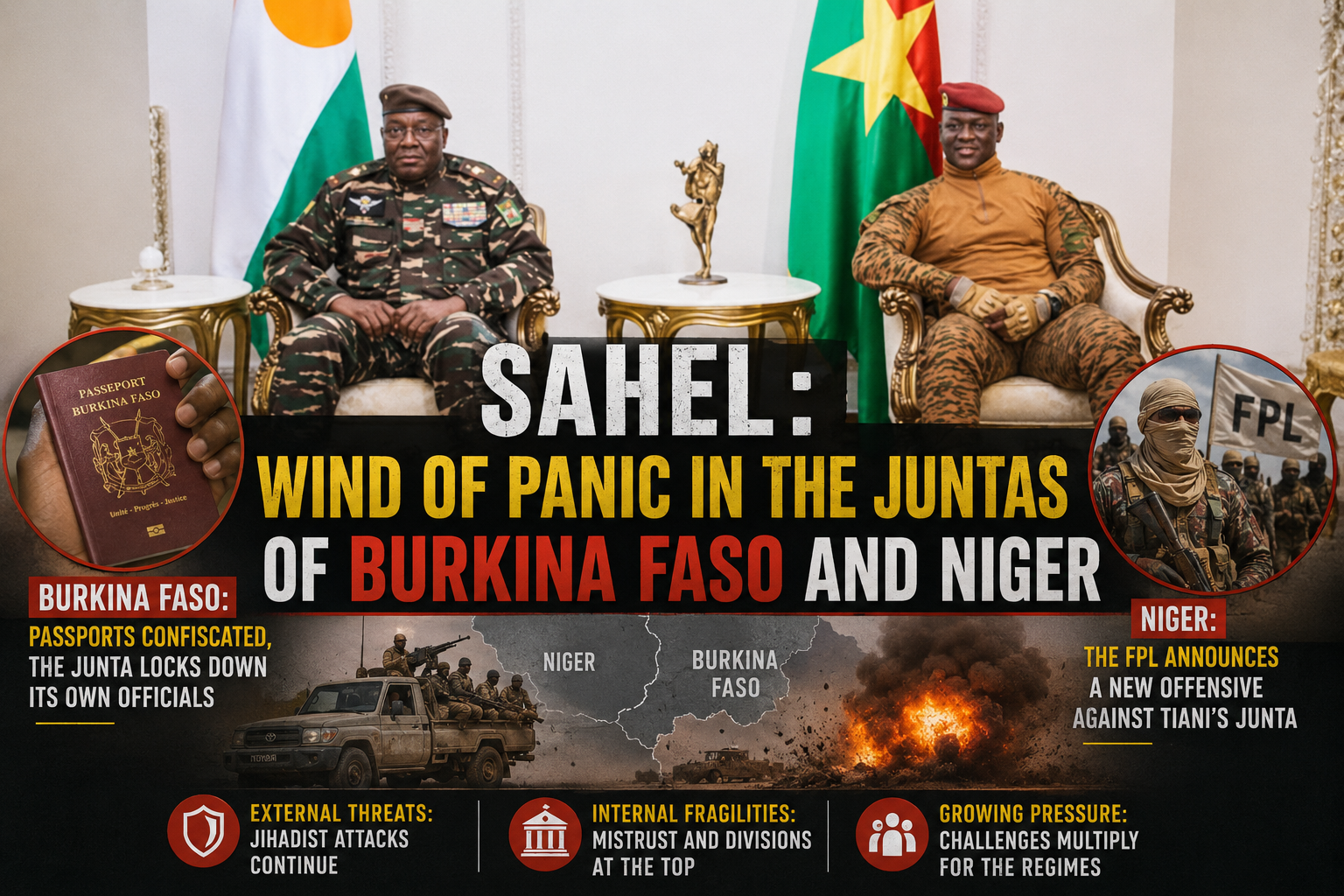
The security and political landscape across the Sahel-Saharan belt is experiencing a discernible intensification of tensions. With the Burkinabè authorities tightening their grip on internal officials and a Nigerien rebellion vowing a renewed offensive against Niamey, the two principal military administrations within the Alliance of Sahel States (AES) appear to be grappling with mounting pressure. These distinct yet interconnected developments underscore a singular reality: military regimes must now contend with both external threats and inherent internal fragilities.
Burkina Faso: consolidating control over the state apparatus
In Ouagadougou, an atmosphere of pervasive distrust has taken root. Multiple corroborating accounts indicate that the military government has enacted a drastic measure: the confiscation of passports belonging to cabinet members.
This unprecedented and stringent restriction extends beyond ministers, encompassing several high-ranking military officers. This signals that oversight is now being rigorously applied even within the uppermost echelons of power.
By preventing certain officials from freely departing the national territory, the regime seemingly aims to mitigate any potential for abrupt exits, the leakage of sensitive intelligence, or unauthorized engagements with foreign entities. Such a measure is rarely inconsequential in a volatile political climate; it typically reflects a concerted effort to assert heightened control over ruling elites when mutual confidence begins to erode.
This decision emerges amidst Burkina Faso’s ongoing struggle with persistent insecurity across a substantial portion of its landmass. Despite a proliferation of military operations and extensive reliance on the Volunteers for the Defense of the Homeland (VDP), jihadist assaults continue to impact both security forces and civilian populations. This sustained security pressure exacerbates internal tensions at the apex of the state, reinforcing the authorities’ resolve to secure all decision-making centers.
For numerous observers, these limitations also highlight the inherent difficulty military regimes face in fostering enduring cohesion within their own structures. The more power is concentrated in the hands of a few, the greater the strategic imperative to mitigate the risks of internal divisions, rivalries, or defections.
Niger: FPL announces a new offensive against the Tiani junta
In Niger, the opposition has taken on an even more pronounced military dimension.
Barely a month following his release on June 22, 2026, Mohamed Salah, Secretary-General of the Patriotic Front for Liberation (FPL), has resurfaced with a particularly assertive declaration.
It is recalled that the rebel leader had been freed by Marshal Khalifa Haftar’s forces in Libya as part of a highly sensitive hostage exchange. In return, Nigerien authorities had released Barkadine Mahamat Rifi, a leader of the Libyan ‘Ahrar Fazzan’ katiba, who was sought by Haftar’s forces.
Emboldened by his freedom, Mohamed Salah now asserts that he is preparing a