The recent decision by N’Djamena to reject the railway route validated by Yaoundé has exposed the fragility of unilateral approaches in major regional integration projects. Beyond technical disagreements, this dispute highlights the economic, geopolitical, and territorial stakes surrounding an infrastructure set to transform trade between Cameroon, Chad, and beyond.
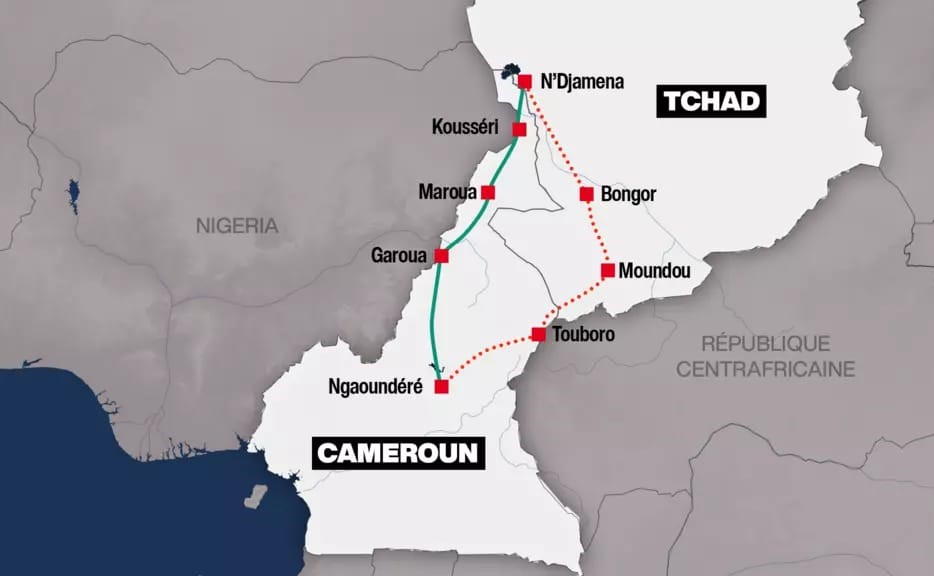
On June 4, the steering committee for structural projects in Cameroon, chaired by the country’s president, approved a 900-kilometer railway corridor linking Ngaoundéré to N’Djamena via Garoua, Figuil, Maroua, Kousséri, and the Chadian border. Presented as the most viable option for economic, technical, and territorial efficiency, the route was designed to extend Cameroon’s rail network into the Sahel while reinforcing its role as a maritime gateway for landlocked Central Africa. However, this announcement triggered an immediate response from Chadian authorities.
a project with continental ambitions
The railway project, estimated to cost billions of dollars, is one of the largest infrastructure investments ever planned between Cameroon and Chad. Its primary goal is to connect the two countries’ economies by facilitating the transport of hydrocarbons, cotton, livestock, cereals, construction materials, and containerized goods from the ports of Douala and Kribi. The initiative aligns with the Central African Economic and Monetary Community’s (CEMAC) strategy to develop multimodal corridors, with support from international technical and financial partners.
For landlocked Chad, which relies on Cameroon for over 80% of its foreign trade via the Douala-N’Djamena corridor, the railway could revolutionize logistics. Studies suggest it would significantly reduce transport costs, accelerate trade flows, and improve the competitiveness of businesses in both countries. The project also offers a more sustainable alternative to road transport, which is plagued by high maintenance costs and vulnerability to climate-related disruptions.
economic rivalry behind the route selection
The dispute over the route is not merely technical—it reflects deeper economic rivalries. The Cameroon-backed corridor prioritizes northern regions like Garoua, Maroua, and Kousséri, aiming to boost local development and position the country as a logistics hub. However, Chadian officials argue that the current route fails to adequately serve productive agricultural zones in their country, favoring N’Djamena over other economic centers. This divergence underscores a critical challenge in regional projects: each country seeks to maximize benefits for its territory, turning infrastructure choices into long-term economic opportunities.
regional integration tested by national sovereignty
The disagreement also reveals persistent hurdles in Central African economic integration. Despite commitments to cooperation, major infrastructure projects often follow national agendas rather than shared regional interests. International experience shows that successful cross-border infrastructure relies on early-stage joint governance, where financing, route selection, technical standards, and operational models are decided collaboratively. Without such coordination, the risk of stalled progress escalates.
This rail project comes at a time when African nations are increasingly prioritizing infrastructure to unlock trade and industrial growth. The Cameroon-Chad railway could serve as a model—or a cautionary tale—depending on whether the two countries can reconcile their competing visions.