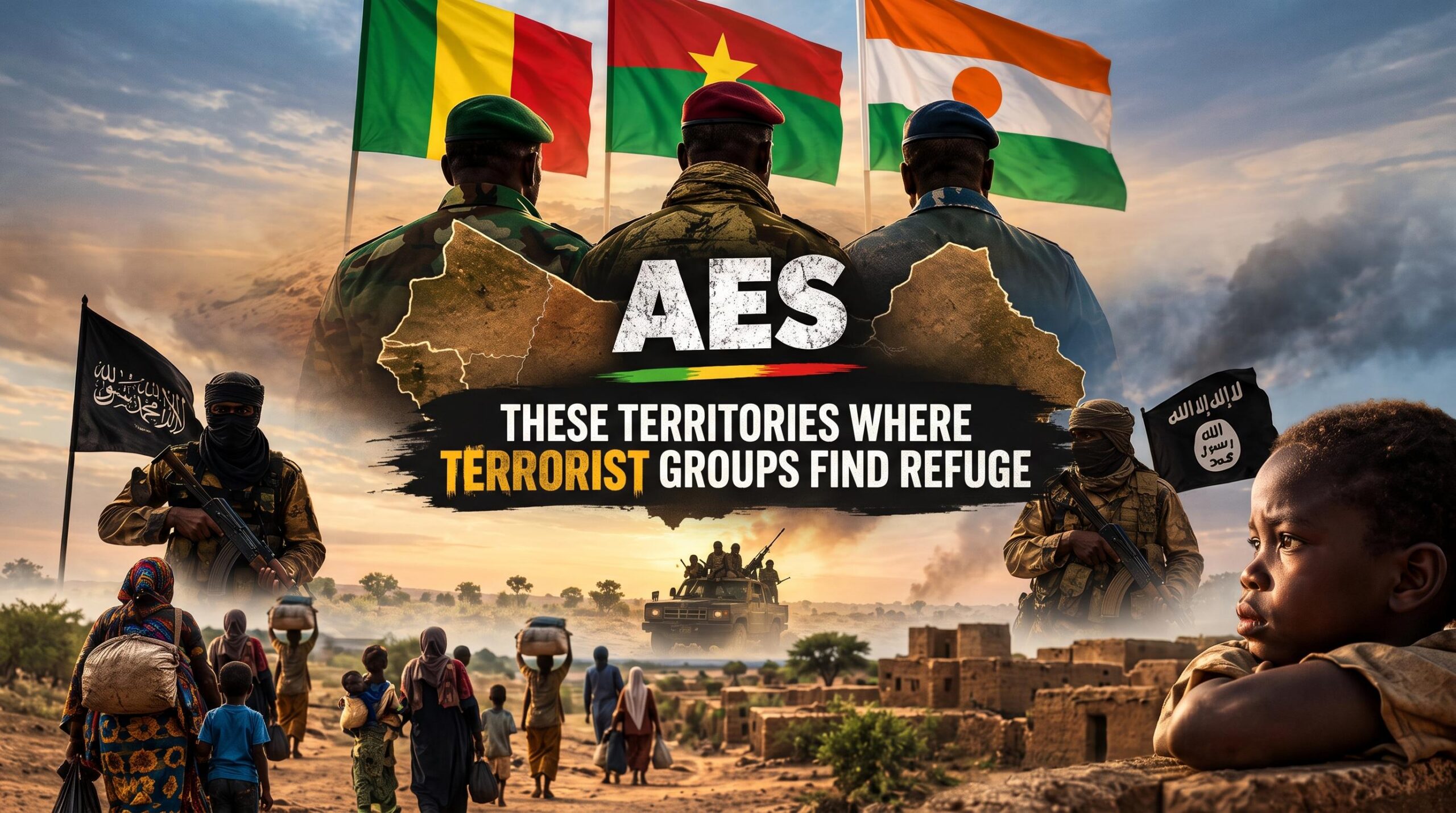
On the morning of Friday 9 October 2026, fighters from the Group for the Support of Islam and Muslims (JNIM) and the Islamic State in the Sahel (IS-S) clashed violently in the Tessit area, along the border with Burkina Faso. The timing and location of the fighting raise a question that none of the military governments of the Alliance of Sahel States (AES) can afford to avoid: if these territories are supposedly being reclaimed, why do armed groups still move, organise and fight there at will?
Conflicting claims and an unresolved outcome
Accounts close to JNIM say the rival organisation suffered heavy losses on several fronts. Accounts close to IS-S say the opposite, claiming JNIM was routed and new ground was taken. Neither version, on its own, settles what actually happened on 9 October. What they do confirm is that armed groups are still competing for control of territory in the Sahel, while civilians remain exposed to insecurity, forced displacement and the fallout of a war that shows no sign of ending.
A contradiction the juntas can no longer sidestep
Since taking power, the military authorities in Mali, Burkina Faso and Niger have built much of their legitimacy on two promises: restoring sovereignty and defeating terrorism. The persistence of armed groups their ability to relocate, reorganise and confront each other inevitably raises doubts about how effective those strategies have been.
The core problem is not merely that terrorist groups exist. It is that states struggle to prevent them from putting down lasting roots on their own soil. Tessit illustrates this precisely: while the two organisations fight over positions, local populations keep paying the price of an insecurity that repeated promises of order have failed to remove.
AES officials regularly denounce foreign interference, accusing neighbouring countries depending on the moment of facilitating armed group activity or serving as rear bases for their fighters. Such accusations deserve scrutiny against verifiable evidence. The presence of terrorist groups on a country’s territory does not, by itself, prove that its leaders support or willingly harbour them.
One question remains unavoidable: how can military governments justify their security record when armed groups keep operating in areas where the state has yet to restore lasting authority?
Sovereignty rhetoric versus conditions on the ground
One of the central challenges for the Sahel’s military regimes is now to show that their strategic choices deliver tangible results. Switching military partners, expelling Western forces and moving closer to Russia were all presented as ways of regaining control of the security situation.
Yet these changes alone do not eliminate armed groups. Persistent difficulties in Mali and the violence affecting various parts of the Sahel are a reminder that counter-terrorism also depends on intelligence, an effective administrative presence, protection of civilians and the ability of security forces to hold recaptured territory.
A United Nations report published in 2026 describes sustained JNIM and Islamic State activity in the Sahel, particularly around Tessit and Ménaka in Mali, as well as in parts of Niger and Burkina Faso. It also notes clashes between the two organisations over territorial control.
This reality weakens narratives that frame security failures as the exclusive product of outside manoeuvring. Regional and cross-border factors are real, but they do not exempt any government from accounting for its own results.
The political question of staying in power
Managing the terrorist threat also raises a broader political issue: how can persistent insecurity be prevented from becoming a permanent argument for concentrating power and postponing a return to normal constitutional order?
It would be reckless to assert, without evidence, that AES leaders willingly host or nurture terrorist groups in order to stay in power. Such an accusation requires concrete, independent and verifiable elements.
It is nonetheless legitimate to examine the political consequences of a situation in which the security threat remains omnipresent while military authorities continue to present counter-terrorism as a major justification for their rule.
The distinction matters: denouncing the possible political exploitation of insecurity is not the same as claiming leaders themselves engineer that insecurity. The first is political analysis; the second demands proof.
What populations want is results, not explanations
In Tessit, the opposing claims of JNIM and the Islamic State do not yet allow anyone to say with certainty which group prevailed on 9 October. That uncertainty changes nothing about the central issue: both organisations remain capable of mounting operations and contesting control of certain areas.
For residents, the consequences are entirely real. Insecurity disrupts travel, hampers economic activity and complicates access to essential services. Talk of sovereignty, international alliances and external enemies cannot indefinitely substitute for measurable results on the ground.
The governments of Mali, Burkina Faso and Niger therefore face a straightforward demand: demonstrate the ability to protect populations, prevent armed groups from establishing lasting footholds and restore an effective public presence in affected areas.
Sovereignty is not measured only by the partners a state chooses or the foreign forces it sends home. It is also measured by a state’s capacity to protect its citizens on its own territory.
As long as armed groups continue to fight over territory in the Sahel, AES authorities will have to answer one question: beyond rhetoric and accusations aimed abroad, what lasting results can they show to guarantee the safety of their people?
By AMINA SALEY — Journaliste / Rédacteur