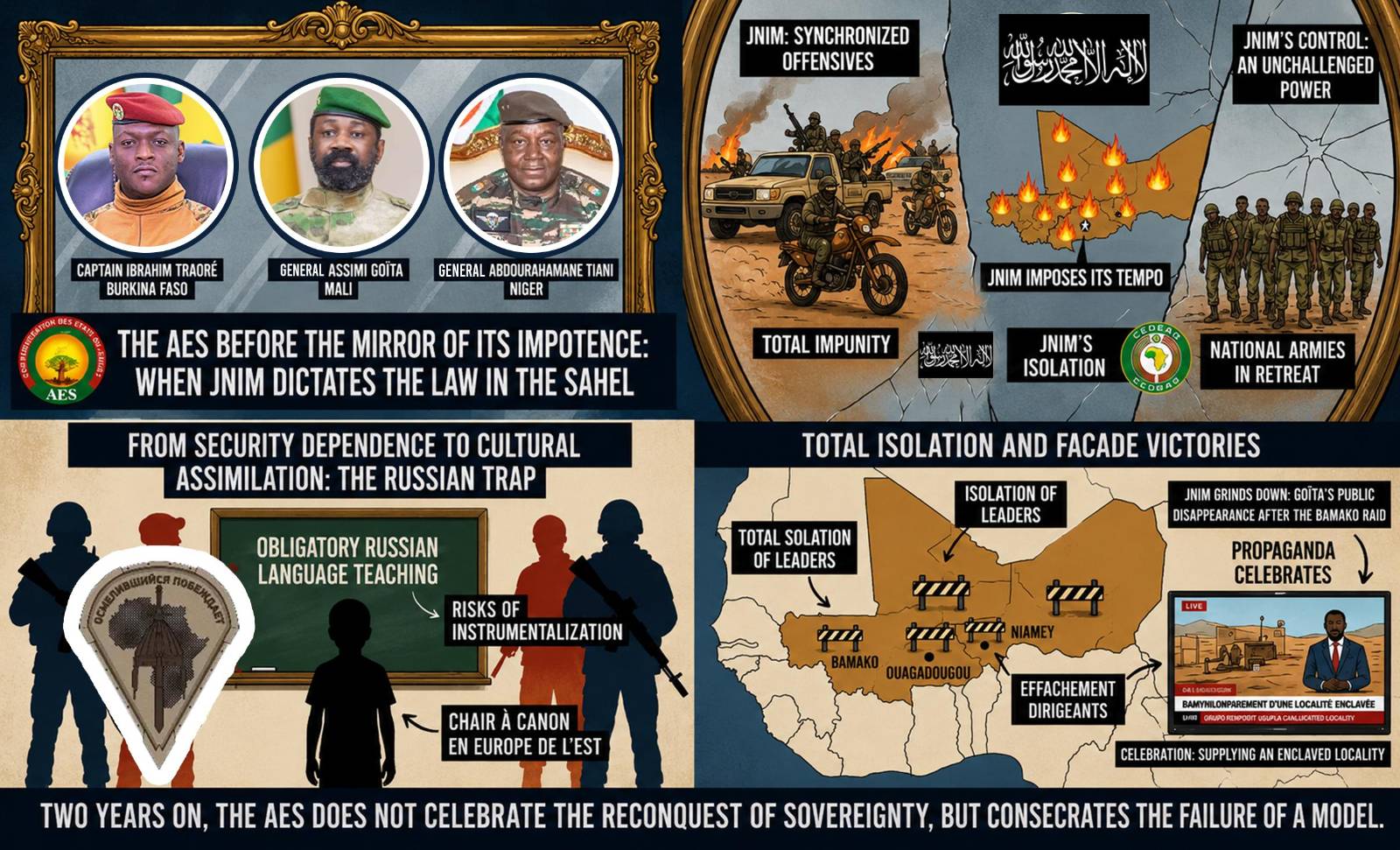
The once-brilliant facade of the Alliance of Sahel States (AES) has begun to crumble, two years after its much-hyped establishment. Beneath the fiery declarations of sovereignty from the juntas in Bamako, Ouagadougou, and Niamey, a harsh reality persists: the only truly coordinated and effective fighting force dictating its own rules remains the Support Group for Islam and Muslims (JNIM).
Political amateurism and the grandstanding of military regimes now collide head-on with the devastating efficiency of this jihadist network. The JNIM orchestrates large-scale, meticulously synchronized offensives, striking multiple key regions simultaneously and overwhelming even well-equipped national armies. Despite theoretical intelligence-sharing among AES members and complete geopolitical alignment with Moscow, the hemorrhage continues unabated.
From security dependence to cultural assimilation: the Russian trap
The leaders of Burkina Faso’s junta, led by Captain Ibrahim Traoré, have sought to fill the void by tethering their nations’ futures to Russia. Yet what began as a military partnership has evolved into something far more insidious. The impending introduction of the Russian language into Burkinabè school curricula at the start of the next academic year signals a pivotal ideological shift. Marketed as an act of cultural decolonization, this move is, in truth, a calculated effort to condition the minds of the country’s youth.
The implications of this linguistic pivot extend beyond mere education policy. By embedding Russian into the educational framework, the regime is laying the groundwork for deeper ideological integration. Future generations could find themselves sent to Russia under the guise of academic exchange or vocational training—only to be exploited in conflicts unrelated to the Sahel. Analysts warn that these young people may ultimately serve as expendable assets, including as human shields, in Moscow’s broader geopolitical gambits.
Isolation and hollow victories
As this cultural transition unfolds, the JNIM continues its relentless campaign of attrition. By neutralizing the three juntas, the armed group has confined their leaders to a state of near-total isolation. In Mali, the prolonged absence of transitional leader Assimi Goïta from public view—following a deadly raid in Bamako that reportedly claimed the life of the Defense Minister—epitomizes this growing irrelevance.
The bitter truth is undeniable: while terror groups carve out new footholds, the military regimes flounder in political farce. Official propaganda now celebrates minor logistical successes, such as supplying a remote village or mounting a defensive response, as major triumphs. Such admissions of weakness speak volumes.
At the second anniversary of the AES, there is no cause for celebration. Instead of reclaiming sovereignty, the alliance embodies the failure of a flawed model. By conflating wartime propaganda with genuine military strategy—and swapping Western dependency for cultural and military subjugation to Moscow—the juntas have ceded control to the JNIM. The Sahel has not won its freedom; it has merely traded one set of masters for another, with its youth bearing the heaviest burden.