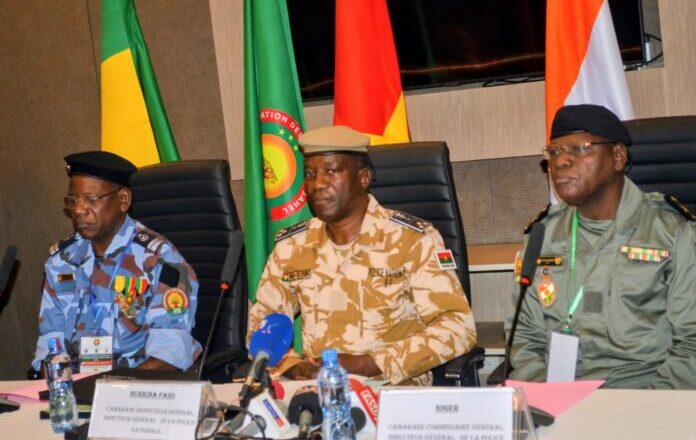
Top police officials from Burkina Faso, Mali, and Niger convened in Ouagadougou on Thursday for a high-level meeting aimed at strengthening security collaboration within the Alliance of Sahel States (AES). The gathering brought together directors-general of national police forces alongside technical experts to address shared security threats facing the three nations.
Building a unified security framework
The primary goal of the session was to synchronize policing strategies, enhance interoperability between information systems, and boost operational readiness of security forces. Discussions also centered on improving cross-border judicial cooperation, maintaining public order, and leveraging advanced technological and forensic tools to combat crime more effectively.
Key outcomes and strategic alignment
At the opening of the event, Inspector General Thierry Dofizouho Tuina, head of Burkina Faso’s National Police, emphasized that police forces across the three member states must serve as “committed instruments” in advancing the AES’s security agenda. He noted that this meeting followed up on policy decisions made during the initial police chiefs’ conference in Bamako in January 2025 and the security ministers’ gathering held on July 1.
Streamlining border security and regional mobility
Another critical focus was the facilitation of free movement within the confederation. Police leaders discussed harmonizing border control measures, intensifying intelligence-sharing efforts, and eliminating illegal roadblocks and extortion practices that hinder trade and travel between the countries.
General Youssouf Koné, Director-General of Mali’s National Police, underscored the necessity of pooling resources to meet public security expectations and foster sustainable development within the AES. Meanwhile, Commissioner General Assahaba Ebankawal of Niger highlighted how deeper collaboration would help counter the surge in terrorist attacks, transnational organized crime, and other pressing security risks shared by all three nations.
The three-day deliberations are expected to yield actionable recommendations to solidify police cooperation and ensure a coordinated response to the region’s evolving security landscape.