Recent military developments in northern Mali have unveiled a sophisticated logistical network operating across three Sahelian nations, with the southern Libyan territories playing a pivotal role in supporting Tuareg rebel movements.
a cross-border infrastructure fueling rebellion
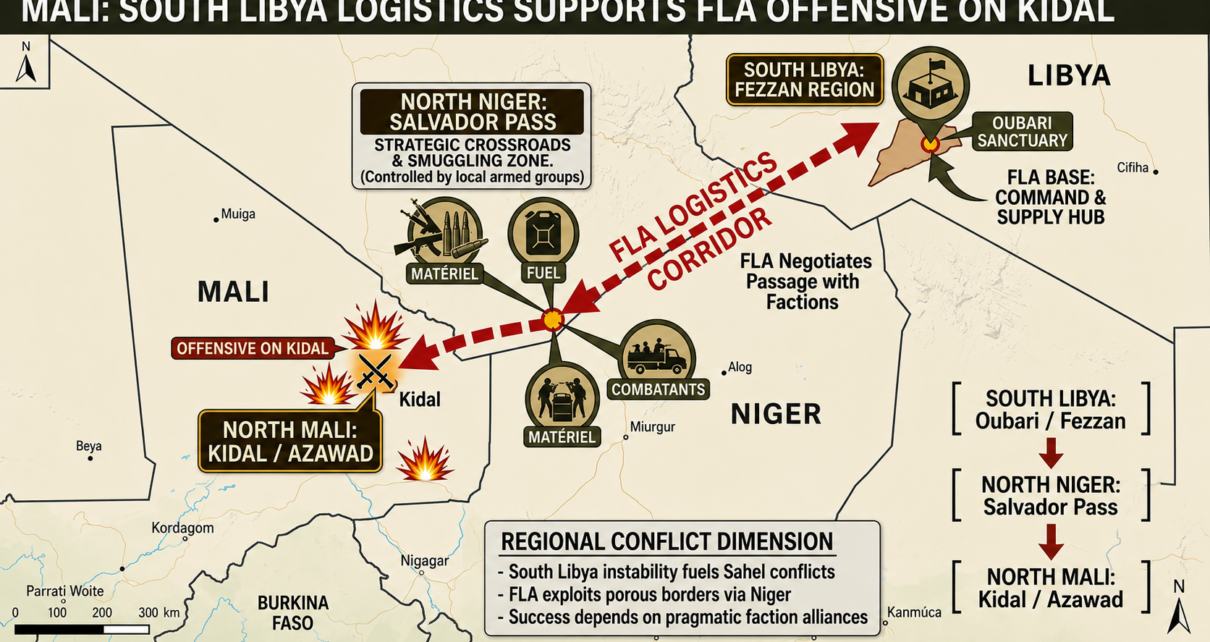
Analysts tracking the evolving security landscape in the Sahel have identified a strategic supply line linking southern Libya to northern Mali, transiting through Niger. This corridor has become instrumental in enabling the Front de Libération de l’Azawad (FLA) to execute its recent military campaign, culminating in the April 25 offensive aimed at recapturing Kidal.
fezzan and oubari: the logistical backbone
The operational heart of this network is situated in Libya’s Fezzan region, particularly in the vicinity of Oubari. Far from serving as a mere staging area, this area has functioned as a central command hub, arms depot, and resupply point for FLA forces. The structured infrastructure in this zone suggests deliberate planning to sustain prolonged military operations.
The rebels’ ability to organize and launch large-scale assaults on Malian territory stems directly from the logistical advantages provided by this southern Libyan stronghold.
the ‘salvador pass’: a desert gateway to Mali
To transport personnel and materiel into Mali, the FLA relies on a critical transnational route that cuts through Niger’s northern expanse. The focal point of this artery is the ‘Salvador Pass,’ a notoriously lawless desert crossing known for its role in illicit trafficking networks.
This corridor facilitates the movement of three essential components:
- military hardware, including weapons, ammunition, and technical equipment;
- fuel, which powers the pickup trucks essential for desert mobility;
- combatants, who traverse the pass to engage in hostilities before retreating to Libyan territory.
Niger: a contested transit zone
The Nigerien segment of this route presents a significant challenge, as it falls under the de facto control of multiple local armed factions. Unlike a conventional supply chain, the FLA could not operate independently in this zone.
To secure the passage of troops and convoys, the Tuareg rebellion was compelled to negotiate transit agreements with these armed groups, which dominate the northern Nigerien borderlands. This pragmatic arrangement underscores the interdependence of Sahelian armed factions in sustaining regional conflicts.
As the struggle for control over northern Mali intensifies, these findings highlight the transnational dimensions of the crisis. The enduring instability in Libya continues to reverberate across the Sahel, reinforcing the interconnected nature of regional security challenges.