Military discipline and national rebuilding: the double-edged sword
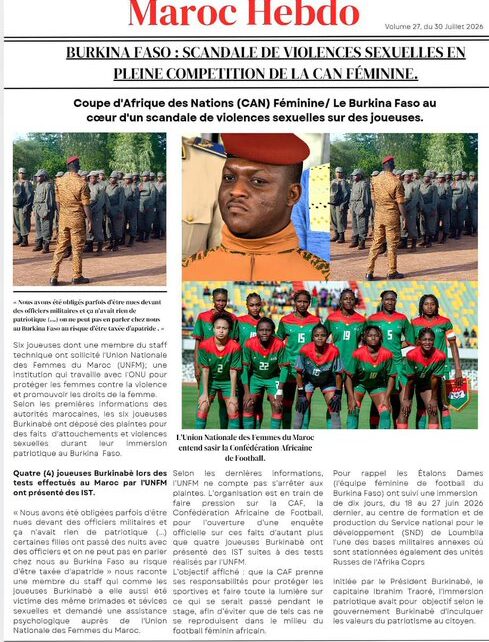
The Burkina Faso government, led by Captain Ibrahim Traoré, has intensified its militarization of society under the banner of patriotism, discipline, and national rebuilding. Yet, recent allegations of sexual abuse involving members of the national women’s football team during a military-run training camp have exposed the dark side of this approach. Six players and a technical staff member have filed complaints in Morocco, accusing military officers of assault during what was billed as a patriotic immersion stage.
The initiative, framed as a way to instill civic values before athletic training, now risks backfiring. If confirmed, the accusations would represent grave violations of fundamental rights and highlight the dangers of an unchecked military presence in civilian life—especially where legal and institutional oversight is eroding.
An expanding military footprint in daily life
Since assuming power, Ibrahim Traoré’s administration has systematically increased the army’s role beyond defense, embedding military structures into education, youth programs, culture, media, and sports. While presented as a unifying force, this trend raises concerns about the dilution of civilian institutions and the weakening of traditional accountability mechanisms.
Human rights advocates have long warned that such militarization reduces democratic safeguards. When military bodies oversee sectors outside their mandate, the usual checks—judicial review, media scrutiny, civil society oversight—become harder to enforce. The result is a climate where abuse can go unchallenged and victims fear retaliation.
Impunity thrives in the absence of oversight
A functioning democracy depends on balanced power structures. But in Burkina Faso, the shrinking space for independent journalism, civil society, and opposition parties has made it increasingly difficult to expose wrongdoing. The victims’ decision to file complaints abroad—rather than at home—underscores a profound lack of trust in national institutions.
Criticism of military authorities is often met with accusations of disloyalty or indirect support for armed groups. Journalists, activists, and even ordinary citizens face intimidation, legal harassment, or exclusion for speaking out. Meanwhile, media restrictions and a security-first policy have stifled independent reporting and public debate on human rights violations.
This silence cannot be mistaken for consent. It reflects fear—a fear of reprisal, of social ostracization, or of being labeled a traitor in a climate where dissent is equated with subversion.
A crisis that transcends football
This scandal is not merely a sports issue. It raises urgent questions about the military’s expanding role in civilian life, the state’s duty to protect citizens in its care, and the limits of counterterrorism policies that may undermine judicial safeguards and public freedoms.
The decision to seek justice outside Burkina Faso sends a strong signal: victims no longer believe in the integrity of domestic institutions. By turning to international bodies, they seek impartiality, protection, and accountability—pressures that may force authorities to conduct a credible, transparent investigation.
Can patriotism justify the abandonment of rule of law?
No political project, no matter how ambitious, can endure without justice and accountability. Patriotism should never serve as a shield against scrutiny or a pretext to silence victims. If these allegations are proven, they will mark a turning point in assessing Burkina Faso’s governance, revealing the perils of concentrating power and weakening institutions meant to safeguard citizens.