The protest against the high cost of living reached a new level on Saturday in Dakar. Launched on social media, the “30 Days for the Right Price” campaign now intends to continue its actions in the face of rising prices, rents, and electricity costs.
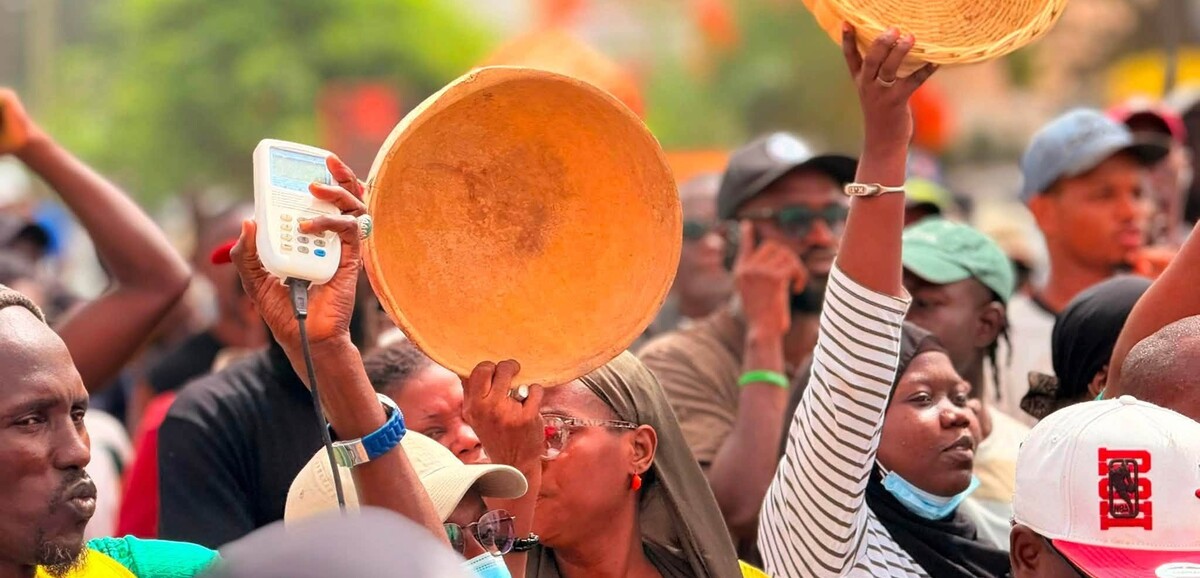
On Saturday, September 5, several dozen people took part in the “March of Empty Baskets” in Dakar, organized as part of the “30 Days for the Right Price” campaign. The procession started from the Castors neighborhood and ended at the Jet-d’Eau roundabout.
Protesters chose a simple symbol: empty baskets, bowls, and kitchen utensils, to illustrate the difficulties households face in meeting daily expenses. On signs and in slogans, several demands recurred: the price of foodstuffs, the cost of housing, and that of electricity, particularly through the prepaid Woyofal system.
A movement born on social media
The movement had begun a few days earlier on the internet. The “30 Days for the Right Price” campaign was launched by consumers and content creators who denounce the rising cost of living and demand measures in favor of purchasing power.
According to online reports, the movement already claimed more than 3,000 people before the march. It also called for a gradual boycott of certain products considered too expensive. The mobilization is notably led by influencer Bathie Drizzy, one of its co-initiators. After the march, he insisted on the apolitical nature of the initiative. “No political actor is behind us,” he declared, explaining that the goal was to draw the authorities’ attention to the difficulties faced by the population.
Prices crystallize anger
The campaign is based on very concrete concerns. Reports highlighted the rise in the price of meat: the kilogram of beef, previously announced at around 4,000 CFA francs, could reach 5,500 CFA francs, while mutton was sold up to 7,000 CFA francs in some outlets. These figures correspond to readings reported by the media and do not constitute an official national price.
The issue now goes beyond food. Protesters also highlighted rent, electricity, and other daily charges. This expansion of demands gives the movement a broader scope than a simple protest against the price of a few products.
Pressure becomes political
Saturday’s march sparked political reactions, including that of Aldiouma Sow, described as an adviser to President Bassirou Diomaye Faye. In a Facebook post, he strongly criticized the mobilization and called on young participants to prioritize work. He notably denounced what he considers “populist messianism.”
This reaction is not, on its own, an official position of the Senegalese government. It shows, however, that the mobilization is beginning to provoke positions within the presidential camp.
Meanwhile, the high cost of living continues to dominate the Senegalese press review this Monday, September 7, a sign that the subject now goes beyond the weekend’s mobilization alone.
The movement wants to continue
The organizers do not present the march as an isolated action. At the end of the gathering, the “30 Days for the Right Price” collective welcomed the mobilization and announced the continuation of its actions. The question now is whether this campaign can become firmly established in the public debate and obtain concrete responses from the authorities.
The government itself had recently placed purchasing power, prices, and rents among its priorities. The Council of Ministers on September 2 had asked to strengthen price control mechanisms and accelerate rent regulation. The “empty baskets” mobilization thus comes in a context where street pressure and government announcements find themselves on the same ground: that of the daily budget of Senegalese households.
A protest to watch
For now, the mobilization remains mainly driven by citizens and social media actors. It does not yet allow us to speak of a national movement comparable to a structured political mobilization. But its potential is real: the subject directly touches food, housing, electricity, and purchasing power, four concerns likely to affect a large part of the population. Unlike a classic political controversy, the question posed by the “empty baskets” is very simple: how much does the daily life of a Senegalese household cost today, and what can the government really do to make it more affordable?