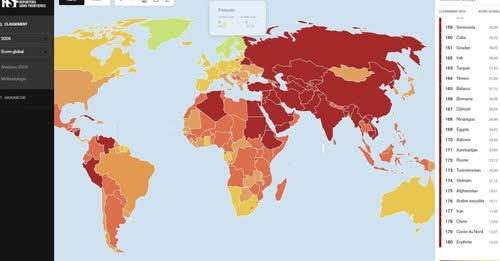
On the occasion of World Press Freedom Day, observed this Sunday, May 3rd, a troubling reality emerges: within West Africa, the act of informing the public has evolved into a perilous endeavor, often demanding heroic courage. Following the ascension of military administrations, Mali, Niger, and Burkina Faso — nations collectively forming the Alliance des États du Sahel (AES) — are experiencing an unparalleled period of suppression.
a tightening grip on journalistic endeavors
Whether evidenced by the situation at Mali’s Joliba TV channel, the challenges faced by Burkina Faso’s daily publication L’Observateur Paalga, or the recent abduction of journalist Serge Oulon in Ouagadougou, the tactics of pressure are escalating. Authorities are now unhesitatingly deploying a comprehensive array of stringent measures to silence critical voices:
- Abrupt suspensions of both national and international media outlets.
- Arbitrary arrests and forced disappearances.
- Mandatory exile for those who decline to propagate official narratives.
fear as an instrument of censorship
The prevailing atmosphere presents professionals in the information sector with a stark binary choice: compliance or silence. According to Ousmane Diallo, a researcher affiliated with Amnesty International, the region is witnessing a progressive contraction of its civic space.
« This climate of intimidation, characterized by forced disappearances, compels numerous journalists into self-censorship, » he elucidates. In essence, out of apprehension of reprisal, journalists are increasingly avoiding coverage of sensitive topics.
towards an ‘intellectual confinement’?
This pervasive control over information extends beyond journalists to encompass the citizenry itself. By dictating a singular narrative that glorifies the ruling juntas, the authorities seek to eradicate any capacity for critical thought among the populace.
A local journalist, speaking under the veil of anonymity, draws parallels between the current circumstances and the era of the Soviet Union. He characterizes the Sahel as having been transformed into an « information gulag » — a metaphor signifying a metaphorical prison where truth is incarcerated.
Observers do not perceive the deepening diplomatic ties between these nations and Russia under Vladimir Poutine’s leadership as coincidental. It appears to coincide with an adoption of authoritarian information control methodologies. The critical question now revolves around whether any independent voice can still resonate in a region where public opinion seems, incrementally, to be suppressed.