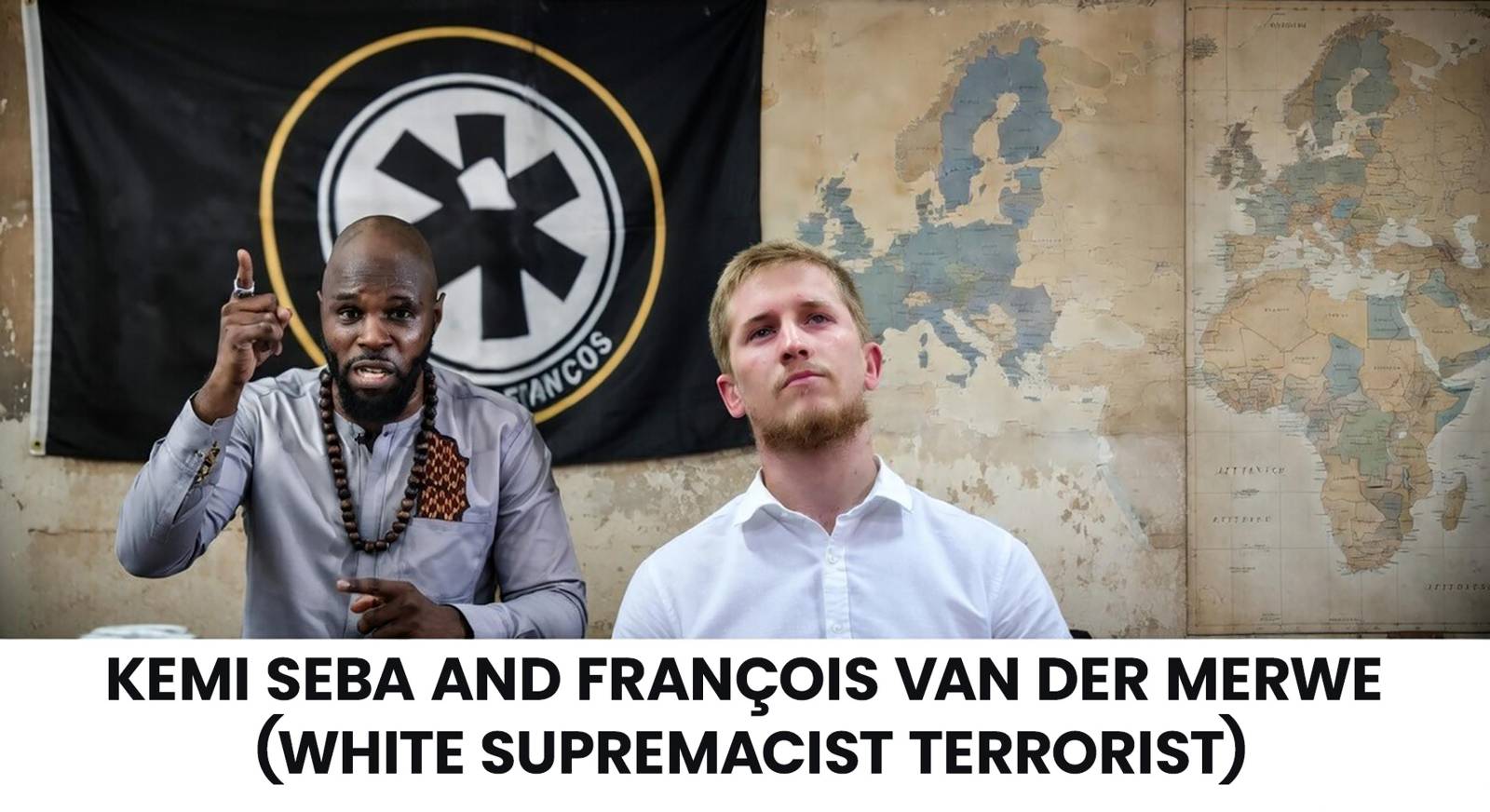
Some arrests catch us off guard, while others simply validate what was already suspected. However, the detention of Kemi Seba on South African soil on Wednesday, April 15, serves as a profound revelation. This event is significant not only because of Seba’s capture but because of the individual found by his side and the financial transactions that allegedly took place between them.
Who is François van der Merwe?
At 26 years old, Pretoria-born François van der Merwe leads the Bittereinders, a group officially classified as a terrorist entity by South African authorities. To grasp the gravity of this alliance, one must look at the history and extremist goals of this organization.
The ideology of the Bittereinders
The group draws its name from the “bitter enders” of the Second Boer War—guerrilla fighters who viewed any negotiation with British forces as a betrayal of their civilization. Van der Merwe has revived this fanatical heritage, transforming it into a modern movement that views Black political leadership as an existential danger to Afrikaner society.
The Bittereinders’ primary objective is the establishment of a Volkstaat. This would be a racially segregated, sovereign state carved out of South Africa, where Black citizens would be entirely excluded. This vision mirrors the most radical Afrikaner nationalist demands from the end of the Apartheid era, echoing the violent tactics used by groups like the AWB in the 1990s to disrupt the country’s first democratic elections.
A history of extremism and paramilitary activity
Since 2021, Van der Merwe has been a vocal opponent of the current democratic order, which he describes as an “occupation” rather than a democracy. Under his leadership, the Bittereinders conduct paramilitary training sessions, focusing on tactical operations and self-defense. These activities are often recorded and shared by the group as a show of strength, keeping them under the constant surveillance of the State Security Agency.
Van der Merwe’s personal legal record is equally troubled. He has faced multiple arrests, including charges for assault and inciting violence during courthouse protests in Groblersdal. Rather than deterring him, these legal battles have only bolstered his reputation among his followers, who use the slogan “Soet is die Stryd” (Sweet is the Struggle) to justify their actions.
The financial link and legal consequences
The investigation by the Hawks, South Africa’s elite police unit, suggests a transactional relationship between Seba and Van der Merwe. It is alleged that Kemi Seba paid approximately 250,000 rands (roughly 13,000 euros) to Van der Merwe to facilitate an illegal crossing into Zimbabwe via the Limpopo River for himself and his son.
This payment carries heavy legal weight. Under South African counter-terrorism law, providing funds to a designated terrorist leader is a major criminal offense, regardless of the stated reason for the payment. By handing over this sum, Seba did more than just seek travel assistance; he allegedly financed a movement dedicated to white supremacy.
The collapse of a political narrative
For years, Kemi Seba has cultivated an image as a champion of Black dignity and African sovereignty. He positioned himself as a fierce critic of Western imperialism and a defender of the oppressed across francophone Africa. However, his alleged financial support for a leader who advocates for a return to Apartheid-style segregation creates a massive contradiction.
The charges Seba now faces—ranging from illegal immigration to the potential financing of a terrorist organization—threaten more than just his freedom. They represent the total disintegration of the public identity he spent years building. For an activist who claims to stand for Black empowerment, writing a check to an anti-Black extremist is a betrayal that history will not easily overlook.