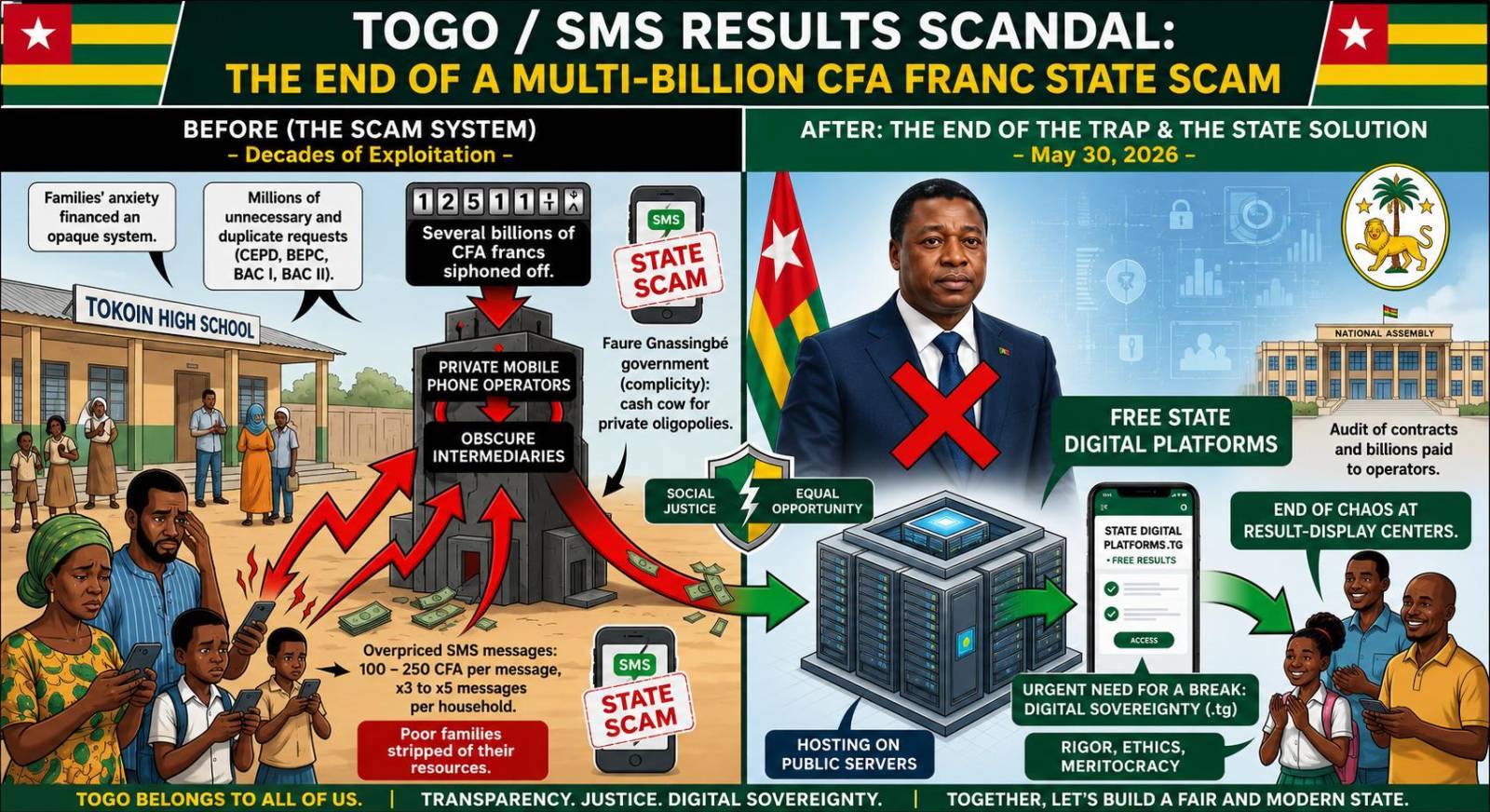
The Togolese education system has long been plagued by a systemic financial drain, systematically exploiting the anxieties of families awaiting exam results. This long-standing practice, which operated under the previous administration, has recently been exposed by the current Minister of National Education, Mama Omorou, following a decisive announcement to abolish SMS-based result queries.
Unveiling a decades-long financial exploitation
During an unannounced inspection on May 30, 2026, at the BAC I correction centers in Tokoin and Agoè-centre high schools, Minister Omorou delivered a scathing assessment of the system. Describing it as a financial scam and a massive waste of public funds, he highlighted the blatant exploitation embedded within the examination result dissemination process.
The mechanism was deceptively simple: families, gripped by the stress of waiting, would send multiple SMS requests for the same results. Each candidate’s household—fathers, mothers, relatives—would repeatedly text the service, often paying between 100 and 250 CFA francs per message. This redundant and unnecessary volume of inquiries generated artificial revenue streams, directly siphoning funds from struggling households.
A financial hemorrhage spanning generations
While detailed financial audits have yet to be published, preliminary calculations reveal staggering figures. With annual national exam candidates in the Togolese education system numbering in the hundreds of thousands, and each family sending an average of three to five duplicate messages per candidate, the total volume of SMS queries per exam session reached tens of millions.
Extrapolating these numbers over the past 15 to 20 years of the previous regime, the financial drain amounts to billions of CFA francs—funds that were diverted from the education sector and redirected into the coffers of private telecom operators and unaccountable intermediaries. This systematic transfer of wealth from impoverished families to private oligopolies occurred under the tacit or active complicity of outgoing authorities, representing a gross violation of public trust.
Transitioning to transparent and equitable digital solutions
The abrupt termination of SMS-based result queries by Minister Omorou presents an immediate challenge: ensuring that the transition does not revert to the chaos of in-person result displays, which often led to overcrowding, disorder, and heightened stress for families.
To address this, Togo must accelerate the implementation of state-run, free, and secure digital platforms. This reform aligns with the country’s broader digital integration strategy, particularly under the Ministry of Digital Economy. Key priorities include:
- Sovereign digital infrastructure: Exam results must be hosted on public servers (.tg domains) exclusively managed by the state to ensure data sovereignty and security.
- Full transparency: Access to results must be entirely free, funded through the national education budget to uphold fairness and equal opportunity for all candidates.
- Modernization of dissemination: Results should be published in batches via email or lightweight web portals optimized for mobile devices—technologies that are both cost-effective and widely accessible.
Reaffirming ethical standards in education
Beyond the financial scandal, Minister Omorou used the inspection tour to re-energize the morale of examiners, emphasizing the need to restore rigor, ethics, and meritocracy as the core principles of Togolese education. This announcement signals a significant ideological shift, marking a commitment to safeguarding families from institutionalized fraudulent practices.
The path forward requires unwavering political will. The government must now demonstrate the courage to audit past contracts with telecom operators, exposing the full extent of the financial hemorrhage that has deprived Togo’s youth of critical resources for generations. Only through such decisive action can the foundation for a just and equitable education system be laid.