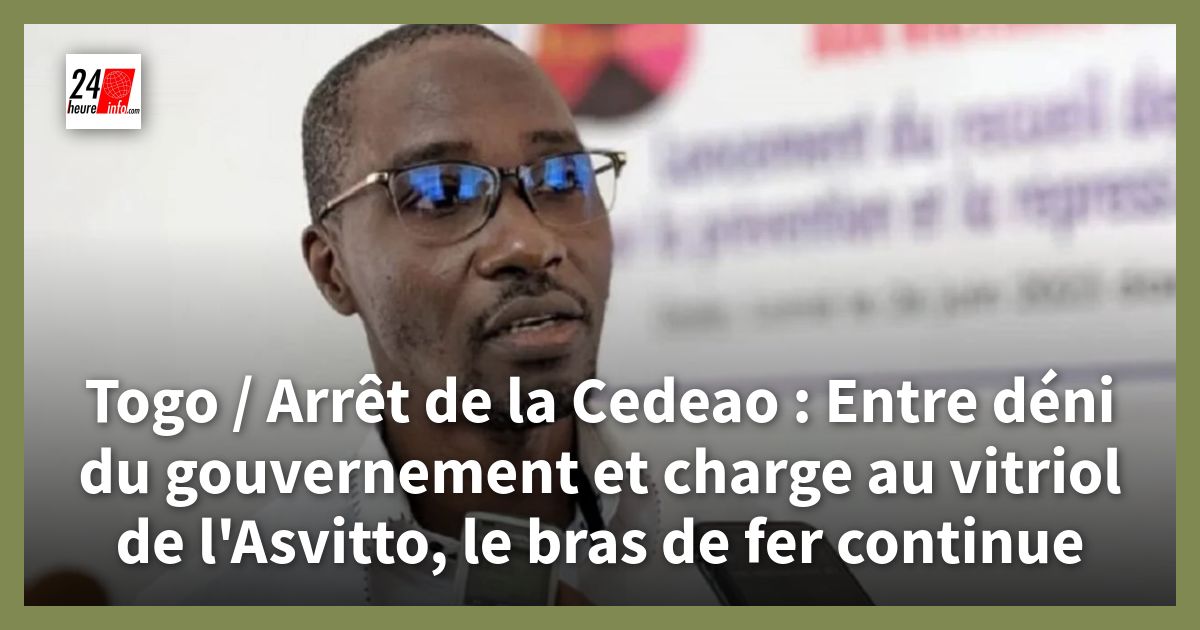
The recent CEDEAO court ruling on Togo’s constitutional changes has sparked fierce debate in Lomé. While the government dismisses it outright as legally irrelevant, the Association of Victims of Torture in Togo (ASVITTO) has launched a scathing public condemnation, accusing authorities of orchestrating a state-sponsored constitutional coup.
Government asserts court lacks jurisdiction
Within hours of the decision, Togolese authorities swiftly countered by arguing that the CEDEAO Court of Justice has no authority to review domestic constitutional matters or judge national constituent powers. This legal maneuver aims to render the ruling meaningless under national law.
Civil society fires back at Lomé’s arguments
ASVITTO wasted no time in rejecting the government’s stance, calling it a “denial of the obvious” on social media. The organization went further, warning that those behind what they describe as a “constitutional coup” are now trapped in their own fear, awaiting an inevitable fall.
“Their history speaks for itself,” the association emphasized in a statement, highlighting a long-standing pattern of disregarding regional court rulings. A clear example: political prisoners remain behind bars despite multiple CEDEAO orders for their immediate release.
“What remains consistent is their disregard for and disregard of CEDEAO decisions.”
Call for decisive regional action against state-backed violations
ASVITTO has escalated its pressure, directly urging the CEDEAO to intervene firmly. In a bold appeal, the group demands the enforcement of ruling ECW/CCJ/JUD/01/26, issued in January, which declared Togo’s 2024 constitutional reforms incompatible with the African Charter on Democracy, Elections and Governance.
“The region must put an end to this form of state gangsterism,” ASVITTO declared, underscoring the urgency of holding authorities accountable for repeated breaches of international obligations.
Political deadlock leaves prisoners in limbo
What began as a legal dispute has now escalated into a standoff. On one side, a government clinging to legal technicalities; on the other, civil society voices exposing the human cost of institutional inaction. Behind the verbal clashes and social media exchanges, the most vulnerable continue to suffer—political detainees linger in prison, their fate hanging in the judicial void.