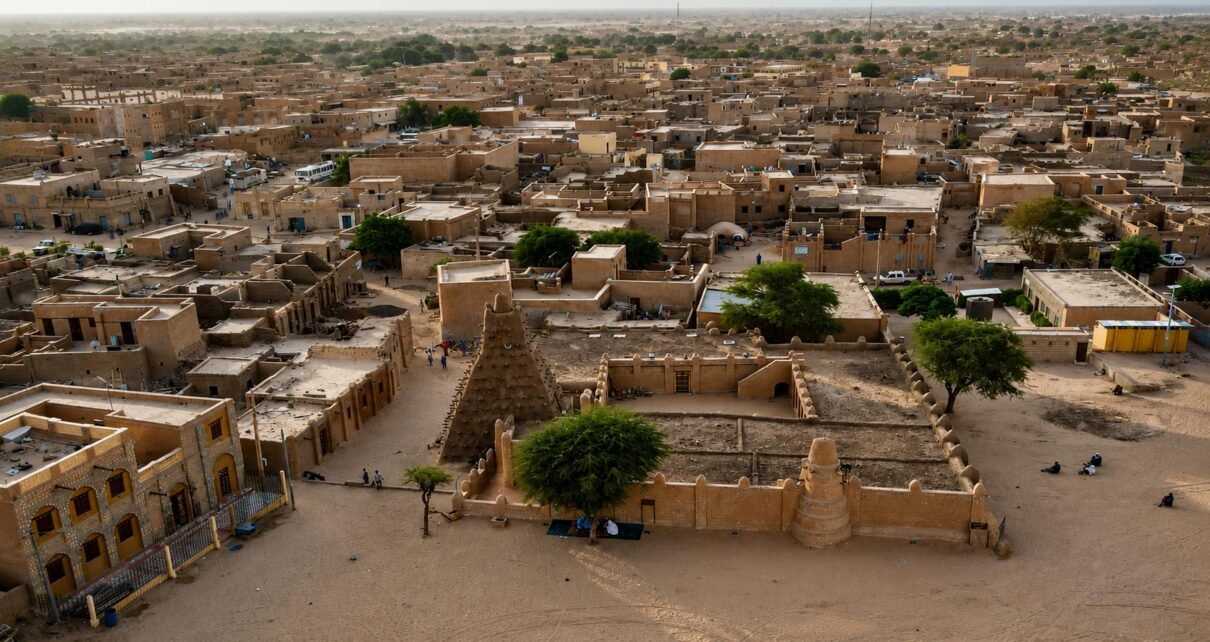
The silent siege of Tombouctou: when fuel shortages bring a historic city to its knees
Perched on the edge of the Sahara, Tombouctou—once a beacon of knowledge and trade—now faces an unprecedented humanitarian crisis. Cut off from the rest of Mali by relentless insecurity, the city is trapped in a suffocating energy blackout, leaving its 50,000 residents in sweltering darkness. Temperatures soar above 40°C, yet no fan hums, no fridge preserves food, and no tap delivers water.
The root of the disaster lies in a critical fuel shortage that has crippled the local thermal power plant, operated by Énergie du Mali (EDM-SA). With no diesel to fuel its generators, the entire city has been plunged into a technological void. The crisis has spilled over to the Somagep, Mali’s national water utility, which can no longer pump water to households. What began as an infrastructure failure has morphed into an invisible blockade, strangling daily life.
The logistics blockade: when fuel becomes a weapon of war
Tombouctou’s suffering is compounded by its remote location and the ongoing jihadist threat. For over a month, a crippling fuel shortage has paralyzed the city, triggered by a calculated siege on supply routes.
- The jihadist stranglehold: Militants from the Group for the Support of Islam and Muslims (JNIM) have tightened their grip on the main roads leading to the north. Fuel tankers, once a lifeline, are now routinely ambushed, delayed, or forced to navigate under heavy military escort—if they arrive at all.
- The black market’s crushing cost: With formal supply chains severed, Tombouctou has turned to informal networks. The price of diesel on the black market has skyrocketed, rendering private generators and small businesses economically unviable. For a city already reeling from poverty, this is a fatal blow.
A health system on the brink
The collapse of the power grid has shattered the cold chain, endangering the preservation of food and critical medicines. At the Tombouctou Regional Hospital, the situation is dire. Staff are forced to prioritize life-saving interventions under the dim glow of phone torches or makeshift solar setups—equipment that barely scratches the surface of the hospital’s needs.
Abandoned by the state: promises unfulfilled
In a bid to mitigate the crisis, local authorities have resorted to emergency water deliveries via tanker trucks. Yet these stopgap measures do little to mask the deep frustration of residents, who feel abandoned by a government that prioritizes military solutions over the restoration of basic services. The pledge to secure supply routes and achieve energy self-sufficiency remains unmet, leaving EDM-SA and Somagep powerless to restore stability.
Can Tombouctou survive on life support?
The city cannot endure indefinitely in this state of perpetual crisis. For Mali to prove its ability to govern its entire territory, the restoration of public services is as vital as military control. Until the roads are secured and fuel convoys can reach the north unimpeded, Tombouctou will continue to flicker on the edge of oblivion, one neighborhood at a time.