A series of synchronized assaults across Mali on April 25, 2026, signal a pivotal moment, not only for Bamako’s fight against escalating violence in the Sahel but also for the broader West African landscape. This critical juncture reveals the inherent vulnerabilities within Mali’s existing security framework, prompting crucial inquiries for West Africa, especially Ghana, regarding the perils of excessive dependence on a singular foreign military alliance.
This was no ordinary security incident. Instead, it comprised a sophisticated, coordinated offensive directed at several vital sites within the Alliance of Sahel States (AES) member nation. The extensive scope and precise execution of these attacks underscored a profound advancement in insurgent operational capacity, concurrently exposing critical deficiencies in intelligence gathering, readiness, and tactical response among both the Malian Armed Forces and their international collaborators.
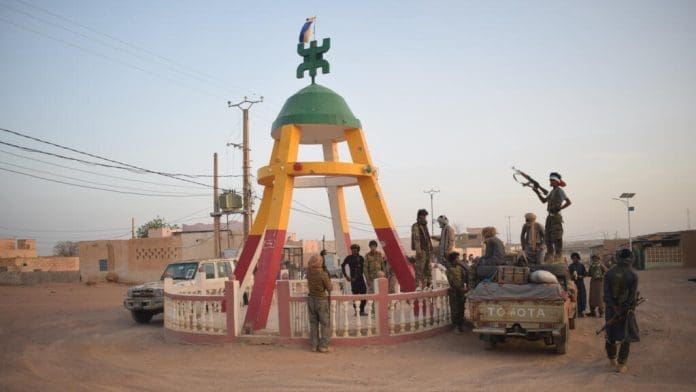
Concurrent strikes by groups affiliated with JNIM and the Azawad Liberation Front (FLA) targeted numerous locations, including Bamako, Kati, Gao, Kidal, Mopti, Bourem, and Sévaré. During these events, a Russian Mi-8 helicopter was disabled close to Wabaria, checkpoints north of the capital fell, and armored vehicles suffered destruction. Tragically, Mali’s Defence Minister, General Sadio Camara, lost his life, and other high-ranking military officials, including the Chief of Defence Intelligence, sustained injuries. The sheer magnitude and meticulousness of this assault strongly suggest a profound intelligence failure affecting both the Malian Armed Forces and their Russian-supported allies, the Africa Corps.
Central to this escalating crisis is the capture of Kidal. For an extended period, Mali’s military command and its Russian counterparts had portrayed Kidal as a beacon of restored national control; its recent fall, however, carries both practical and symbolic weight. Accounts suggest that Russian-aligned forces, operating as part of the Africa Corps, retreated following minimal resistance, thereby abandoning Malian soldiers to vulnerability and isolation. For an alliance founded on pledges of enhanced security, the visual and strategic repercussions are undeniable.
A familiar strategy
Moscow’s reaction unfolded precisely as anticipated. The Africa Corps asserted the elimination of between 1,000 and 1,200 insurgents and the destruction of 100 adversary vehicles. The Russian Defence Ministry subsequently recharacterized the incidents as an attempted coup, transforming a significant military defeat into a narrative of successful intervention. Media channels aligned with Moscow further disseminated this perspective. Conspicuously, neither the Russian Embassy in Mali nor the Foreign Ministry in Moscow issued an official statement. By portraying a well-coordinated insurgent operation as an externally orchestrated conspiracy, Russia skillfully diverted attention from its own shortcomings, instead pointing to geopolitical machinations involving France, Ukraine, and the West as convenient antagonists. This tactic mirrors approaches employed in Syria, Ukraine, and other theaters where Russian forces have encountered setbacks they are unwilling to concede.
The profound intelligence lapse preceding these attacks holds equal importance. A high-ranking Malian official informed RFI that Russian contingents received warnings of the imminent offensive three days prior but failed to act. The insurgents’ capability to neutralize an Africa Corps helicopter additionally implies a proactive anticipation and preparation for aerial countermeasures, demonstrating a level of counter-surveillance sophistication that neither Moscow nor Bamako seemed to grasp. These are not merely standard combat casualties; they represent clear symptoms of a security apparatus facing immense pressure.
Ghana’s imperative: understanding the regional threat
Dismissing these occurrences as remote would constitute a serious strategic miscalculation. Jihadist factions active in Mali have already proven their capability for territorial expansion, extending their influence from northern Mali, through its central areas, and into Burkina Faso. Geographically, northern Ghana is situated along this increasingly volatile pathway. The dangers are tangible, not hypothetical. Permeable national boundaries enable the discreet infiltration of small, agile extremist cells. The ongoing conflict in the Sahel exacerbates the spread of illegal weaponry and strengthens transnational criminal enterprises. Furthermore, disrupted commercial arteries and population displacement create southward-spreading repercussions, gradually undermining local stability in ways more challenging to identify and counteract than an isolated, high-profile assault.
Mali’s situation vividly illustrates the hazards associated with relying on a solitary external security partner whose primary focus is overwhelmingly military intervention. Russia’s involvement has supplied weaponry, mercenary forces, and strategic messaging. However, it has failed to stimulate vital investments in energy infrastructure, agricultural advancements, or the economic conditions essential for diminishing recruitment into extremist organizations. A security approach that merely suppresses violence without tackling its fundamental causes does not genuinely resolve instability; it merely shifts its manifestation. Moreover, a partner already strained by its own conflict in Ukraine is unlikely to maintain its extensive commitments throughout the African continent indefinitely.
The imperative of regional cooperation
Irrespective of present political discord, ECOWAS continues to serve as the indispensable framework for regional collaboration. The Alliance of Sahel States, comprising Mali, Burkina Faso, and Niger, has demonstrated an incapacity to forge an effective joint response to this unfolding crisis, functioning currently more as a conceptual entity than a practical operational force. It is crucial that Ghana and its ECOWAS counterparts prevent political disagreements from undermining the existing regional security infrastructure.
Establishing integrated intelligence units that connect military, police, and border control agencies along vulnerable transit routes, especially between Ghana and Burkina Faso, is no longer a distant objective but an urgent requirement. Global partners like the European Union, the US, the United Kingdom, and even China offer valuable technical expertise in areas such as surveillance and intelligence assessment. Such partnerships should be cultivated based on principles of openness, dependability, and enduring dedication, rather than transient convenience.
Mali’s experience delivers an unambiguous message: national security is not something that can be entirely delegated. While external assistance can augment domestic initiatives, it can never serve as a substitute. A purely military strategy that secures land without simultaneously fostering effective governance, economic stability, or public confidence will inevitably create the circumstances for its own undoing. Ghana’s national safety is not solely determined by its own frontiers, but profoundly influenced by decisions made presently in Bamako, Ouagadougou, and Niamey.
The Sahel should be perceived not as a protective barrier, but as a thoroughfare. Elements traversing this region will not halt at the boundaries of coastal West Africa. The critical task for Ghana and the wider region is to assimilate these lessons promptly, adjust with agility, and collaborate collectively.