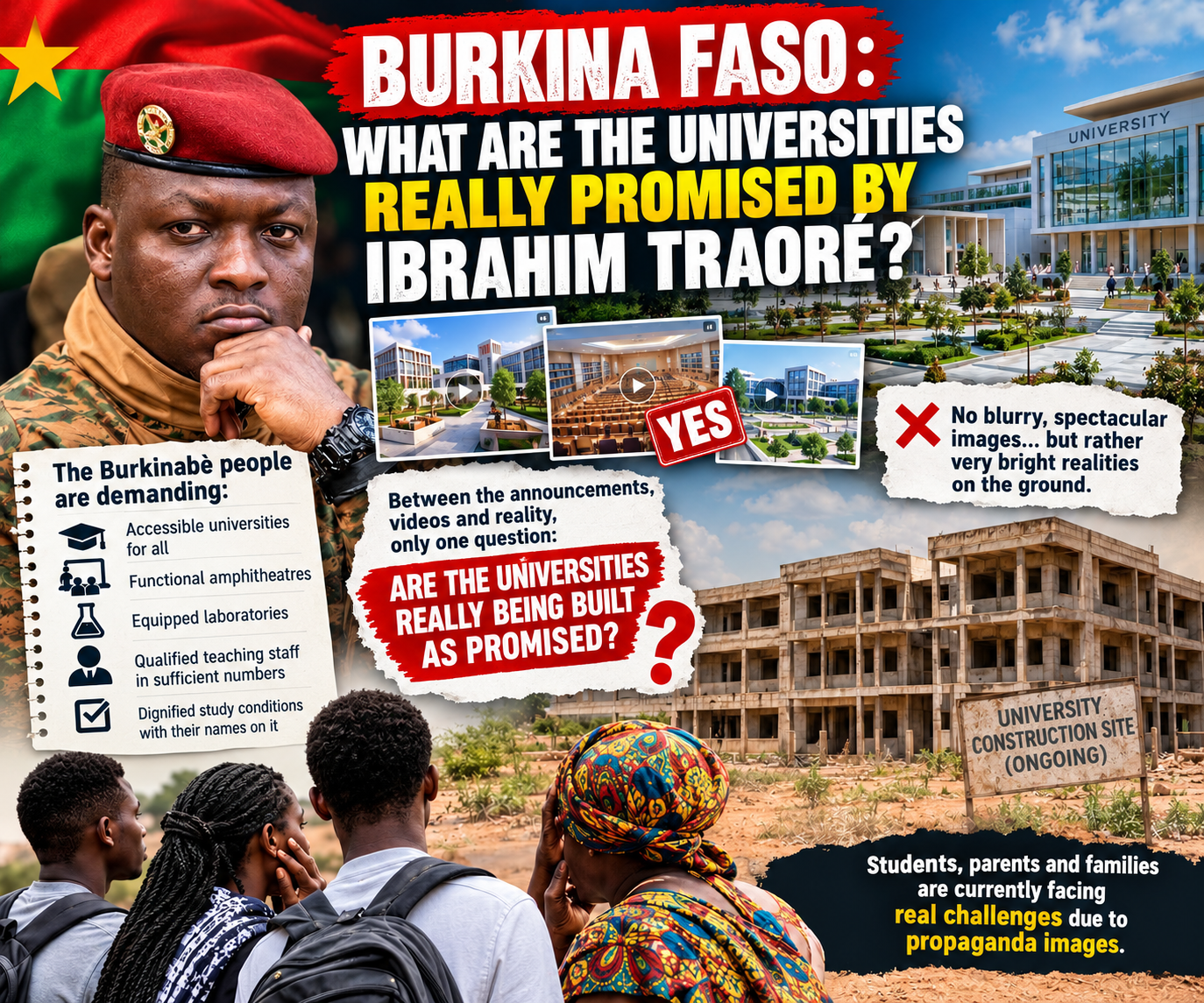
Can social media images replace tangible university facilities?
Burkina Faso’s higher education sector faces a critical dilemma: while viral images showcase modern university campuses, students, parents, and educators demand proof of actual progress. Behind the polished visuals promoted by official communications lies a pressing question: where are the promised ultramodern universities, and what concrete evidence supports their existence?
When digital imagery overshadows educational investments
Social media has become a battleground for political narratives, with Burkina Faso’s leadership using dramatic footage to illustrate developmental strides. However, these images often presented as evidence of completed projects raise serious credibility concerns. Investigations have repeatedly exposed manipulated visuals, including AI-generated content and misattributed construction footage from other countries, such as Algeria.
The implications are profound. For families investing in education, the discrepancy between promised facilities and unreachable standards creates uncertainty. While digital content can shape perceptions, tangible campus access, functional laboratories, and qualified faculty remain the true benchmarks of progress.
From announcements to reality: the gap between words and infrastructure
Political declarations often precede real-world implementation. A university may be announced, a groundbreaking ceremony held, and a building constructed yet remain non-operational due to funding shortages, equipment gaps, or staffing issues. To assess the government’s commitments, a rigorous evaluation must distinguish between:
Announced projects with no visible progress;
Completed buildings lacking necessary resources;
Inaugurated institutions with operational challenges.
Measurable progress: the test of transparency
In September 2026, authorities highlighted the inauguration of a 1,200-seat auditorium, four 210-seat lecture halls, and six laboratories at Nazi-Boni University in Bobo-Dioulasso. While commendable, such announcements require independent verification: Are these spaces fully equipped? Are students actively using them? What about other promised projects?
AI-generated content: a double-edged sword in political messaging
The rise of artificial intelligence has blurred the line between fact and fabrication. Synthetic videos can create the illusion of completed infrastructure, misleading the public and undermining trust. Though not all misleading content is state-sponsored, the government’s response whether through counter-messaging, verified documentation, or media access will determine its commitment to transparency.
Accountability over aesthetics: the ultimate test for Burkina Faso’s education policy
The credibility of a leadership should not hinge on the sophistication of its promotional materials but on verifiable outcomes. Families, students, and educators deserve clear answers: Which universities are operational? What resources do they possess? How do they perform?
Until tangible progress measured by active student enrollment, functioning laboratories, and transparent governance matches the grandeur of digitally crafted narratives, skepticism will persist. Real educational transformation demands more than headlines; it requires bricks, mortar, and active learning environments.
The bottom line: facts over visuals
Burkina Faso’s future hinges on whether its higher education promises translate into reality. While innovation in communication is inevitable, the paramount measure of success lies in accessible, well-equipped institutions that deliver on their promises. The question remains: Can digital ambition stand alongside physical achievement?
By IBRAHIM OUMAROU — Journalist