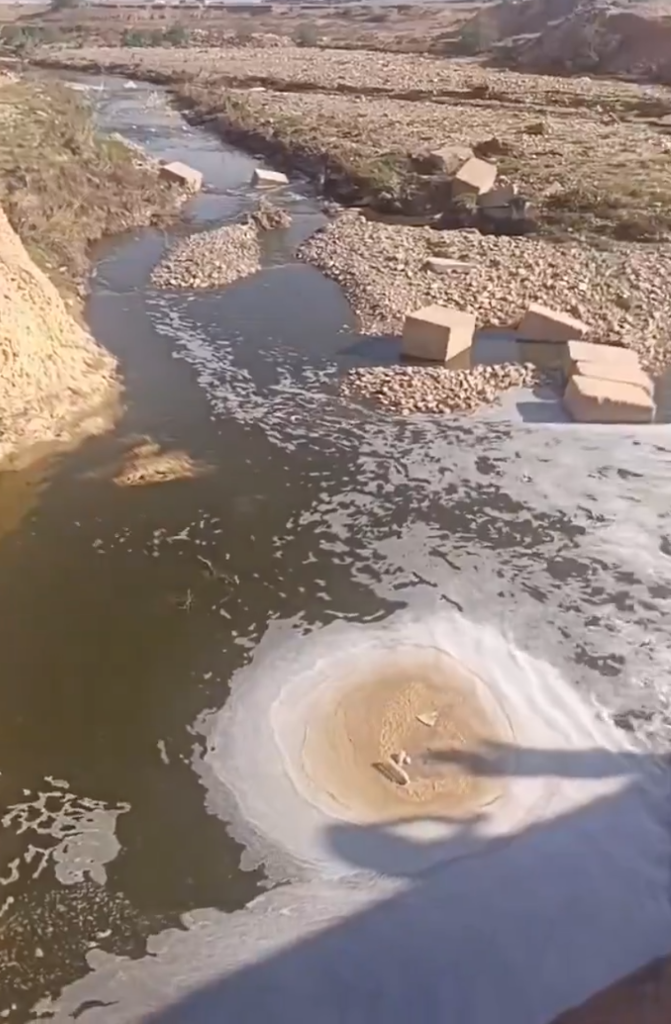
As Algeria and Morocco navigate one of the most strained bilateral relationships in recent history, a new environmental crisis threatens to escalate an already fragile diplomatic situation. At the heart of this unfolding dispute lies a vital resource: water. In the Tlemcen region of western Algeria, the Mouilah wadi—a critical water source for local communities—has become the center of a growing controversy, with Algerian authorities pointing to cross-border pollution originating in Morocco.
Pollution in the Mouilah wadi: an environmental and public health emergency
The Mouilah wadi, a key tributary feeding the Hammam Bougara dam, has raised alarm bells among Algerian officials due to rising levels of contamination. Recent water quality assessments have detected alarming concentrations of nitrites, heavy metals, pharmaceutical residues, and microbiological pollutants—posing risks not only to aquatic ecosystems but also to public health in communities dependent on these water resources.
The Hammam Bougara dam supplies drinking water to several municipalities, and its contamination could significantly strain local water treatment operations, inflating costs and raising concerns over long-term supply sustainability. For now, Algerian authorities are implementing emergency monitoring and treatment measures to mitigate the impact on residents.
Is Morocco the source of the water pollution?
Algeria has directly implicated Morocco, alleging that industrial and domestic wastewater from Moroccan territory is flowing into the Isly wadi before crossing into Algeria and merging with the Mouilah wadi. While the accusation has triggered sharp diplomatic reactions, verifying the source of contamination remains complex. Scientifically sound investigations—including coordinated water sampling across the shared river basin—are essential to determine the pollutants’ origin with precision.
The lack of independent verification raises questions about the validity of the claims. Clear, verifiable data and transparent analysis are necessary before assigning responsibility. The environmental damage is undeniable, but the path to clarity requires rigorous, impartial scientific inquiry.
Is an international legal response inevitable?
With diplomatic relations between Algiers and Rabat already in a precarious state, the environmental dispute risks escalating into a formal international legal confrontation. Algerian officials and local parliamentarians have urged that the case be brought before international bodies, citing principles of transboundary environmental harm prevention and shared responsibility for natural resources.
International law does offer mechanisms for resolving disputes involving pollution that crosses national borders. However, invoking such a process requires concrete evidence and a structured, evidence-based case. At this stage, statements and calls for action remain preliminary; a formal legal filing has not yet been initiated. The question remains: will cooperation prevail, or will this become another flashpoint in an already tense relationship?
Water scarcity amplifies tensions in North Africa
The Mouilah wadi dispute unfolds against a broader regional backdrop of mounting water insecurity. Both Algeria and Morocco face severe challenges stemming from climate change, overuse of groundwater, and rapid population growth—factors that have intensified competition over shared water resources. In such a climate, even allegations of transboundary pollution can quickly evolve from a technical issue into a matter of national sovereignty.
Yet despite the high stakes, there is no indication that this crisis will lead to military confrontation. The immediate concern remains environmental degradation and its long-term impact on public health and water security. To address these challenges, both countries must prioritize science, transparency, and joint action to safeguard their shared ecosystems.
Shared rivers demand shared solutions
The future of the Mouilah wadi—and the millions who depend on it—lies in cooperation, not confrontation. Establishing a joint monitoring system, conducting transparent water quality assessments, and implementing cross-border pollution control measures are essential steps toward resolution. Independent scientific studies, involving hydrologists, toxicologists, and environmental experts from both nations, could provide the clarity needed to identify sources of contamination and prevent future harm.
Water flows without regard for political borders. When a river crosses multiple territories, its protection becomes a shared responsibility. Algeria and Morocco must rise above their political divisions to address this crisis—not as adversaries, but as neighbors bound by a common environmental fate.