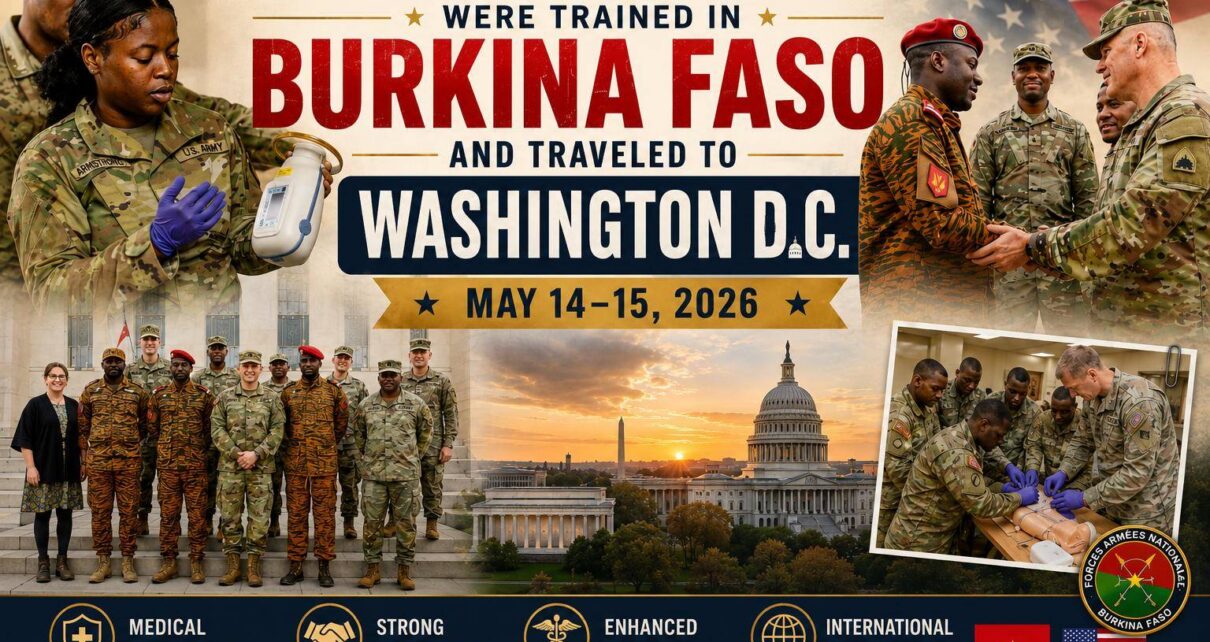
In a move that underscores the complexities of Sahelian geopolitics, Burkina Faso has recently engaged in a high-level medical exchange with the United States, signaling a nuanced approach to international cooperation despite its public alignment with alternative alliances. On May 14 and 15, 2026, Burkinabe military surgeons traveled to Washington D.C. for an intensive two-day training session with the U.S. National Guard as part of the State Partnership Program (SPP). This development, announced by the U.S. Embassy in Ouagadougou, raises a critical question: why does Burkina Faso continue to rely on traditional Western partners for advanced military medical training, even as it publicly distances itself from them?
An understated yet vital medical mission
A brief communiqué from the U.S. Embassy in Ouagadougou on June 6, 2026, shed light on this strategic collaboration. The Burkinabe delegation, comprising military surgeons, spent two days in the U.S. capital, focusing on battlefield trauma care, combat wound management, and emergency surgical procedures in hostile environments. In a nation grappling with an ongoing asymmetric conflict, the direct transfer of medical expertise from American specialists represents a lifeline for the country’s soldiers on the front lines.
The AES paradox: ideology vs. operational necessity
This training session in Washington highlights a striking contradiction within the Alliance of Sahel States (AES), which includes Burkina Faso, Mali, and Niger. Officially, the alliance has adopted a confrontational stance toward Western powers, particularly France, accusing them of passivity or even indirect support for terrorist groups plaguing the region. Yet, behind closed doors, technical cooperation with the United States remains not only active but actively pursued.
How can senior Burkinabe officers participate in high-level exchanges with American institutions while their government publicly advocates severing ties with former colonial powers? This apparent inconsistency reveals that, when faced with the harsh realities of warfare, operational pragmatism often outweighs ideological posturing.
Why Russia’s military medical support falls short
Since Burkina Faso distanced itself from France, the country has significantly expanded its partnership with Russia, securing combat equipment, air support, and tactical training. However, Moscow’s military medical assistance has yet to match the sophistication of Western programs. The U.S. National Guard’s SPP offers a battle-tested model of combat medicine, refined over decades of global deployments and aligned with internationally recognized academic standards. Additionally, Western military medical protocols—including evacuation systems and equipment compatibility—are deeply embedded in Burkinabe military training, creating a seamless integration that Russia’s more tactically focused support currently lacks.
A quiet diplomacy with mutual advantages
For the United States, maintaining programs like the SPP is a strategic opportunity to retain influence in Burkina Faso and, by extension, within the AES bloc. As American troops were recently withdrawn from neighboring Niger, this medical diplomacy allows Washington to preserve a discreet yet meaningful connection with the Burkinabe military leadership without provoking public backlash.
For Burkina Faso’s transitional authorities, led by Captain Ibrahim Traoré, this collaboration serves as a reminder that complete isolation is neither necessary nor desirable. While publicly reaffirming its sovereignty and allegiance to the AES, the Burkinabe government continues to leverage the strengths of multiple global partners to bolster its military capabilities.
Sovereignty on shifting grounds
The Washington exchange is a stark reminder that Sahelian geopolitics cannot be reduced to slogans or symbolic gestures. Beneath the rhetoric of anti-Western alliances and public declarations of independence, the primary objective remains the survival of the Burkinabe state against terrorist threats. By prioritizing medical training with American specialists, Burkina Faso is making a pragmatic choice—one that favors battlefield effectiveness over political consistency. This paradox, while challenging for ideological purists, is a lifesaving reality for the soldiers risking their lives on the front lines.