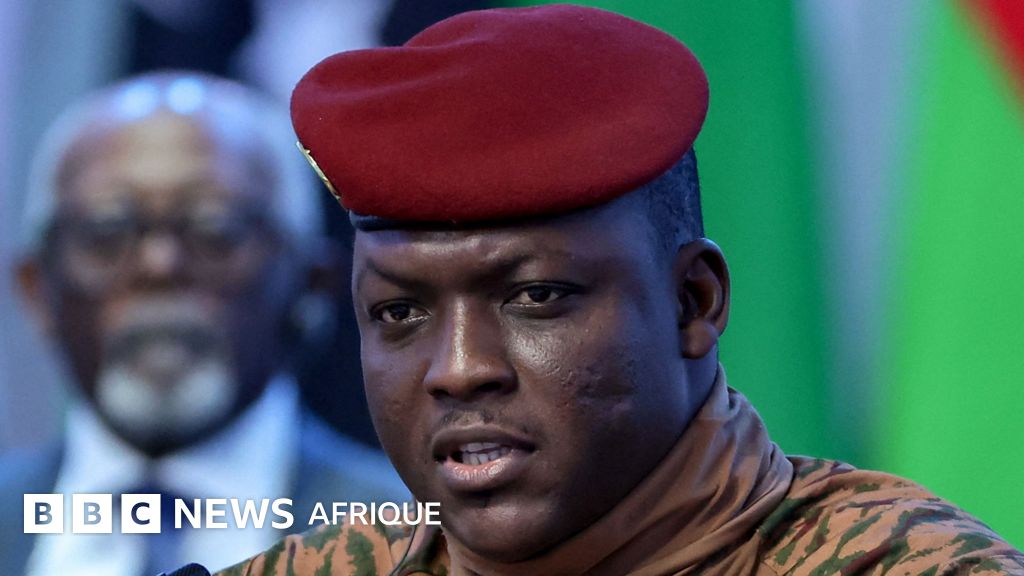
Burkina Faso’s military leader rejects democracy as the nation’s path forward
- Temps de lecture: 5 min
In a televised address on Thursday, Burkina Faso’s military head Ibrahim Traoré declared that democracy was not the nation’s destiny, urging citizens to abandon its pursuit entirely. The 38-year-old leader, who seized power in a 2022 coup, argued that the system had failed Africa and suggested an alternative path without providing specifics.
Traoré had previously pledged to restore democratic rule by July 2024, but with the deadline approaching, the junta announced a five-year extension of its mandate—effectively postponing elections indefinitely.
This shift follows January’s sweeping ban on political parties, part of a broader state reconstruction plan. The government justified the move by labeling parties as divisive forces incompatible with the revolutionary agenda.
During the interview, Traoré drew parallels with Libya, citing its post-Gaddafi instability as a cautionary tale. He argued that Western interventions often led to chaos and bloodshed, positioning his military government as a break from foreign-imposed systems.
The Burkina Faso leader condemned conventional politics, calling politicians “liars, flatterers, and charlatans” who embodied corruption. He insisted on building a new system rooted in sovereignty, patriotism, and grassroots mobilization, where traditional leaders and community structures would play pivotal roles.
Traoré also emphasized economic and military self-reliance, asserting that Burkina Faso could not progress with conventional working hours. His administration has clamped down on dissent, targeting opposition figures, media outlets, and civil society groups, with critics alleging retaliatory measures such as deploying opponents to frontline combat.
Despite this, Traoré has cultivated significant support across Africa for his anti-Western rhetoric and pan-Africanist stance. Like neighboring juntas in Mali and Niger, Burkina Faso has distanced itself from Western partners, particularly France, in the fight against Islamist militants. Instead, it has turned to Russia for military assistance, though violence in the region continues unabated.
Recent reports indicate that since Traoré’s rise to power in 2023, over 1,800 civilians have been killed in Burkina Faso. Human rights groups attribute two-thirds of these deaths to state forces and allied militias, with the remainder linked to Islamist extremists.