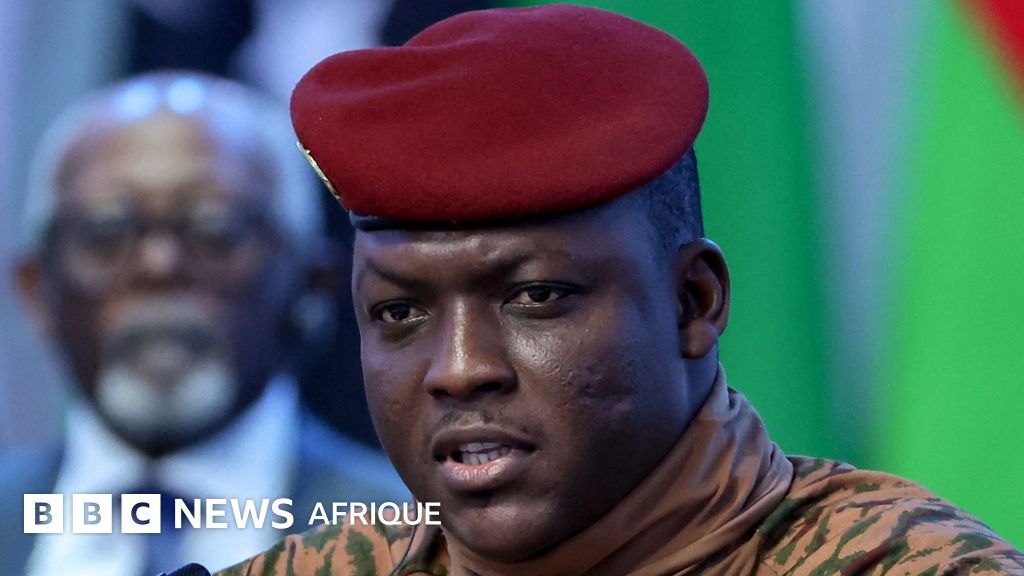
In a nationally televised address on Thursday evening, Burkina Faso’s military leader Captain Ibrahim Traoré made a striking declaration: the people of Burkina Faso must abandon any hope of democratic governance. “People must forget about democracy,” he stated firmly. “Democracy is not for us.”
From promised transition to indefinite rule
Traoré, who seized power three years ago, had initially pledged to restore democratic rule in Burkina Faso by July 2024. However, just two months before the deadline, the military junta announced a five-year extension of its mandate, effectively postponing any return to civilian government.
The shift in strategy aligns with a broader pattern of military-led governance in the Sahel region, where several nations have experienced coups in recent years. While elections continue in many African countries, including Burkina Faso’s neighbors, critics argue that some contests lack fairness and transparency.
A radical break with political parties
In January, authorities dissolved all political parties, consolidating state control over their assets. Traoré framed this move as essential to the nation’s rebuilding process, describing political parties as divisive forces incompatible with his revolutionary vision. “In Africa—and especially in Burkina Faso—a real politician embodies all the vices: a liar, a flatterer, a smooth talker,” he declared.
He emphasized the need to construct a new system rooted in sovereignty, patriotism, and revolutionary mobilization, where traditional leaders and grassroots structures would play a central role.
Economic sovereignty and revolutionary change
During the interview, Traoré underscored the importance of economic and military self-reliance, arguing that Burkina Faso cannot progress with traditional six-to-eight-hour workdays. He advocated for a complete transformation of governance, distancing himself from Western models. “We have our own approach,” he said. “We’re not trying to copy anyone. Our goal is to change everything.”
Traoré positioned himself as a revolutionary leader resisting Western imperialism, frequently citing Libya as a cautionary example. He compared Libya’s post-Gaddafi collapse—marked by political fragmentation and ongoing armed conflict—to Burkina Faso’s path forward. “Look at Libya,” he cautioned. “It’s a close example of what happens when outside forces impose change.”
Controversial policies and escalating violence
Since taking power, Traoré’s government has faced accusations of suppressing dissent. Opposition figures, media outlets, and civil society groups have reported crackdowns, with critics often sent to dangerous frontline positions in the fight against Islamist militants.
Despite these controversies, Traoré has cultivated support across Africa for his anti-Western rhetoric and panafricanist stance. Like neighboring juntas in Mali and Niger, Burkina Faso has distanced itself from Western partnerships, including France, in its battle against Islamist insurgencies that have ravaged the region for a decade. Instead, these nations have turned to Russia for military assistance—but violence persists unabated.
Human rights reports indicate a grim toll under Traoré’s rule. Since 2023, over 1,800 civilians have been killed in Burkina Faso, with two-thirds of the deaths attributed to state forces and allied militias, according to recent findings.