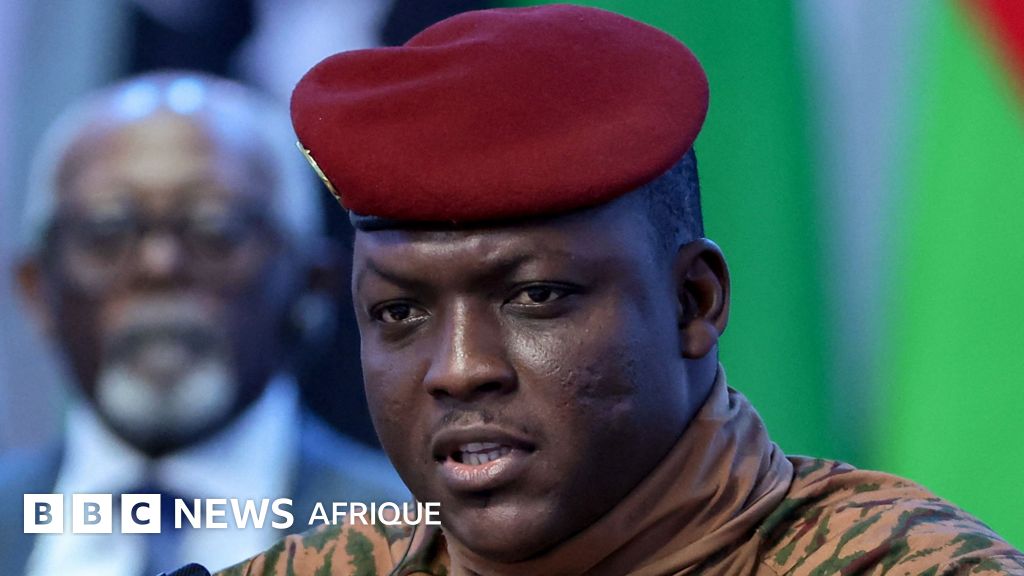
The military leader of Burkina Faso has declared that democracy is not suited for the nation, urging citizens to abandon the concept entirely. In a nationally televised address, Captain Ibrahim Traoré made sweeping remarks about the inadequacy of democratic systems in Africa, particularly in the context of Burkina Faso’s ongoing challenges.
Traoré, who seized power in a 2022 coup, initially pledged to restore civilian rule by July 2024. However, his administration recently extended its transitional mandate by five years, raising concerns about the country’s democratic future. The decision followed the January announcement of a ban on all political parties, part of a broader state reconstruction plan.
During the interview, the 38-year-old leader stated, “People must forget about democracy. It is not for us.” He drew parallels with Libya, warning that Western-backed interventions could lead to chaos, citing the country’s prolonged instability since the fall of Muammar Gaddafi’s regime.
Traoré positioned himself as a revolutionary figure resisting Western imperialism, emphasizing the need for Burkina Faso to forge its own path. “We have our own approach. We are not copying anyone,” he declared, outlining plans for a system rooted in sovereignty, patriotism, and revolutionary mobilization. Traditional leaders and grassroots structures were highlighted as key components of this new framework.
The military leader criticized political parties, labeling them as divisive and incompatible with his vision. “In Africa—and particularly in Burkina Faso—politicians embody all vices: liars, flatterers, and empty talkers,” he asserted. His government has also intensified crackdowns on dissent, targeting opposition figures, media outlets, and civil society groups.
Traoré’s administration has prioritized economic and military self-reliance, advocating for extended work hours and collective effort to accelerate development. Despite international condemnation over human rights abuses, including the alleged deployment of critics to frontline combat zones, his anti-Western rhetoric has garnered significant support across the continent.
Burkina Faso, along with neighboring Mali and Niger, has distanced itself from Western partners—particularly France—in its fight against Islamist militants. Instead, these nations have turned to Russia for military assistance, though violence in the region continues unabated. A recent report by Human Rights Watch documented over 1,800 civilian deaths in Burkina Faso since Traoré’s rise to power, with two-thirds attributed to state forces and allied militias.
The statement underscores a growing trend in the Sahel, where military juntas are increasingly rejecting democratic norms in favor of centralized, sovereignty-driven governance models.