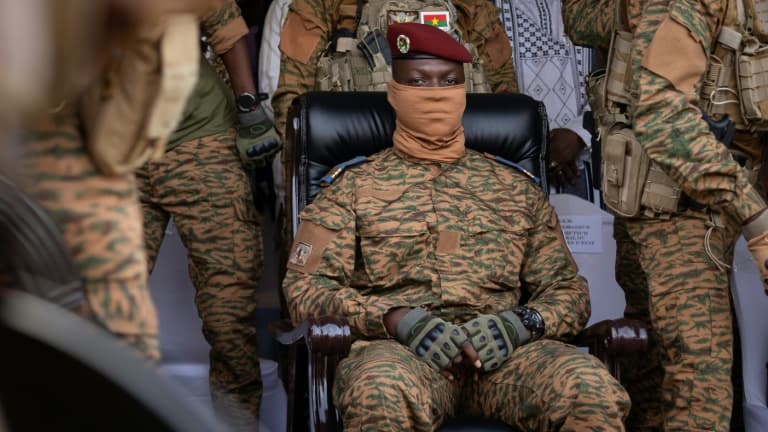
military rule in Burkina Faso: junta leader dismisses democracy as incompatible with the nation
The captain Ibrahim Traoré, who seized power in Burkina Faso in September 2022, has made a bold statement: the people of Burkina Faso should “forget” democracy. In a televised address to the nation, he declared that Burkina Faso is “not a democracy,” a stance he reiterated during a rare two-hour interview with both local and international journalists, including representatives from Rai and Sky News.
The junta’s recent political charter extends its rule by five years from July 2024 and allows Captain Traoré to run in future elections, including presidential, legislative, and municipal polls, scheduled for the end of this extended period. This move follows the dissolution of the Independent National Electoral Commission (Céni) in October 2025 and the suspension, and later outright ban, of political parties in February 2024.
no elections in sight: democracy “not for us”
Captain Traoré’s remarks came during a press conference where he emphasized that elections are not a priority. “We don’t even talk about elections first,” he stated. “People need to forget about democracy—it’s not for us.” This declaration underscores the junta’s commitment to maintaining its grip on power, despite the originally planned transition to civilian rule in July 2024.
crackdown on dissent and international media
Since taking control, the military regime has taken a hardline stance against Western influence, particularly France, and has restricted or banned several international media outlets. The junta has also expelled foreign journalists and intensified its control over domestic media.
In his interview, Captain Traoré addressed the case of his predecessor, Lieutenant-Colonel Paul Henri Sandaogo Damiba, who was extradited from Togo earlier this year. Damiba faces charges including corruption and alleged involvement in multiple coup attempts. “A judge has already seen him,” Traoré stated. “He is in the hands of the justice system.”
security crisis and allegations of human rights abuses
Burkina Faso has been grappling with a decade-long insurgency by jihadist groups, resulting in thousands of deaths. The military, along with its civilian defense auxiliaries (VDP), has been accused by NGOs of committing human rights violations, including attacks on civilians. Traoré dismissed these allegations, asserting that “there is no evidence” to support them.
Despite receiving military equipment from Russia—an ally of the junta—Traoré clarified that no foreign forces are involved in training Burkinabe troops. “On the ground, it is the Burkinabe soldiers who are fighting,” he affirmed.
regional implications and ongoing instability
The junta’s actions reflect broader shifts in West Africa’s political landscape, where military takeovers have become increasingly common. Burkina Faso’s trajectory raises concerns about the future of democratic governance in the Sahel region, a topic of growing interest among analysts and policymakers.