Cameroon’s political landscape transformed by Atanga Nji’s ‘imperfect balance’ theory
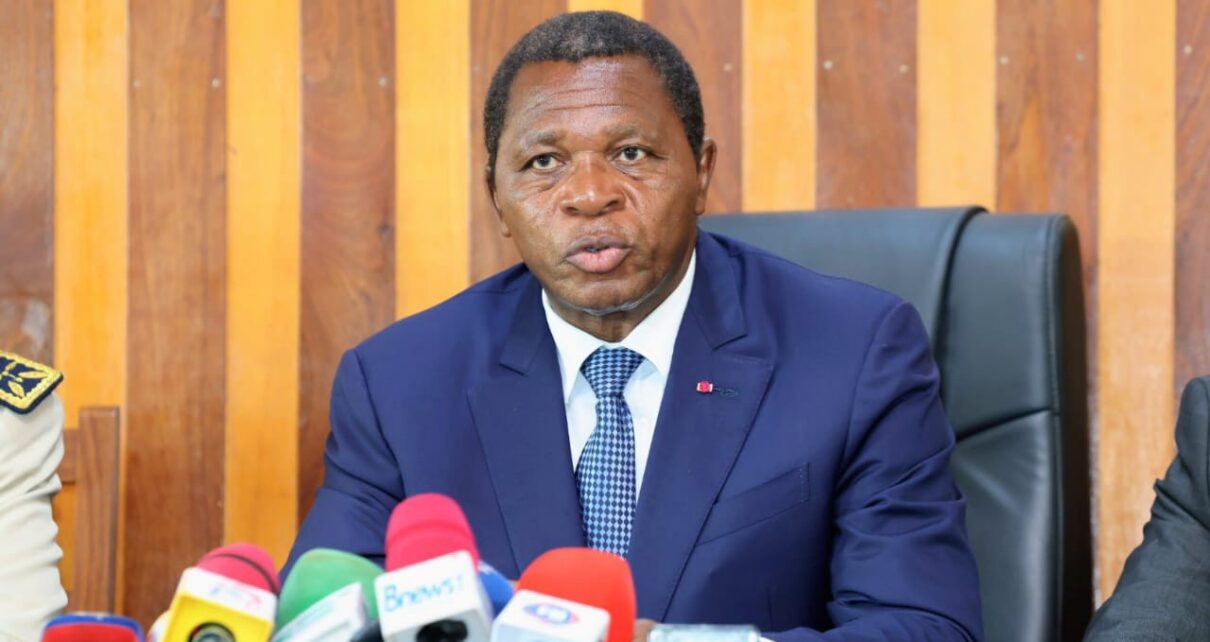
The recently published work by Minister Atanga Nji, titled “Understanding the Meaning of My Permanent Struggle for Respect of Republican Legality,” presents more than just political rhetoric. It introduces a groundbreaking theoretical framework that challenges traditional conflict resolution models.
Minister Atanga Nji’s Political Framework: A New Paradigm for Cameroon
Minister Atanga Nji’s recent publication, “Understanding the Meaning of My Permanent Struggle for Respect of Republican Legality,” serves as both a testament to the government’s commitment to constitutional principles and a profound contribution to political theory. While the work may initially appear as political advocacy, its postscript contains a novel theoretical framework—the “imperfect balance” theory—that offers fresh perspectives on conflict resolution and governance.
The ongoing crisis in Cameroon’s Northwest and Southwest regions, which escalated into armed conflict in 2016 following separatist claims for an “Ambazonia Republic,” provides a critical context for understanding this theory. These separatist movements argue that Anglophone Cameroonians face systematic marginalization by the Francophone majority. However, Atanga Nji challenges this narrative by presenting empirical evidence of the government’s achievements in these regions, including his own prominent position within the state apparatus and that of numerous other Anglophone leaders in strategic public and private sector roles.
The Core of the “Imperfect Balance” Theory
The minister’s argument rests on the concept of successful integration. By occupying high-level positions and demonstrating the tangible benefits of state investment in Anglophone regions, he argues that allegations of systematic discrimination represent a politically constructed myth. This perspective forms the foundation of his broader symbolic counter-insurgency strategy.
The postscript introduces the “imperfect balance” theory as a guiding principle for conflict resolution and negotiation. This framework builds upon President Paul Biya’s international peace and security discourse, particularly his address to the 72nd UN General Assembly. Atanga Nji elevates this presidential intuition into a theoretical paradigm, distinguishing between legitimate defense (such as counter-terrorism operations) and unnecessary wars.
The theory challenges the ideal of perfect compromise, arguing that the pursuit of absolute balance in negotiations is not only unrealistic but counterproductive. As Atanga Nji states: “To end all justified or unjustified conflicts that disturb humanity’s tranquility, we must engage in negotiations and compromises. This requires accepting the politics of the golden mean, which isn’t always just, as there is never a perfect compromise. However, compromise isn’t necessarily compromise—if belligerents viewed compromise as surrender, armed conflicts would never cease.”
The theory comprises four key propositions:
- Proposition 1: The golden mean isn’t always just
The “imperfect balance” represents a functional rather than normative equilibrium. It prioritizes process equity (achieving resolution) over substantive justice (conformity to ideal justice standards). - Proposition 2: Compromise as reciprocal renunciation
Negotiation involves “doing violence to oneself” by accepting losses to preserve collective order. This perspective aligns with hierarchical contractualism rather than equalitarian contractualism. - Proposition 3: Imperfection as a condition for peace
The theory inverts traditional epistemology: imperfection in balance becomes its enabling condition. Waiting for perfect compromise leads to deadlock, while accepting imperfection enables resolution. - Proposition 4: Universal applicability of the logic
The “imperfect balance” should guide international negotiations and everyday social interactions. Atanga Nji presents this as a universal governance principle.
Application to Cameroon’s Anglophone Crisis
The theory’s relevance becomes evident when examining the Anglophone crisis. According to Atanga Nji, the separatist demand for perfect balance—numerical equality, strict parity, or institutional symmetry based on colonial languages—represents an unrealistic expectation. Such an equilibrium would be not only impossible in Cameroon’s diverse society but also undesirable, as it would freeze identities and paralyze decision-making.
The “imperfect balance” offers an alternative: asymmetric but peaceful coexistence. While Anglophones lack strict proportional representation, they occupy key positions in the state apparatus. This “equity within inequality” represents, according to the author, the only realistic horizon for Cameroon.
The theory’s heuristic strength lies in its ability to explain real political negotiation processes where actors accept suboptimal solutions to preserve social order. It resonates with rational choice theorists’ “imperfect Nash equilibria” and Jon Elster’s analyses on the rationality of renunciation. It also provides a framework for understanding the Cameroonian regime’s relative stability despite structural tensions: President Paul Biya’s managerial expertise lies precisely in his ability to manage imperfect balances, achieving partial satisfaction without total exclusion.
The Minister’s Contribution to Political Science
The “imperfect balance” theory represents Atanga Nji’s most original contribution. By asserting that “the golden mean isn’t always just” and that “the balance we seek isn’t always balanced,” and that peace requires “accepting to lose something precious,” he shifts the focus from substantial justice to process viability. This work constitutes an exceptional political document for researchers in African political science, offering insights into Cameroonian power discourse during the National Renewal era, mechanisms for legitimizing a regime in tension with its margins, and how integrated Anglophone elites negotiate their dual community and state affiliation.
imperfect balance
Cameroonian politics
conflict resolution
political theory