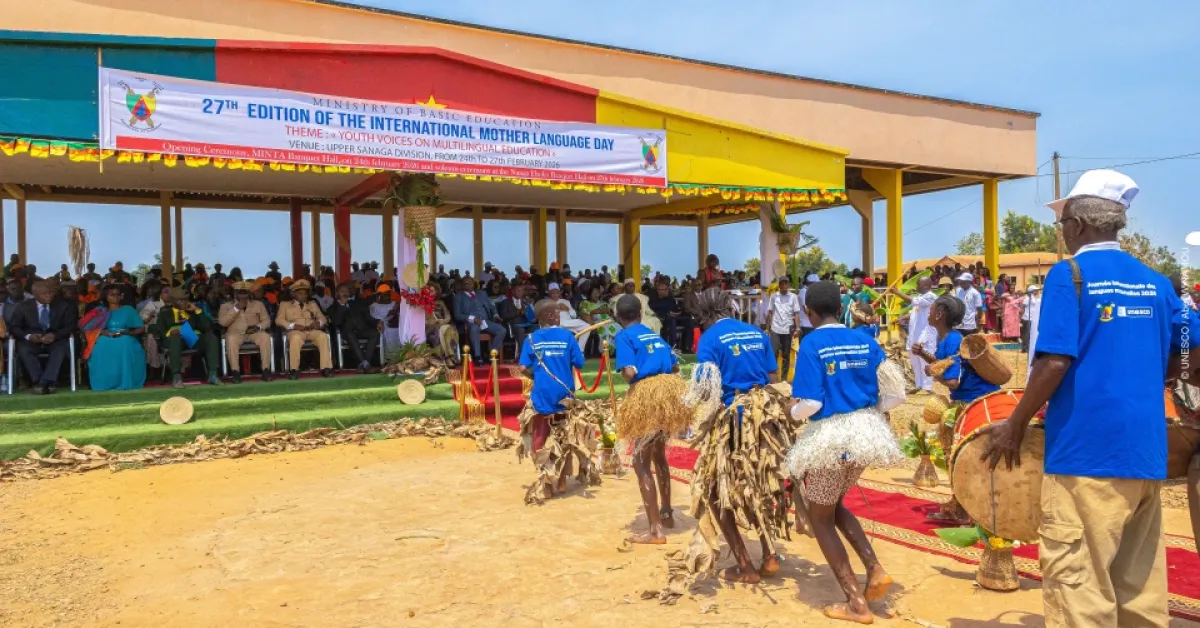
As part of the 27th edition of Mother Tongue Day, Cameroon joined forces with UNESCO to champion multilingual education and linguistic diversity. The week-long campaign, culminating in a closing ceremony on February 27, 2026, in Nanga Eboko, highlighted the urgent need to preserve and promote indigenous languages while fostering inclusive learning environments.
The event, themed “Voices of Youth on Multilingual Education,” placed young learners at the forefront, underscoring their vital role in sustaining cultural heritage and enhancing educational outcomes through mother-tongue instruction. Youth-led performances and discussions showcased the vibrant linguistic tapestry of Cameroon’s regions, from the grasslands of the Northwest to the coastal areas of the South.
Government and UNESCO unite for inclusive education
The closing ceremony was presided over by Cameroon’s Minister of Basic Education, Professor Laurent Serge Etoundi Ngoa, alongside Mr. Hilaire Mputu, Director of UNESCO’s Regional Office for Central Africa. Together, they reaffirmed their commitment to integrating mother-tongue learning into early education, a strategy proven to boost literacy rates and academic success.
UNESCO’s global advocacy for multilingual education aligns with its broader mission to safeguard linguistic diversity as a cornerstone of sustainable development. The annual International Mother Language Day, observed every February 21, serves as a rallying point for nations to recognize the transformative power of indigenous languages in education, social cohesion, and cultural preservation.
Cultural performances spotlight Cameroon’s linguistic wealth
The event featured dynamic cultural showcases by primary school students, demonstrating the beauty of Cameroon’s languages—such as Yao, Duala, and Bamileke—through song, dance, and spoken word. These activities not only celebrated linguistic heritage but also empowered young Cameroonians to become ambassadors of their cultural identities in classrooms and beyond.
By aligning with UNESCO’s framework, Cameroon is taking bold steps to bridge educational gaps while nurturing a generation proud of their roots. The collaboration underscores the critical link between language, identity, and equitable learning—a vision set to reshape the future of education in Africa.