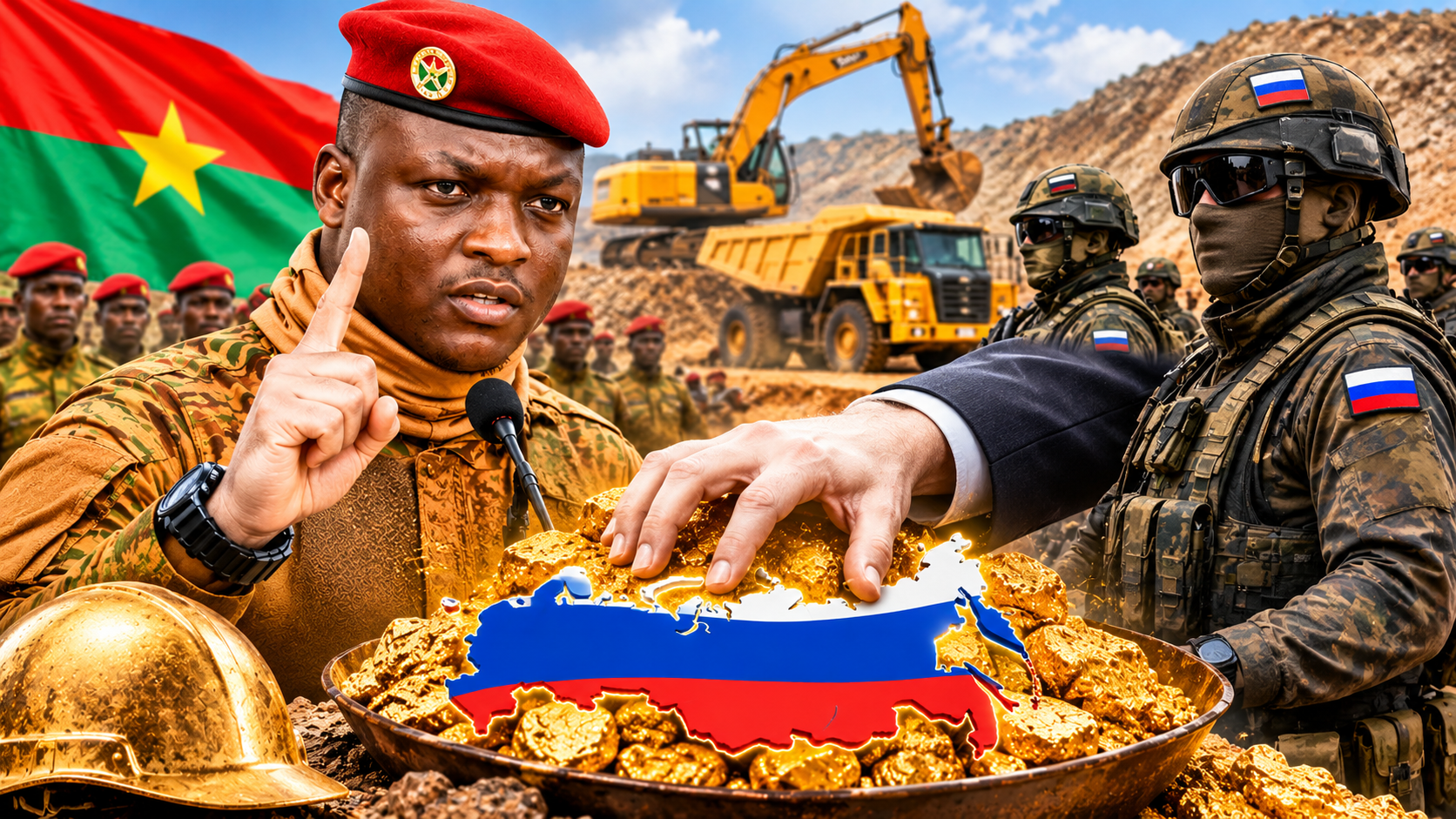
Since seizing power, Burkina Faso’s military leader Ibrahim Traoré has positioned himself as a champion of economic sovereignty, particularly when it comes to the nation’s gold reserves. His government has repeatedly emphasized that Burkinabè resources must be fully controlled by and for Burkinabè citizens. Yet, as Russian security firms increasingly secure gold mining sites across the country, serious questions emerge about the true extent of Ouagadougou’s control over its most valuable natural asset.
The promise of ‘100% Burkinabè gold’ resonates deeply in a nation grappling with post-colonial economic dependencies. But rhetoric alone cannot shield a country from the geopolitical forces reshaping its extractive industries. When foreign security contractors begin to vie for influence over strategic mining infrastructure, sovereignty is no longer a matter of declaration it becomes a question of operational reality.
The strategic dilemma at the heart of Burkina Faso’s gold sovereignty
The rise of Russian security companies in Burkina Faso’s mining sector is not merely a commercial trend; it is a geopolitical shift with profound implications. These firms operate in spaces where economic, logistical, and strategic interests converge securing extraction sites, managing mineral transport, and protecting financial flows. At issue is whether such roles can coexist with the junta’s stated ambition of full national control over gold resources.
A mine is more than a pit in the ground. It is a node of national wealth, governed by contracts, security protocols, and regulatory oversight. When foreign entities assume pivotal roles in these domains, the state’s ability to assert independent decision-making is inevitably tested. Who sets security protocols? Who profits from the contracts? Who monitors compliance with Burkinabè law?
Why the presence of russian security firms raises concerns
The involvement of Russian security contractors introduces multiple layers of complexity. First, these companies operate under opaque corporate structures, often linked to state interests in Moscow. Second, their presence in Burkina Faso’s mining belt follows a broader pattern of engagement across West Africa, where they are reportedly involved in both security provision and resource protection. Third, their compensation models and contractual terms are rarely disclosed, leaving citizens unaware of how much is being paid for their services and to whom.
Such opacity is incompatible with the transparency required to justify claims of full sovereign control. A nation asserting ownership of its gold cannot simultaneously cede operational security to external actors without sacrificing part of its autonomy.
From political rhetoric to economic reality: can Burkina Faso deliver?
The junta’s narrative of self-reliance paints a compelling picture: a future where Burkina Faso no longer relies on former colonial powers, but instead turns to new partners like Russia to reclaim its destiny. Yet sovereignty demands more than a change of allies. It requires unbroken chains of accountability from the mine gate to the national treasury.
Consider the life cycle of a gold mine: extraction, processing, transport, export, and revenue distribution. At each stage, control must remain with Burkinabè institutions mining regulators, customs authorities, financial institutions, and ultimately, the population. But when foreign security firms are entrusted with safeguarding these processes, the line between partnership and dependency begins to blur.
This is not an argument against collaboration with foreign actors. Rather, it is a demand for clarity: what exactly are these firms authorized to do? Are they merely providing perimeter defense, or are they also involved in internal logistics, personnel oversight, or even information control? Without clear boundaries, the risk is not just financial leakage it is the erosion of national agency.
Who really benefits from Burkina Faso’s gold?
The central question remains: who ultimately enjoys the fruits of Burkina Faso’s gold wealth? Is it the Burkinabè people, as the junta claims? Is it the shareholders of Russian security firms? Or is it a narrow elite that negotiates contracts behind closed doors?
To answer this, three conditions must be met:
Transparent contracting: All agreements involving security and mining operations must be publicly accessible, with terms negotiated by Burkinabè officials without foreign interference.
National oversight: Burkina Faso must retain full authority over security protocols, personnel vetting, and operational decisions related to its mines.
Equitable revenue use: Proceeds from gold sales must be reinvested in public infrastructure, education, and health proof that sovereignty yields tangible benefits.
A sovereignty that must be proven, not proclaimed
The narrative of ‘100% Burkinabè gold’ has been a powerful tool for rallying domestic support. But words alone cannot secure a nation’s future. True sovereignty is measured in deeds: in the ability to set prices, enforce customs, audit expenses, and redistribute wealth. It is seen in the independence of judges reviewing mining contracts and in the transparency of bank accounts receiving royalty payments.
The presence of Russian security firms in Burkina Faso’s goldfields is not inherently illegitimate. What is illegitimate is the lack of accountability that surrounds their deployment. Without public scrutiny, without parliamentary oversight, without clear limits on their mandate, their involvement risks transforming Burkina Faso’s gold from a symbol of national pride into yet another lever of external influence.
Ibrahim Traoré may stand before the nation and declare that Burkina Faso’s gold belongs entirely to its people. But sovereignty is not declared it is earned. And on the banks of the Komoe River, in the shadows of the Essakane mine, and along every smuggling route to Togo and Ghana, Burkina Faso’s leaders are being tested. Not by words, but by their readiness to prove that no foreign actor however powerful can claim a stake in what is rightfully Burkinabè.
By AMINA SALEY — Journalist